

Key Takeaways
Why Roundabouts Still Catch Drivers Off Guard
Roundabouts are demonstrably safer than traditional signal-controlled intersections - lower speeds, fewer severe collision angles, and no risk of running a red light. Yet they remain one of the junctions where driver error is most common, particularly in areas where their use is still relatively new. The confusion rarely comes from complexity; it comes from drivers applying the wrong mental model to a familiar-looking situation.
Part of the challenge is that roundabouts vary. A small single-lane residential roundabout and a large multi-lane interchange require meaningfully different decisions, yet drivers often use the same rough-and-ready approach for both. Understanding the core rules - and the specific points where those rules get misapplied - is the first step to navigating any roundabout with confidence.
For a broader look at building safe driving habits across all road types, see the complete foundation for safe driving resource.
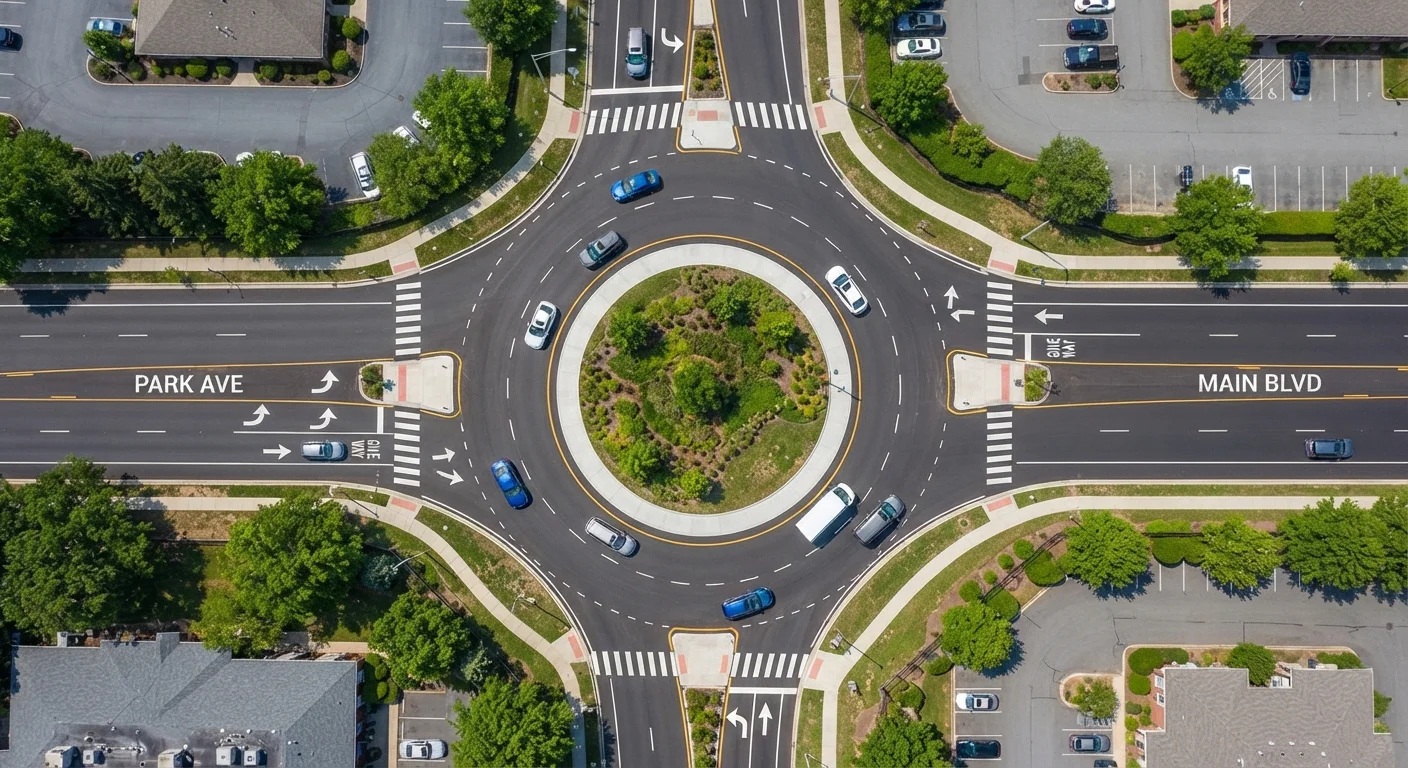
Failing to yield to traffic already in the roundabout before entering.
Why it happens: Drivers accustomed to traditional intersections instinctively look for a stop sign or traffic light and may not process the give-way line as a mandatory stop. The open appearance of the entry can create a false sense that the path is clear.
Choosing the wrong lane before entering a multi-lane roundabout.
Why it happens: Drivers often delay their lane decision, hoping to see exit signs from closer range. Signage at complex roundabouts can be dense, and without pre-planning, a driver may drift into whichever lane feels natural in the moment.
Signalling incorrectly - or not at all - when entering and exiting.
Why it happens: Many drivers are unsure whether to signal on entry, or they forget to cancel a signal once inside. Some simply don't signal at all, treating the roundabout as a brief, informal manoeuvre.
Stopping unnecessarily inside the roundabout when the path ahead is clear.
Why it happens: Anxiety about the unfamiliar geometry - and concern about cutting across lanes - causes some drivers to brake mid-circle. This is often compounded by passengers giving conflicting verbal directions.
Failing to give way to cyclists and pedestrians at designated crossing points.
Why it happens: Drivers focused on vehicle traffic often scan only for cars and overlook pedestrian crossings located on the approach and exit arms of the roundabout. These crossings exist outside the circulatory carriageway but are still part of the roundabout system.
Getting Lane Choice and Signalling Right
At multi-lane roundabouts, the two most consequential decisions happen before you reach the give-way line: which lane to use and how to signal your intentions. Get either wrong and you risk a collision or, at minimum, disrupting flow for every driver behind you.
Give Way to Circulating Traffic
The single most critical rule at any roundabout is this: vehicles already travelling inside the roundabout have priority. You must give way at the give-way line before entering, regardless of how clear the road looks ahead. Failing to yield is one of the most frequent causes of roundabout collisions, and it is a traffic violation in every U.S. state that operates standard modern roundabouts.
Lane discipline inside the roundabout matters just as much as entry. Stay in your chosen lane throughout; do not drift toward the exit until you are ready to leave. If you're in the outer (right) lane, be alert to vehicles in the inner (left) lane that may be exiting at the same point - this is a common conflict zone.
Signalling isn't merely courteous; in many states it is legally required as part of turning or changing direction. Consistent, predictable signals let pedestrians, cyclists, and other motorists plan around you. Unpredictable behaviour - including no signal at all - is a leading cause of hesitation and near-misses at busy roundabouts.
Don't Cut Across Lanes Mid-Roundabout
Changing lanes inside a roundabout without checking mirrors and blind spots is particularly hazardous because other vehicles are also curving through the space simultaneously. If you realize you're in the wrong lane once inside, complete the roundabout, exit safely, and re-approach. Never cut across lane markings mid-circle to correct a missed exit.
Unfamiliar road layouts in new areas amplify all of these risks. If you're driving in a city you don't know well, the strategies for navigating unfamiliar cities can help you stay oriented before you reach complex junctions.
~40%
Reduction in fatal crashes vs. stop-controlled intersections
The Federal Highway Administration reports that converting conventional intersections to roundabouts typically reduces fatal and injury crashes substantially, largely because collision speeds and angles are lower.
75%
Decrease in injury crashes at converted intersections
Studies cited by the Insurance Institute for Highway Safety found roundabouts reduced injury crashes by around 75% compared with stop signs or traffic signals at the same sites.