

Key Takeaways
Why Frameworks Matter More Than Rules
Nutrition advice often feels like a moving target - one week fat is the enemy, the next it's sugar. That confusion largely stems from a mismatch between how nutrition science works (slow, population-level, probabilistic) and how it gets communicated (as simple rules). Dietary frameworks exist to bridge that gap. Rather than prescribing exact amounts of individual nutrients, they organize foods into meaningful patterns that public health research consistently links to better long-term health outcomes.
Frameworks are also inherently general - they describe what tends to work across large, diverse populations, not what any individual specifically needs. That distinction matters. As you explore these models, it helps to understand what each one is designed to do, who developed it, and where its limitations lie. If you've encountered persistent misconceptions along the way, our guide to nutrition myths provides science-backed context for some of the most stubborn ones.
The Major Plate Models Explained
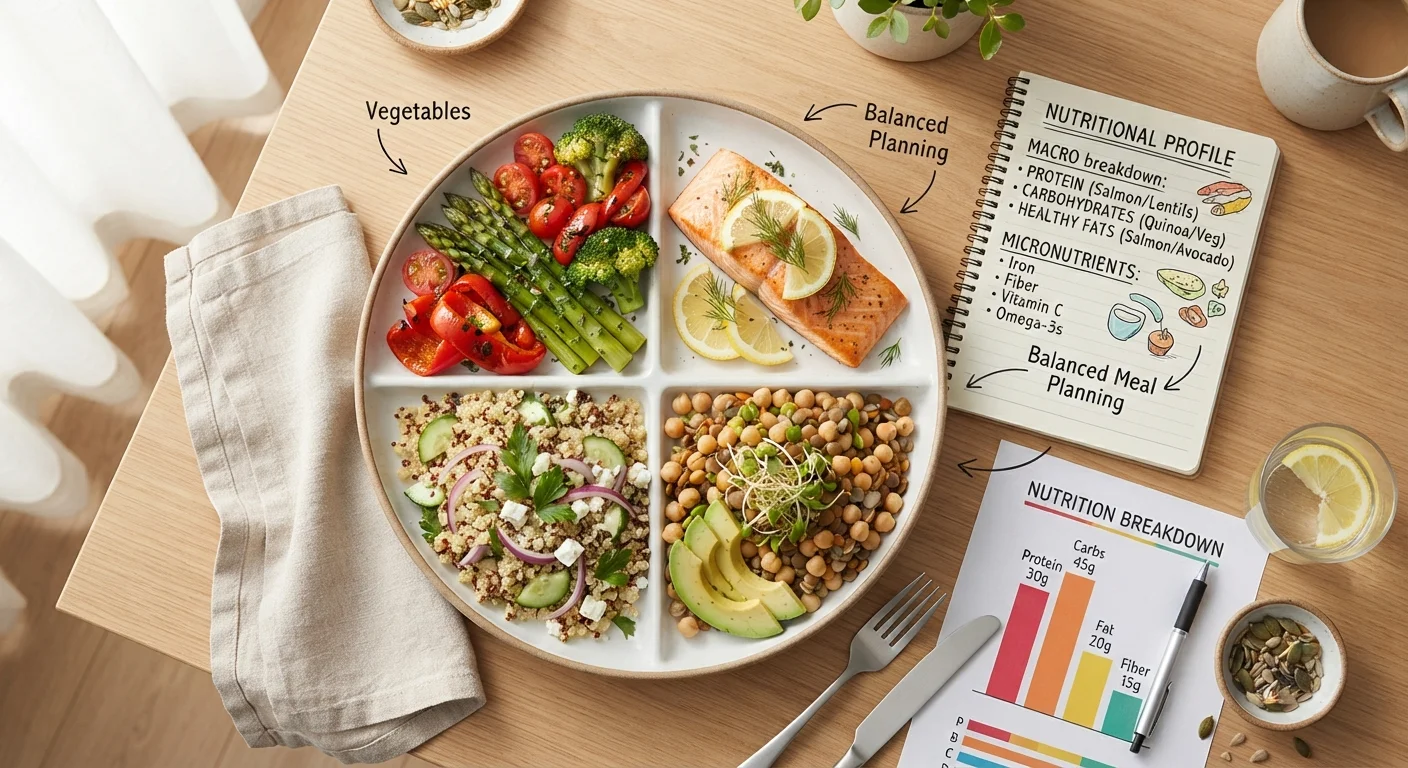
Two frameworks dominate public nutrition education in the United States, and they share a common visual metaphor - the dinner plate - but differ in important ways.
USDA MyPlate
Introduced in 2011, MyPlate replaced the long-running food pyramid. It divides a plate into four sections - fruits, vegetables, grains, and protein - with a small dairy circle alongside. Its primary strength is simplicity: it's immediately intuitive for a wide audience. Critics, including nutrition researchers at Harvard, note that it doesn't distinguish between food quality within categories - refined grains and whole grains both appear under "grains," for example - and that it lacks guidance on healthy fats.
Harvard's Healthy Eating Plate
Developed by faculty at the Harvard T.H. Chan School of Public Health, this model incorporates more nuance. Vegetables and fruits fill half the plate; whole grains (specifically, not refined) fill a quarter; and healthy protein sources fill the remaining quarter. It also includes an explicit recommendation for healthy plant-based oils and water as the primary beverage. The Harvard model more directly reflects the research literature on food quality rather than food category alone.
50%
Plate proportion for vegetables and fruit
Both the USDA MyPlate and Harvard Healthy Eating Plate recommend fruits and vegetables occupy half the plate, a threshold echoed by public health guidelines internationally.
~90%
Americans not meeting vegetable intake recommendations
According to CDC dietary surveillance data, fewer than 1 in 10 American adults meets recommended daily vegetable intake, illustrating the gap between framework guidance and actual behavior.
Neither model is a prescription - they're educational starting points. For a closer look at how nutrient needs shift across different life stages, see our article on how nutritional needs change over time.
Core Principles Shared Across Evidence-Based Models
Despite their differences, well-regarded dietary frameworks tend to converge on several principles supported by decades of epidemiological and clinical research.
Prioritize vegetables and fill at least half your plate with them at most meals.
Vegetables provide fiber, vitamins, minerals, and phytonutrients while being relatively low in calories. Consistent vegetable intake is associated in large prospective studies with reduced risk of cardiovascular disease and certain cancers.
Choose whole grains over refined grains whenever possible.
Whole grains retain the bran and germ, preserving fiber, B vitamins, and minerals that milling removes. Higher whole-grain intake is consistently linked to better blood glucose regulation and cardiovascular outcomes in long-term cohort studies.
Include a variety of protein sources, with an emphasis on plant-based options and lean animal proteins.
Protein diversity helps ensure a broader range of amino acids and micronutrients. Research suggests that replacing some red and processed meat with legumes, nuts, fish, or poultry is associated with improved long-term health markers.
Treat water as your default beverage and limit sugary drinks.
Liquid calories from sweetened beverages contribute to excess energy intake without providing satiety or meaningful nutrition. Multiple dietary frameworks and public health bodies identify sugary drinks as a significant modifiable risk factor.
Don't treat all fats as equivalent - include sources of unsaturated fats in your diet.
Decades of research distinguish between types of dietary fat. Unsaturated fats from sources like olive oil, avocado, nuts, and fatty fish are associated with favorable cardiovascular markers, while trans fats and excessive saturated fats have the opposite association.
One area where models diverge most noticeably is protein. Whether plant or animal sources are emphasized depends heavily on the population the framework was designed for and the environmental assumptions built into it. Our comparison of plant versus animal protein explores those differences in depth.
What These Frameworks Don't Cover - and How to Fill the Gap
Even the most carefully designed plate model is a simplification. Individual factors - genetics, gut microbiome composition, medication use, health status, cultural food traditions, and economic access - all influence how a given eating pattern affects a particular person. A framework cannot account for all of these variables.
Frameworks Are Population Tools, Not Personal Plans
Dietary guidelines and plate models are designed using data from large, diverse populations - they describe statistical patterns, not individual prescriptions. Factors like food allergies, cultural dietary practices, gastrointestinal conditions, and metabolic differences can all mean a general framework needs meaningful adaptation. Use these models as useful orientation, not rigid rules, and work with a healthcare professional for personalized guidance.
Frameworks also say little about micronutrients - the vitamins and minerals that don't define a meal's structure but are essential to nearly every biological process. Our micronutrient reference guide covers where those nutrients come from and why they matter alongside macronutrient balance.
If you're working within a budget, note that eating in alignment with these frameworks doesn't require premium or specialty foods - staples like legumes, canned vegetables, whole grains, and eggs are both affordable and nutritionally dense. Finally, certain populations - including people who are pregnant, managing chronic conditions, or in older adulthood - have specific needs that general frameworks don't fully address. A registered dietitian can help tailor broad principles to individual circumstances.
This article is for general informational and educational purposes only and does not constitute medical or dietary advice. Always consult a qualified healthcare professional or registered dietitian before making significant changes to your diet.