

Key Takeaways
Option A
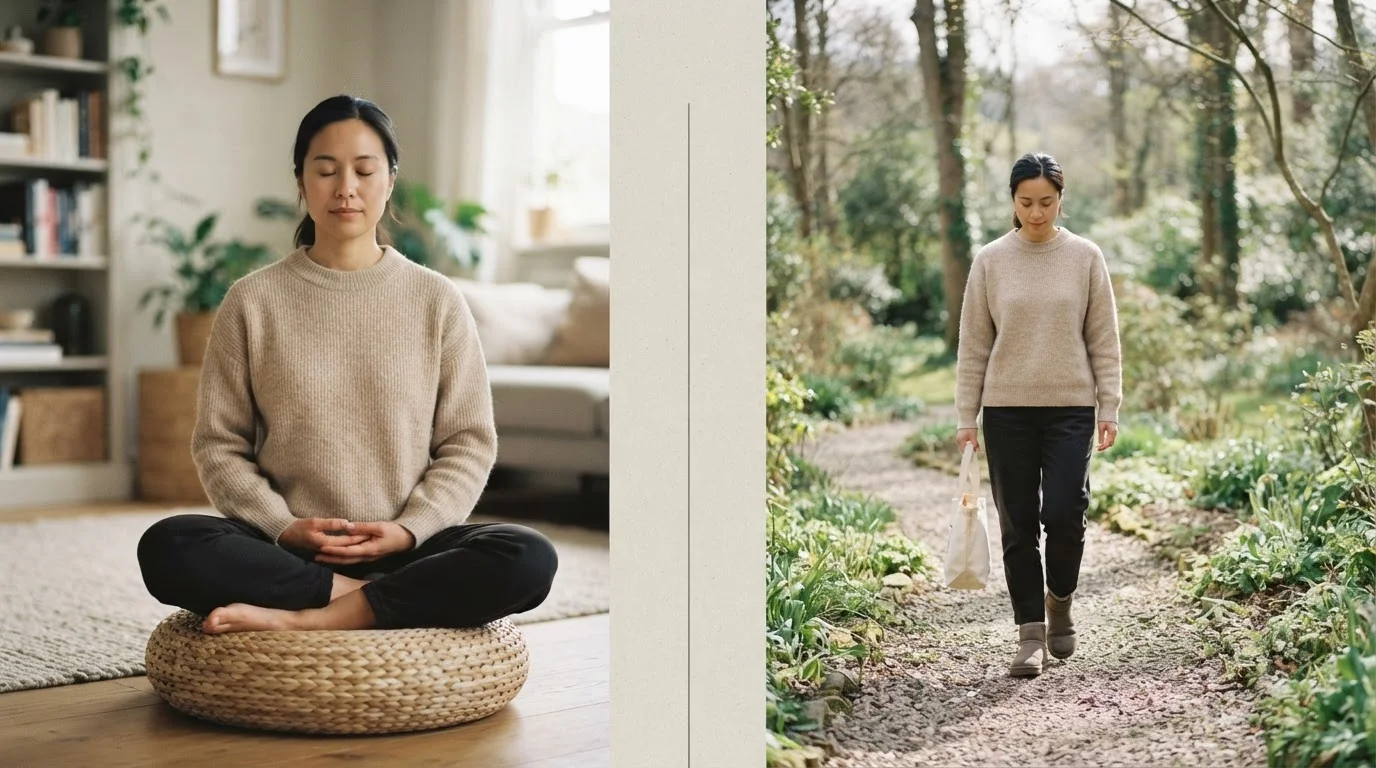
Mindfulness
The always-available awareness practice.
Best for: People who want to reduce stress and build mental clarity throughout the rhythms of everyday life.
Option B
Meditation
The structured, intentional mental training session.
Best for: People seeking a dedicated, repeatable practice to deepen focus, emotional regulation, or self-awareness over time.
If you want a low-barrier entry point that fits into a busy schedule
Mindfulness
Mindfulness can be practiced during routine activities - eating, walking, even commuting - requiring no dedicated time block or quiet space.
If you want a structured, progressive practice with measurable depth
Meditation
Scheduled meditation sessions build a consistent mental training habit, making it easier to track progress and explore specific techniques like breathwork or body scanning.
If you're exploring tools to support ongoing stress management
Both
Using mindfulness throughout the day alongside a regular meditation practice creates a complementary approach that addresses both acute moments of stress and long-term mental resilience.
What Each Practice Actually Means
The terms mindfulness and meditation often appear side by side - in wellness apps, clinical research, and everyday conversation - as if they describe the same thing. They don't. Understanding the distinction helps you choose, or combine, them with more intention.
Mindfulness is a state of awareness. It refers to the quality of paying deliberate, non-judgmental attention to the present moment - your thoughts, sensations, emotions, and environment, as they are right now. You can be mindful while eating, working, or having a conversation. No special setting required.
Meditation, by contrast, is a practice - a deliberate activity you engage in for a defined period. It involves intentionally directing your attention using a specific technique: focusing on the breath, repeating a phrase (mantra), scanning the body, or visualizing a scene. Many forms of meditation are explicitly designed to cultivate mindfulness, which is where the confusion often begins.
A useful framing: mindfulness is the destination; meditation is one well-traveled road to get there.
| Criterion | Mindfulness | Meditation |
|---|---|---|
| What it is | A state or quality of awareness | A structured mental practice |
| When it happens | Anytime, during daily activities | During a dedicated session |
| Time required | No extra time needed | Typically 5-30 minutes per session |
| Learning curve | Accessible immediately | Techniques vary; takes practice |
| Common techniques | Mindful eating, walking, breathing | Breathwork, body scan, mantra |
| Research base | Studied in daily-life contexts | Extensively studied in clinical trials |
| Goal | Present-moment awareness | Deepened focus and self-awareness |
How the Research Frames Their Benefits
Both practices have attracted significant scientific interest. Research published across institutions including Harvard Medical School and the National Institutes of Health has associated mindfulness-based practices with reductions in perceived stress, improvements in attention, and modest benefits for anxiety and depression symptoms. It's important to note that findings vary by study design, population, and duration - and general information here is not a substitute for clinical guidance.
8 weeks
Duration of the foundational MBSR program
Mindfulness-Based Stress Reduction, developed in 1979, remains one of the most rigorously studied mindfulness interventions in clinical settings.
~14%
US adults who reported meditating in the past 12 months
According to a 2022 National Health Interview Survey report from the CDC's National Center for Health Statistics, meditation use among US adults has grown notably over the past decade.
200+
Randomized controlled trials on mindfulness interventions
A review published in JAMA Internal Medicine found evidence supporting mindfulness meditation programs for improving anxiety, depression, and pain outcomes.
Mindfulness-Based Stress Reduction (MBSR), an eight-week structured program developed by Dr. Jon Kabat-Zinn in the late 1970s, is one of the most studied applications. It blends meditation techniques with the broader cultivation of mindful awareness throughout daily life - a useful illustration of how the two practices work together rather than in opposition.
If you're also drawn to reflective practices that don't require stillness, journalling for mental clarity is worth exploring as a complementary approach to self-awareness.
This article is for general informational purposes only and does not constitute medical or mental health advice. If you are experiencing symptoms of anxiety, depression, or another mental health condition, please consult a qualified healthcare professional.
Practical Differences: How Each Fits Into Real Life
One of the clearest practical distinctions is scheduling. Meditation asks you to carve out time - even five or ten minutes - and show up consistently. Mindfulness, once practiced, can be woven into existing activities without adding anything to your calendar.
This makes mindfulness particularly accessible for people who feel they don't have time to meditate. Paying close attention to the taste and texture of your food, noticing the sensation of your feet on the floor, or taking three deliberate breaths before answering an email are all expressions of mindful awareness.
Meditation, on the other hand, offers depth that informal mindfulness moments may not. Regular, seated meditation practice allows you to explore sustained attention, work through mental distractions systematically, and build familiarity with your own thought patterns over weeks and months.
The choice between them - or the decision to combine them - ultimately depends on your temperament, schedule, and goals. Just as mentorship and coaching serve different but complementary career needs, mindfulness and meditation serve overlapping but distinct roles in mental wellbeing.