

Key Takeaways
Why the Nutrition Facts Label Exists
The Nutrition Facts label is a federally mandated feature on most packaged foods sold in the United States, regulated by the Food and Drug Administration (FDA). Its current format - updated in 2020 - was redesigned to reflect evolving nutrition science and to make key figures more prominent. If you're new to thinking about food composition, our starting point guide to nutrition covers the underlying concepts before you begin decoding labels.
The label's purpose is standardization: it gives every consumer a consistent basis for comparing foods across brands, categories, and portion sizes. It is not a scorecard. A food isn't automatically "good" because it scores well on a single nutrient, nor is it harmful because one figure looks high. Labels are tools for context, not judgment.
Labels Are a Guide, Not a Diagnosis
Nutrition labels are general educational tools based on population-level reference values. They cannot account for your individual health conditions, medications, or dietary needs. If you have a specific medical condition or are managing a diet under clinical guidance, consult a registered dietitian or your healthcare provider before making significant changes based on label reading.
What you will need
Step-by-Step: Reading the Label
Work through the label from top to bottom - the structure is intentional. Each section builds on the one above it.
Find the serving size and servings per container
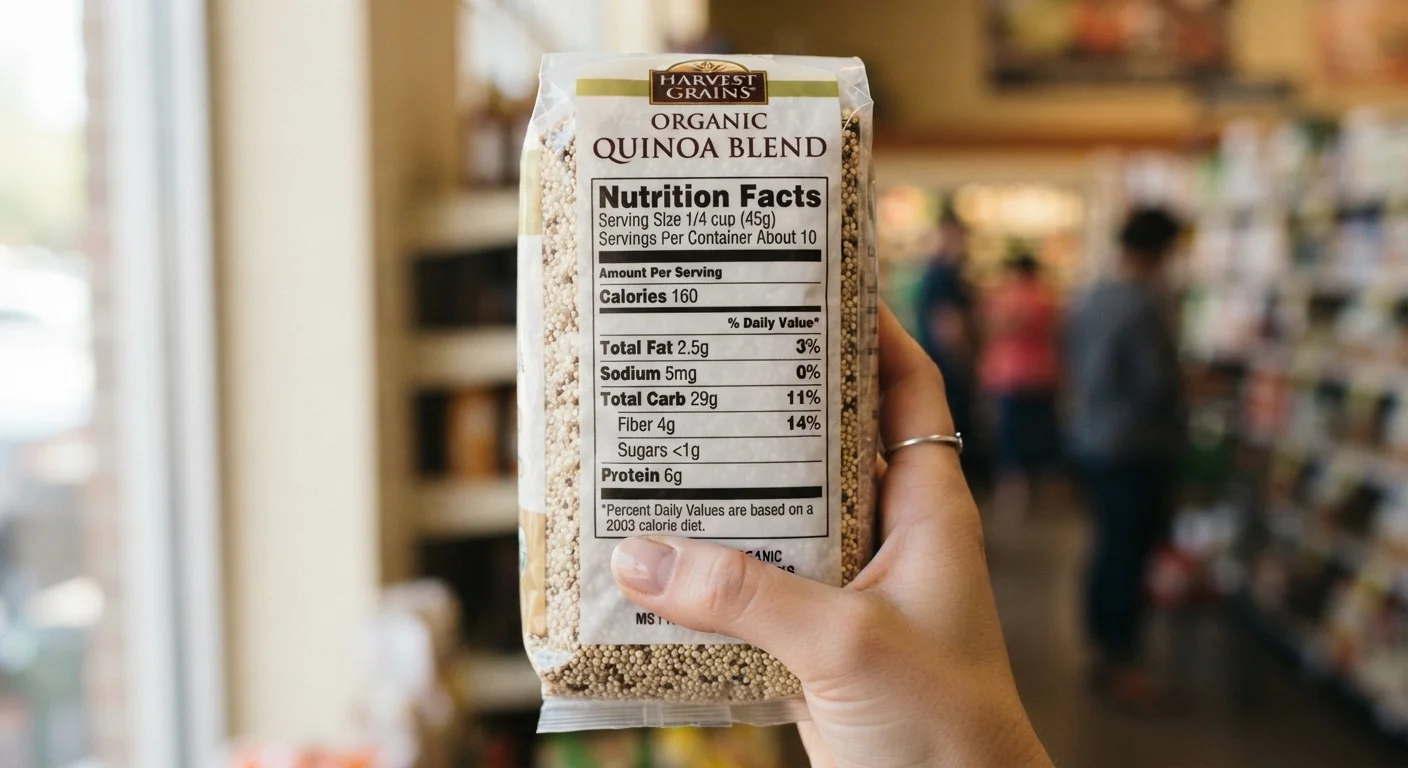
Every figure on the Nutrition Facts label - calories, fat, sodium, everything - refers to one serving, not the whole package. Serving sizes are standardized by the FDA based on amounts people typically consume, expressed in familiar units (e.g., "1 cup" or "about 28g"). Before reading any other number, establish how many servings the container holds and how that compares to what you plan to eat.
Note the calorie count per serving
Calories measure the energy a food provides. The calorie figure appears prominently near the top of the label, directly beneath the serving size. This number reflects total energy from all three macronutrients - fat, carbohydrate, and protein. Calories are not inherently negative; they are simply the energy unit used to compare foods. Context matters: a 200-calorie food that is dense in fiber and protein behaves very differently in the body than a 200-calorie food composed almost entirely of added sugar.
Review the macronutrient breakdown
Below calories, the label lists the three macronutrients - fat, carbohydrate, and protein - along with their subcategories:
- Total Fat is broken into saturated fat and trans fat. Saturated fat is listed separately because current dietary guidelines suggest being mindful of intake; artificial trans fats have been largely removed from the US food supply but may still appear in trace amounts. For a deeper look at fat types, see our plain-language fat comparison.
- Total Carbohydrate is subdivided into dietary fiber and total sugars, with added sugars listed separately since 2020. Added sugars are those incorporated during processing, as distinct from sugars naturally present in the food.
- Protein appears as a single figure. Labels are not currently required to show a % Daily Value for protein for most foods.
Interpret the % Daily Value column
The right-hand column displays each nutrient's contribution as a percentage of its Daily Value (DV) - a reference amount set by the FDA for a 2,000-calorie daily diet. This column is one of the label's most useful tools because it lets you compare products quickly without doing arithmetic. Nutrients to consider getting more of include dietary fiber, vitamin D, calcium, iron, and potassium. Nutrients the FDA highlights for potential over-consumption include sodium, saturated fat, and added sugars.
[tip_callout]Check the micronutrient section
Near the bottom of the label, four micronutrients are required to be listed: vitamin D, calcium, iron, and potassium. These were chosen because surveys suggest Americans commonly under-consume them. Other vitamins and minerals may appear voluntarily. For a broader reference on what these nutrients do and where they come from, see our micronutrients overview.
Read the ingredient list
The ingredient list sits below or beside the Nutrition Facts panel and is governed by a simple rule: ingredients are listed in descending order by weight. The first ingredient is the most plentiful by weight in the product. This means a product whose first three ingredients are sugar, corn syrup, and palm oil is compositionally very different from one whose first ingredient is whole oats - even if their calorie counts are similar. Ingredient lists also reveal things the panel cannot, such as the presence of specific allergens, additives, and preservatives.
Putting It All Together in Practice
Reading one label in isolation is useful; comparing two or three products side by side is where label literacy becomes genuinely powerful. Because serving sizes within a food category are standardized (e.g., all cereals use the same reference amount), the % Daily Value column allows direct comparisons between competing products without any extra calculation.
Keep in mind that your individual nutrient needs may differ from the 2,000-calorie reference diet used on labels. Age, activity level, health status, and life stage all affect requirements - for an overview of how those needs shift over time, see our article on nutrition across life stages. Labels are an input into a broader pattern of eating, and frameworks for building a balanced plate can help you put individual food choices into a wider dietary context.
This article is for general informational and educational purposes only and does not constitute medical or dietary advice. Consult a qualified healthcare professional or registered dietitian for guidance specific to your health situation.