

Key Takeaways
Why Ladder Falls Happen - and How to Stop Them
Ladder-related injuries send hundreds of thousands of Americans to emergency rooms each year, and the majority of those incidents trace back to a small set of preventable mistakes: incorrect placement, overreaching, using a damaged ladder, or underestimating the task. Understanding why ladders fail is the first step toward making sure yours doesn't.
Most falls occur not because the ladder itself breaks, but because the base slides out, the top shifts laterally, or the user leans too far to one side to avoid climbing down and repositioning. These are behavioral and setup errors - which means they're entirely within your control. For a broader orientation to safe DIY work, see our First-Time Homeowner's Introduction to DIY Home Improvement.
500,000+
Ladder injuries treated annually in the U.S.
The American Academy of Orthopaedic Surgeons reports that ladder falls are among the leading causes of traumatic injury in home settings.
~97%
Of ladder accidents attributed to unsafe behavior
The Consumer Product Safety Commission has consistently found that the vast majority of ladder incidents result from improper use rather than equipment failure.
Choosing and Inspecting the Right Ladder
Ladders are classified by duty rating, which specifies the maximum load the ladder is designed to support - including your body weight, clothing, tools, and any materials you're carrying. Type III household ladders support up to 200 lbs; Type II supports up to 225 lbs; Type I supports up to 250 lbs; and heavy-duty Type IA and IAA models go higher. Select the rating that comfortably covers your real working load, not just your body weight alone.
Before every use, visually inspect the entire ladder. Look for:
- Bent, cracked, or missing rungs or steps
- Damaged or loose spreader braces (on stepladders)
- Worn or missing non-slip feet
- Corrosion on metal ladders or splits in fiberglass rails
- Any labels that are unreadable (these carry critical load and angle information)
A ladder that fails inspection should be tagged out of service and not used until repaired or replaced. Never attempt to repair a structurally compromised ladder with tape or makeshift fixes.
Store Ladders to Preserve Their Integrity
Storing a ladder flat on the ground or leaning unsupported can cause warping, especially in aluminum models. Hang ladders horizontally on wall-mounted brackets in a dry, sheltered space - a garage or shed works well. Avoid storing ladders where they can be exposed to prolonged UV light, which degrades fiberglass over time.
Positioning: The Principles That Prevent Slips
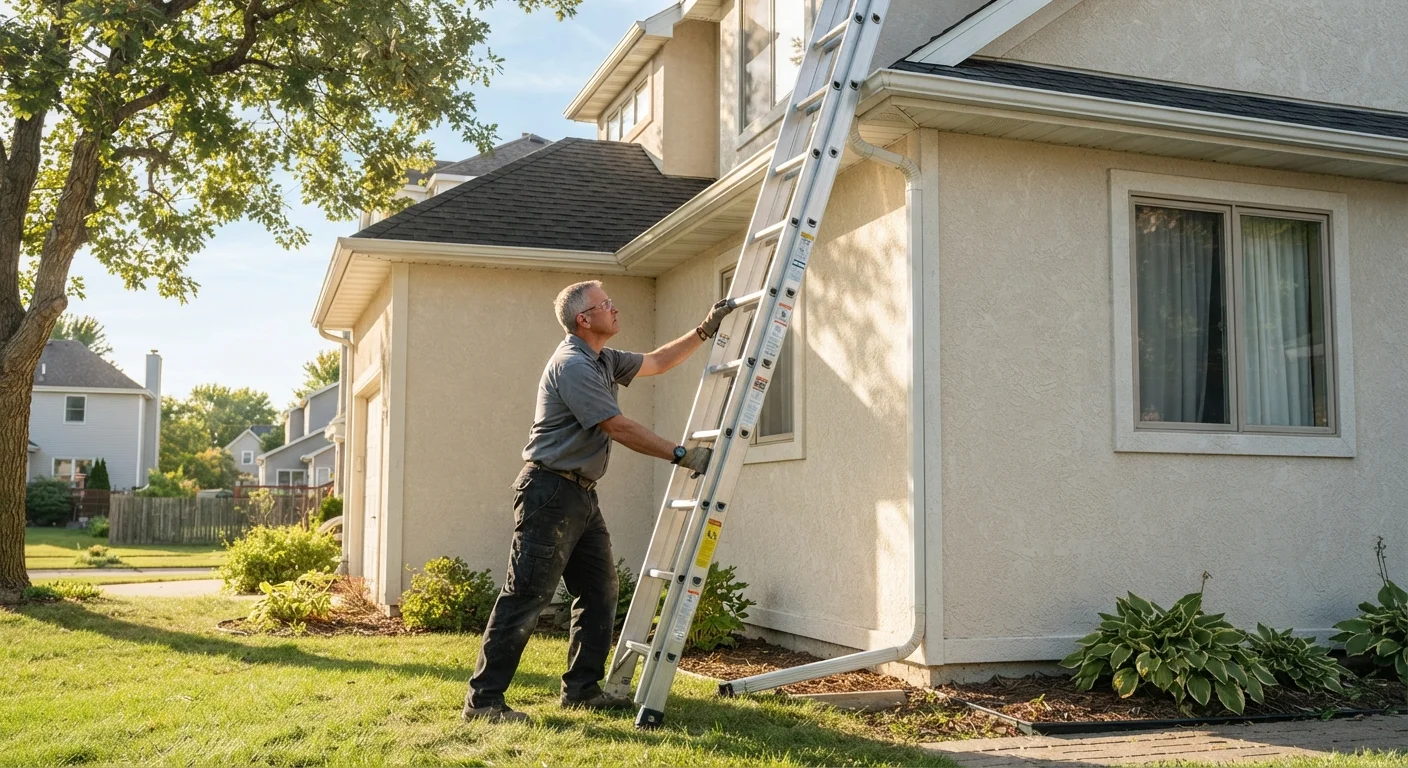
For extension ladders, the foundational rule is the 4-to-1 angle: the base should be placed one foot away from the wall for every four feet of working height. At this angle, the ladder resists both sliding outward at the base and tipping forward at the top. A simple check - stand at the base with your toes touching the feet of the ladder and extend your arms forward; your palms should comfortably reach the rung at shoulder height.
The top of an extension ladder should extend at least three feet above any roofline, platform, or edge you're stepping onto. This gives you a secure handhold as you transition on and off. The feet must rest on firm, level ground. On soft soil, use a mud plate or wide board under the feet. On hard floors indoors, make sure the non-slip pads are intact.
For stepladders, always fully open and lock the spreader braces before climbing. Never use a stepladder in its folded position leaned against a wall - it's designed only for free-standing use. And critically: never stand on the top cap or the top two rungs of any stepladder.
Safe Climbing and Working Practices
Once the ladder is correctly positioned, how you use it matters just as much. Follow these core practices every time you climb:
Maintain three points of contact at all times while climbing or descending.
Three points of contact - two hands and one foot, or two feet and one hand - keep you anchored to the ladder if you slip or lose balance. Releasing all hand contact to carry something is one of the most common causes of falls.
Keep your hips between the side rails - never lean beyond them.
Overreaching shifts your center of gravity past the ladder's stable zone, dramatically increasing tip risk. Repositioning the ladder takes 60 seconds; recovering from a fall can take months.
Secure the ladder's top and base before climbing when working alone.
Without a second person to foot the ladder, the base can shift on smooth surfaces and the top can pivot laterally. Simple securing methods reduce this risk significantly.
Face the ladder when climbing - always ascend and descend while facing the rungs.
Turning your body sideways or backward reduces grip security and changes your center of gravity unpredictably. Most ladder labels explicitly instruct users to face the ladder at all times.
Never use a metal ladder near electrical sources.
Metal conducts electricity. Working near overhead power lines or energized panels with a metal ladder creates a potentially fatal shock hazard. Fiberglass ladders are the appropriate choice for any work near electrical sources.
If you find yourself regularly needing to work at heights above one story, or on roofs, near power lines, or on unstable terrain, strongly consider hiring a licensed contractor. These situations introduce compounding risks that go well beyond what household ladder safety principles can reliably address.
Quick Wins You Can Implement Before Your Next Project
You don't need to overhaul your entire approach at once. Start with these immediate actions before your next project that involves any elevated work:
For larger projects where elevated work is just one component, our Complete Guide to Home Renovation Planning can help you scope work and identify which tasks genuinely call for professional involvement.
This article provides general safety information for educational purposes only. Always consult product documentation, local safety codes, and a qualified professional for tasks involving significant heights, electrical hazards, or structural work.