
Certifications, Degrees, and Micro-Credentials: What Carries Weight in Today's Job Market

Key Takeaways
Our Verdict
No single credential type wins across every industry or role. Degrees provide broad institutional credibility and are still expected in many professions, while industry certifications demonstrate job-specific competency that employers can immediately apply. Micro-credentials fill targeted gaps quickly but carry the most weight when supported by a broader portfolio of experience or education. The right choice depends heavily on your field, career stage, and the specific employers you are targeting.
| Best for | Recommended |
|---|---|
| Those entering regulated or academic professions | Traditional Degree |
| Those in technical fields like IT, cybersecurity, or project management | Industry Certification |
| Those upskilling quickly or filling a specific skill gap | Micro-Credential |
| Those changing careers or building a non-traditional background | Combination Approach |
What Each Credential Type Actually Represents
Before comparing how these qualifications perform in hiring, it helps to understand what each one is designed to communicate.
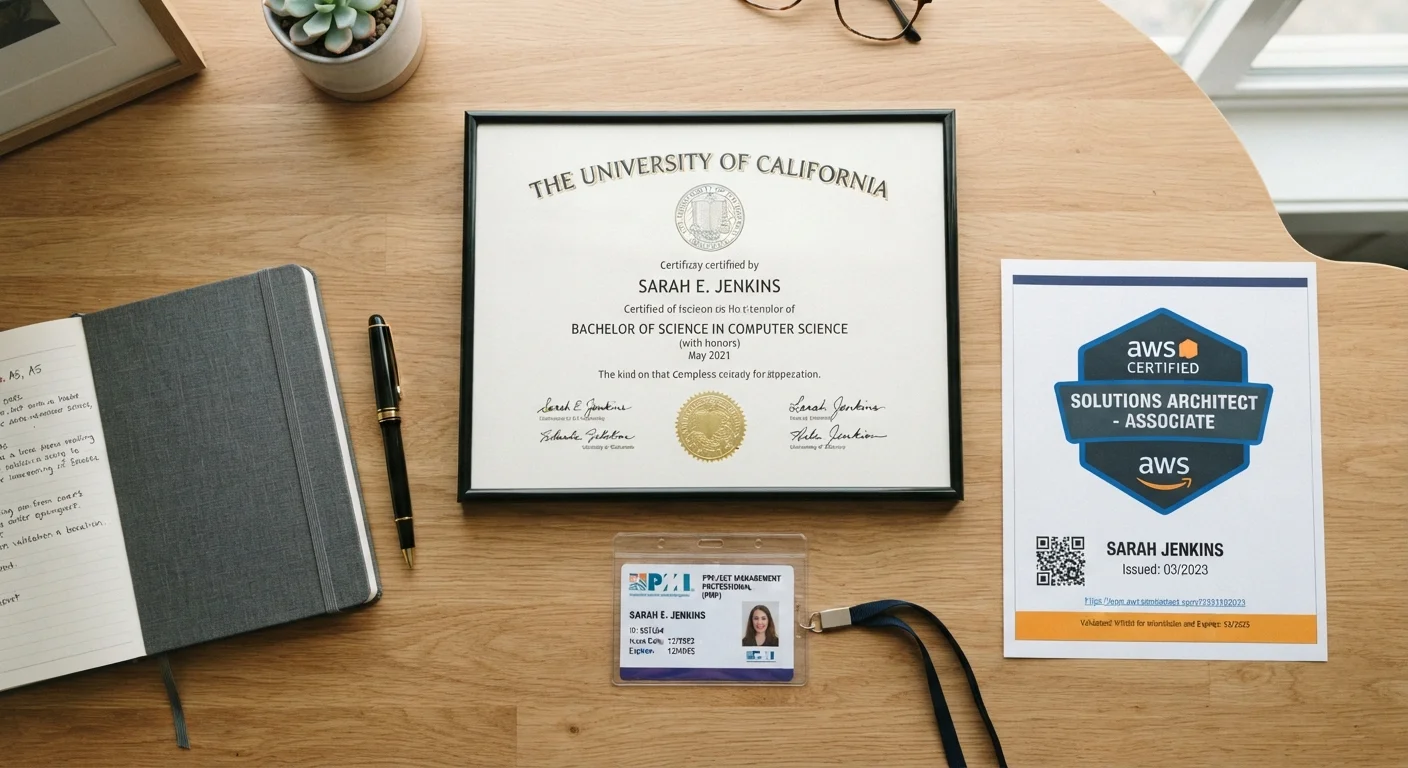
A traditional degree - associate, bachelor's, or graduate - signals that a learner completed a multi-year, broad-based program at an accredited institution. It demonstrates persistence, foundational knowledge across a discipline, and institutional vetting. For many employers and professions, it remains a baseline expectation.
An industry certification is awarded by a professional body, vendor, or standards organization after a candidate passes an exam or demonstrates a defined competency. Examples include credentials in IT infrastructure, project management, or financial analysis. These are usually domain-specific and updated periodically to reflect current practice. Unlike degrees, certifications often require renewal, which signals ongoing engagement with the field.
A micro-credential - sometimes called a digital badge, nanodegree, or certificate of completion - represents focused, short-form learning, typically in a single skill or concept. These can be earned in days or weeks through online platforms. Their value varies considerably depending on who issued them and whether the employer recognizes or cares about the issuing organization.
For a broader look at how these categories intersect in online learning, see The Online Learning Landscape.
How Employers Actually Read These Credentials
Employer perception varies dramatically by industry, role level, and hiring culture. A few patterns hold broadly:
- Regulated professions (law, medicine, licensed engineering, K-12 teaching) often require a specific degree by law or licensing rule. No certification or micro-credential substitutes here.
- Technical roles in IT, cybersecurity, and cloud infrastructure frequently value certifications from recognized bodies - sometimes explicitly over a general degree. Hiring managers in these fields can evaluate whether a specific credential maps to the job's actual requirements.
- Business, marketing, and operations roles show the most variation. Many employers still expect a bachelor's degree as a baseline, but supplementary certifications in data analytics, digital marketing, or supply chain management can differentiate candidates.
- Creative and portfolio-based fields often weigh demonstrated work over credentials entirely - though certifications can still reinforce a candidate's claimed skills.
Micro-credentials face the steepest skepticism in hiring. Research from organizations tracking workforce trends has consistently found that employers place more trust in credentials tied to recognized standards bodies or accredited institutions than in platform-issued completion certificates alone. That said, micro-credentials have gained traction when they are stackable - meaning they accumulate toward a recognized program - or when they are tied directly to a skill shortage the employer is trying to fill quickly.
| Traditional Degree | Industry Certification | Micro-Credential | |
|---|---|---|---|
| Time to earn | 2-6+ years | Weeks to months | Days to weeks |
| Cost range | High (thousands to tens of thousands) | Moderate (hundreds to low thousands) | Low to moderate (free to hundreds) |
| Employer recognition | Broadly recognized across sectors | Strong in relevant technical fields | Varies widely by issuer and role |
| Depth of knowledge signaled | Broad foundational depth | Specific, applied competency | Narrow skill focus |
| Renewal required | No | Often yes (every 2-3 years) | Rarely |
| Best career stage | Early career or career change | Mid-career or specialization | Any stage for gap-filling |
For guidance on how to present any of these credentials compellingly, see Making Your Online Qualification Legible to Employers.
The Role of Accreditation and Issuer Reputation
One factor that cuts across all credential types is the reputation of the awarding body. A certification from a well-established professional association carries more weight than one issued by an unknown provider. Similarly, a degree from an accredited institution is treated very differently from one issued by an unaccredited school.
Accreditation - a formal quality-review process conducted by recognized agencies - matters most for degrees, but the principle applies broadly. For certifications, look for credentials governed by recognized industry or standards bodies. For micro-credentials, consider whether the issuing platform or institution is one that employers in your target field would recognize.
Check Job Postings Before You Enroll
One of the most practical ways to evaluate any credential is to search active job postings in your target role and location. Note which credentials appear most frequently in the 'required' or 'preferred' sections. This real-world signal is often more reliable than general rankings or platform marketing. If a credential rarely appears in listings for your target jobs, that's worth factoring into your decision.
Before investing significant time or money in any credential, it's worth researching whether the employers you are targeting actually recognize it. Job postings in your field often list preferred or required credentials explicitly, which provides a reliable signal. You can also explore how accreditation works before enrolling in any program.
Building a Credential Strategy That Reflects Real Skills
The most effective approach for many learners is not choosing one credential type over another - it's understanding how they work together. A degree provides a foundation; a certification proves current, specific competency; a micro-credential can address a narrow gap quickly.
Credentials also work alongside - not instead of - transferable skills like communication, problem-solving, and adaptability. Strong workplace communication, for instance, is one of the most consistently cited qualities employers seek - and no credential alone demonstrates it. Credentials open the door; skills and experience determine what happens next.
When building your credential strategy, consider:
- What the job postings in your target field actually require or prefer - look at 10-20 listings and note patterns.
- Your timeline and budget - degrees take years and cost significantly more than most certifications or micro-credentials.
- Whether the credential requires renewal - ongoing certification can signal commitment to currency in fast-moving fields.
- How the credential fits your current portfolio - a micro-credential means more when it complements existing experience than when it stands alone.
This article provides general educational information about credential types and employer perceptions. It is not professional career counseling or financial advice. Individual outcomes vary based on field, geography, employer, and many other factors. Consider speaking with a career advisor or workforce development professional for guidance tailored to your specific situation.