

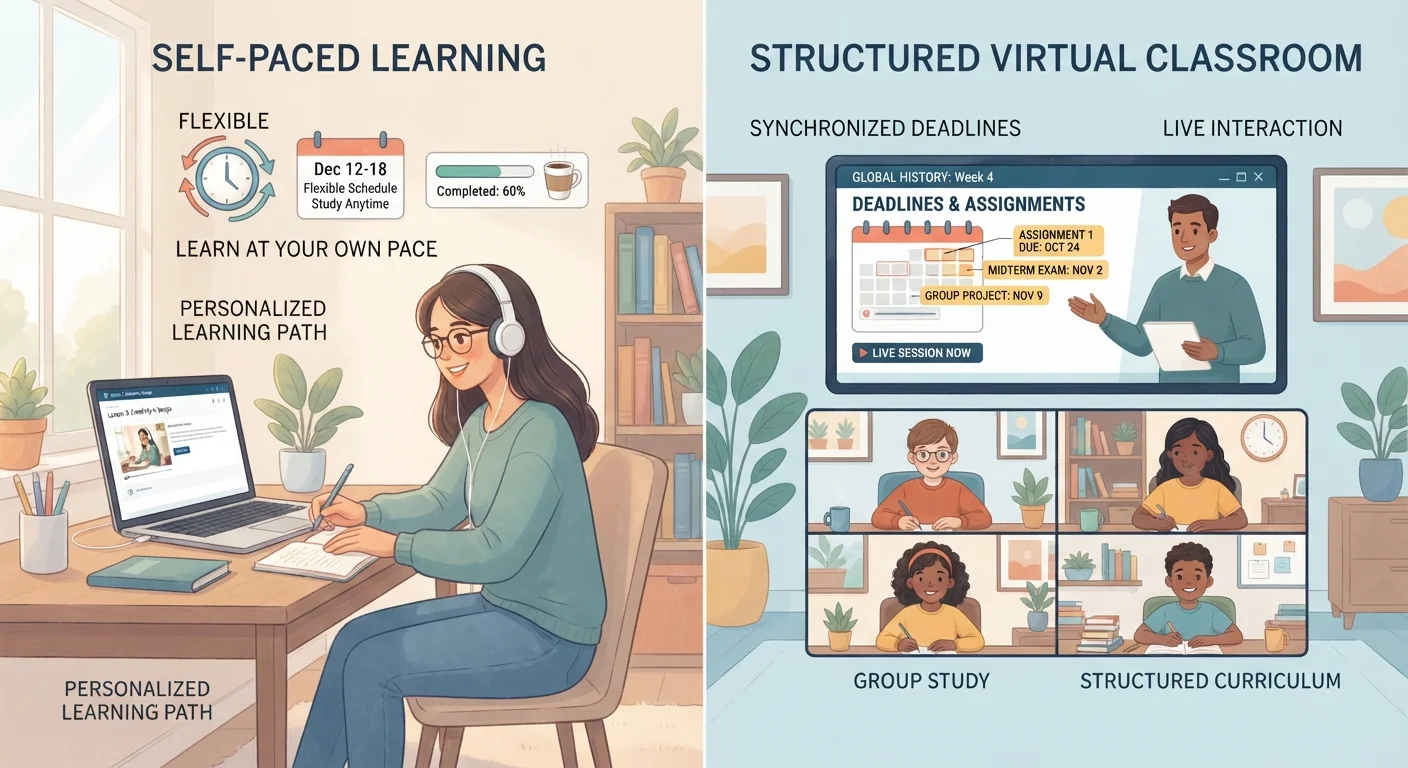
Key Takeaways
Option A
Self-Paced Online Courses
The flexible, learn-on-your-own-schedule approach.
Best for: Learners with irregular schedules, strong self-motivation, or who need to move through material at their own speed.
Option B
Cohort-Based Online Courses
The structured, community-driven learning experience.
Best for: Learners who thrive with accountability, peer interaction, and a defined start-to-finish timeline.
If your work or family schedule changes week to week
Self-Paced Online Courses
Self-paced formats let you study when a window opens - whether that's 11 p.m. on a Tuesday or a slow Saturday afternoon - without missing mandatory sessions.
If you've started online courses before and not finished them
Cohort-Based Online Courses
External deadlines and peer accountability are proven motivators. If past drop-offs were about losing momentum, cohort structure directly addresses that pattern.
If networking and peer learning are part of your goal
Cohort-Based Online Courses
Cohorts create a shared experience - discussion forums, group projects, and live sessions generate professional connections self-paced formats rarely replicate.
If you want to learn at a deep, deliberate pace on a tight budget
Self-Paced Online Courses
Self-paced options are often lower cost or even free, and allow you to revisit difficult material as many times as needed without time pressure.
If you're balancing upskilling with a demanding full-time job
Self-Paced Online Courses
The ability to pause, rewind, and set your own weekly targets makes self-paced learning more compatible with unpredictable professional demands.
What Each Format Actually Involves
Online courses broadly fall into two structural models, and the difference goes well beyond when you log in.
Self-paced courses release all materials - videos, readings, quizzes - at once or on a rolling basis. You set your own study schedule, move through content at whatever speed suits you, and submit work whenever you're ready (within any outside deadline the platform sets). There are no classmates waiting on you and no live sessions to attend.
Cohort-based courses operate more like a traditional semester. A fixed group of students starts together, progresses through modules on a shared weekly schedule, participates in live or synchronous discussions, and meets deadlines as a group. The community aspect is intentional - peer feedback, group projects, and discussion boards are often central to the learning design.
Both models can lead to the same credential or skill outcome. The real difference is in how you get there. For a broader look at how these and other formats are structured, see how different online learning platforms compare.
The Core Trade-Offs Side by Side
Choosing between these formats isn't about which is objectively better - it's about which fits your circumstances. The table below lays out the key contrasts directly.
| Criterion | Self-Paced | Cohort-Based |
|---|---|---|
| Schedule flexibility | Study anytime, at your own pace | Fixed weekly schedule with deadlines |
| Peer interaction | Minimal or none | Central to the experience |
| Instructor access | Usually limited (forums, FAQs) | Often includes live Q&A or office hours |
| Accountability | Self-driven only | Built-in via group and deadlines |
| Typical cost | Lower or free | Higher due to live facilitation |
| Start date | Enrol anytime | Fixed cohort start dates |
| Networking potential | Low | High - shared experience builds connections |
| Pacing control | Full control | Group sets the pace |
One point worth noting: cohort-based courses often have higher sticker prices because of the live facilitation, smaller group sizes, and instructor interaction they involve. If cost is a significant factor, it's worth reading about what you actually get from free versus paid programmes before committing.
The Completion Rate Problem - and Why Format Matters
Research on massive open online courses (MOOCs) - most of which are self-paced - consistently shows completion rates well below 15%, with some studies reporting figures closer to 3-5%. This isn't solely because learners are lazy or unmotivated; it often reflects a mismatch between format and learning needs.
<15%
Typical MOOC completion rate
Multiple studies of large-scale open online courses have found completion rates consistently below 15%, with many reporting single-digit figures.
~6x
Completion gap: cohort vs. self-paced
Research from learning platform studies suggests cohort-based programmes can see completion rates several times higher than equivalent self-paced offerings on the same subject.
73%
Adult learners citing scheduling conflict as barrier
Surveys of working adult learners frequently identify schedule inflexibility as a primary obstacle to completing structured educational programmes.
Without deadlines, peer expectations, or a cohort counting on your participation, it's easy to deprioritise coursework when life gets busy. This is a structural issue, not a personal failing. Understanding why online learners drop out - and what separates those who finish can help you make a more honest self-assessment before enrolling.
Cohort-based courses typically show higher completion rates, largely because social commitment creates friction against quitting. That said, their rigid schedules mean that missing a week can leave you genuinely behind - a cost self-paced formats don't impose.
Matching Format to Your Learning Style and Life
The most predictive factor in online course success isn't the subject matter or even the instructor quality - it's whether the format matches how you realistically operate.
Ask yourself a few honest questions: Do you finish personal projects without external deadlines? Do you prefer learning alongside others or working independently? Is your schedule consistent week to week, or does it shift unpredictably?
If your schedule is irregular or you're balancing multiple responsibilities, how online learning fits around a busy life is worth reading before you decide. And if you lean toward self-paced, building a study routine that holds becomes especially important - without external structure, you supply your own.
Hybrid Models Are Growing
A growing number of platforms now offer asynchronous cohort formats - you watch lectures and complete assignments on your own time, but within a shared weekly framework alongside a defined peer group. These models aim to preserve flexibility while rebuilding the accountability that pure self-paced learning lacks. When reviewing course pages, look for terms like 'weekly modules with peer discussion' or 'async cohort' to identify this middle ground.
Some platforms now offer a middle path: asynchronous cohort models where you complete work on your own schedule but within weekly modules and alongside a defined peer group. If neither pure format feels right, look for this hybrid approach when evaluating programmes before you enrol.