
Community College vs. Four-Year University: What the First Two Years Really Look Like

Key Takeaways
Option A
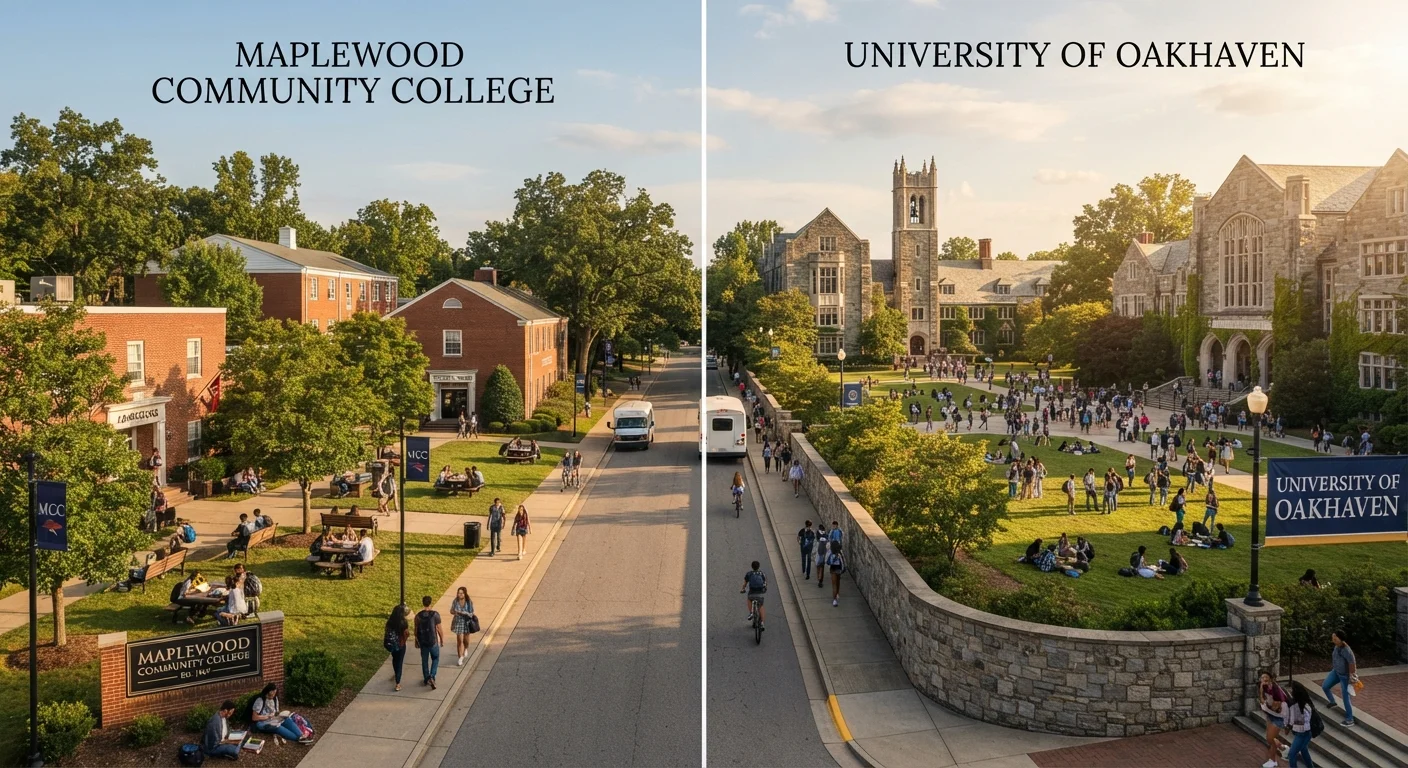
Community College
The flexible, affordable starting point.
Best for: Students seeking lower costs, smaller classes, and the option to transfer to a four-year institution after earning an associate degree.
Option B
Four-Year University
The traditional, immersive undergraduate experience.
Best for: Students ready to commit to a degree program, live on campus, and engage with a wider range of academic and social resources from day one.
If cost is your primary concern
Community College
Community college tuition is typically a fraction of four-year university costs, allowing students to complete general education requirements at a lower price before transferring.
If you want the full residential campus experience from the start
Four-Year University
Four-year universities offer on-campus housing, student organizations, and social networks that are largely unavailable at community colleges.
If you are undecided on a major or career path
Community College
Smaller financial stakes and flexible scheduling give students room to explore interests without committing to a costly program prematurely.
If you have a specific competitive major in mind from the outset
Four-Year University
Some programs - such as architecture, engineering, or nursing - have sequenced curricula that are easier to complete without a mid-degree transfer disruption.
If you are balancing work or family responsibilities
Community College
Community colleges typically offer more evening, weekend, and online class options, making it easier to balance education with other obligations.
The Academic Experience in Years One and Two
During the first two years at either institution, students typically focus on general education requirements - writing, math, natural sciences, and social sciences - before moving into major-specific coursework. The content covered is broadly similar, but the classroom environment differs noticeably.
At a community college, introductory courses are usually taught by experienced instructors in smaller sections, often with 20-35 students. This can make it easier to ask questions, visit office hours, and build relationships with faculty. At a four-year university, introductory lectures in popular subjects may seat hundreds of students, with actual instruction sometimes delegated to graduate teaching assistants.
That said, four-year universities offer research opportunities, honors programs, and specialized electives from the start. Students who want early exposure to a field's cutting-edge work may find more of it at a larger institution. Those who need more foundational support, however, often thrive in community college's more structured, high-touch environment. If you're still building the habits needed for college-level work, see our guide on skills high school doesn't always teach before making your decision.
| Criterion | Community College | Four-Year University |
|---|---|---|
| Average annual tuition | Lower (often under $5,000/yr) | Higher ($10,000-$40,000+/yr) |
| Typical class size (intro courses) | 20-35 students | 50-300+ students |
| On-campus housing | Rarely available | Widely available |
| Path to bachelor's degree | Via transfer after 2 years | Direct 4-year enrollment |
| Schedule flexibility | High (evening, online options) | Moderate |
| Research & lab access (Year 1-2) | Limited | More available |
| Student clubs & activities | Fewer, smaller scale | Extensive variety |
Cost, Financial Aid, and the Transfer Equation
Cost is one of the clearest differences between these two paths. Community college tuition averages far below that of public four-year universities, and dramatically less than private institutions. Students who complete two years at a community college and then transfer can significantly reduce the overall price of a bachelor's degree - provided the transfer is planned carefully.
~$3,860
Average community college tuition per year
According to the College Board's Trends in College Pricing report, in-district community college tuition and fees average significantly less than public four-year institutions.
~$11,260
Average in-state public university tuition per year
The College Board reports this figure for in-state students at public four-year institutions, not including room, board, or other expenses.
Over 40%
Share of U.S. undergraduates at community colleges
The American Association of Community Colleges estimates that community colleges enroll a substantial portion of all U.S. undergraduate students each year.
The key word is planned. Transfer agreements, sometimes called articulation agreements, exist between many community colleges and public universities in the same state. These agreements define which community college credits will count toward a bachelor's degree. Without checking these agreements in advance, students risk retaking courses or losing credits - which can add cost and time, not reduce them.
Financial aid is available at both types of institutions, including federal Pell Grants, loans, and institutional scholarships. Community college students are eligible for federal aid, though the amounts are typically smaller because tuition is lower. When building your college list, it's worth examining both options side by side - our article on building a college list that actually fits your goals walks through how to weigh financial reality alongside academic fit.
Campus Life, Social Integration, and Support Services
The social experience of the first two years diverges sharply between these paths. Four-year universities are generally designed around the assumption that students live on or near campus, participate in clubs and Greek life, attend athletic events, and form a residential community. This immersion can accelerate social development and build lasting professional networks.
Community colleges, by contrast, tend to serve a more commuter-based population. Many students are working adults, recent high school graduates still living at home, or parents returning to school. The social environment is less centralized, and students must be more proactive about connecting with peers and campus resources.
Both institutions offer academic advising, tutoring, and mental health services, though the scale and specialization of those services vary. Four-year universities often have larger counseling centers, career development offices, and alumni networks. Community colleges frequently excel at personalized advising and connections to local workforce programs.
It's also worth noting that starting at a community college doesn't mean missing out on the full university experience - many transfer students report feeling well-integrated once they arrive at their four-year destination, particularly when they engage early with campus life.
This article provides general educational information and is not a substitute for personalized guidance from a school counselor or academic advisor.