

Key Takeaways
Needs vs. Wants
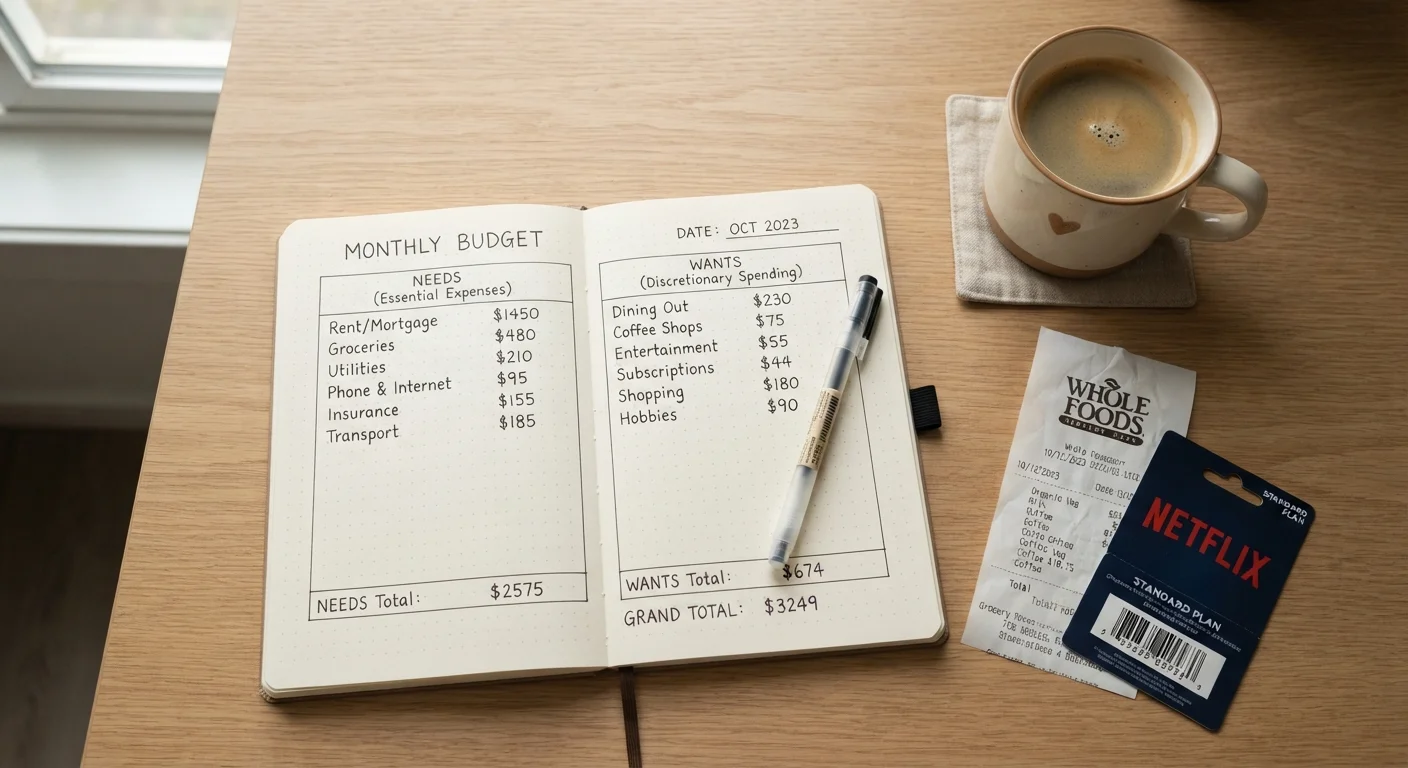
A 'need' is a expense required for basic survival, health, and the ability to earn income - such as housing, food, utilities, and transportation to work. A 'want' is anything beyond that baseline: spending that improves comfort, convenience, or enjoyment but isn't strictly necessary. The distinction forms the foundation of most budgeting frameworks because it helps you prioritize essential outflows before discretionary ones.
In behavioral economics, the needs/wants boundary is complicated by 'lifestyle creep' - the tendency for discretionary spending to feel essential once it becomes habitual. Some budgeting frameworks, like the 50/30/20 rule, use this distinction to allocate income percentages across spending categories.
Why This Distinction Is the Starting Point of Every Budget
Ask most people whether they know the difference between a need and a want, and they'll say yes immediately. Ask them to categorize their last 30 transactions, and the confident answers start to blur. That gap - between knowing the concept and applying it honestly - is where most budgets quietly fall apart.
The needs vs. wants distinction matters because it forces you to make explicit trade-offs. Without it, every expense feels roughly equally important, and cutting back anywhere feels like deprivation. With it, you can identify where you have genuine flexibility and where you don't. That clarity is the practical foundation of any working budget, whether you're using a structured system or building your own from scratch.
This isn't about judgment. It's a sorting exercise - one that gets more useful the more honestly you do it. See how this fits into the broader framework of personal budgeting if you're building your budget from the ground up.
34%
Americans with no monthly budget
A survey by the National Foundation for Credit Counseling found that roughly one-third of US adults do not track their spending or maintain a budget, making needs/wants categorization an unused tool for many households.
50%
Income share suggested for needs
The widely referenced 50/30/20 budgeting guideline suggests allocating up to 50% of after-tax income to essential needs - a benchmark that only works if needs are defined accurately.
$6,080
Average annual US household food spending
According to the Bureau of Labor Statistics Consumer Expenditure Survey, US households spend thousands annually on food - a category that frequently blends genuine needs with discretionary want-level choices.
Where the Line Actually Falls - and Where It Gets Blurry
A need is an expense that sustains your basic functioning and your ability to participate in work and daily life. Clear examples include: rent or mortgage payments, basic groceries, health insurance, utilities (electricity, water, heat), and transportation to your job. Without these, your ability to survive, stay healthy, or remain employed is genuinely at risk.
A want is anything beyond that threshold. Dining out, streaming subscriptions, hobby equipment, upgraded phone plans, name-brand clothing when generic alternatives exist - these improve your quality of life but aren't survival-critical.
The genuinely tricky cases sit in the middle:
- A smartphone: Having a phone is a need for most people. Having the latest flagship model is a want.
- Groceries: Basic food is a need. Specialty items, premium brands, and pre-made meals add a want component to the same cart.
- A car: In areas without reliable transit, a car may be a genuine need. The make, model, and payment tier may not be.
- Clothing: Adequate, weather-appropriate clothing is a need. Fashion-driven purchases are wants.
The useful habit is to ask: If my income dropped by 30%, would I still need this? That pressure test tends to separate the genuinely essential from the deeply habitual.
How to Apply This in Your Own Budget
Start with your last full month of bank and credit card statements. Go through each transaction and label it N (need), W (want), or M (mixed). Don't overthink it on the first pass - your instincts will be mostly right. Then revisit the M column.
For mixed expenses, ask whether you can separate the need portion from the want portion. Your phone bill might be $85 for a basic plan (need) and $25 for an upgraded data tier you barely use (want). Separating these gives you real numbers to work with rather than treating the whole $110 as untouchable.
Once categorized, add up each group. Most people find that a significant share of what felt automatic - subscriptions, convenience spending, premium tiers - lands in the want column. That doesn't mean you should cut all of it. It means you now have an honest map of where choices exist.
Use a Simple Three-Column Worksheet
Create three columns - Need, Want, and Mixed - and run your last month's transactions through them in a single sitting. Don't agonize over edge cases; flag them as Mixed and revisit. The goal of the first pass is a rough map, not perfection. Even an imprecise sort is more useful than no sort at all.
Understanding how your expenses are structured also helps - fixed vs. variable expenses behave differently when you're trying to reduce spending, and many wants cluster in the variable category where trimming is most feasible.
If your needs are consuming more than you expected, that's important information too. It may point to structural expenses - housing costs, debt payments, healthcare - that need a longer-term strategy rather than a quick monthly trim. Consulting a nonprofit credit counselor or a licensed financial planner can be valuable when essential costs feel unmanageable.
This article is for general informational and educational purposes only and does not constitute personalized financial advice. Please consult a qualified financial professional for guidance specific to your situation.