

Key Takeaways
Option A
Debt Avalanche
The mathematically optimal approach to eliminating debt.
Best for: People who want to minimize total interest paid and are comfortable staying motivated without early wins.
Option B
Debt Snowball
The psychologically driven approach built on momentum.
Best for: People who need visible early progress to stay committed to their repayment plan.
If you carry high-interest debt such as credit cards and want to minimize total cost
Debt Avalanche
Targeting the highest interest rate first reduces the amount that compounds against you each month, lowering your total repayment amount over the life of your debts.
If you have struggled to stay consistent with debt repayment plans in the past
Debt Snowball
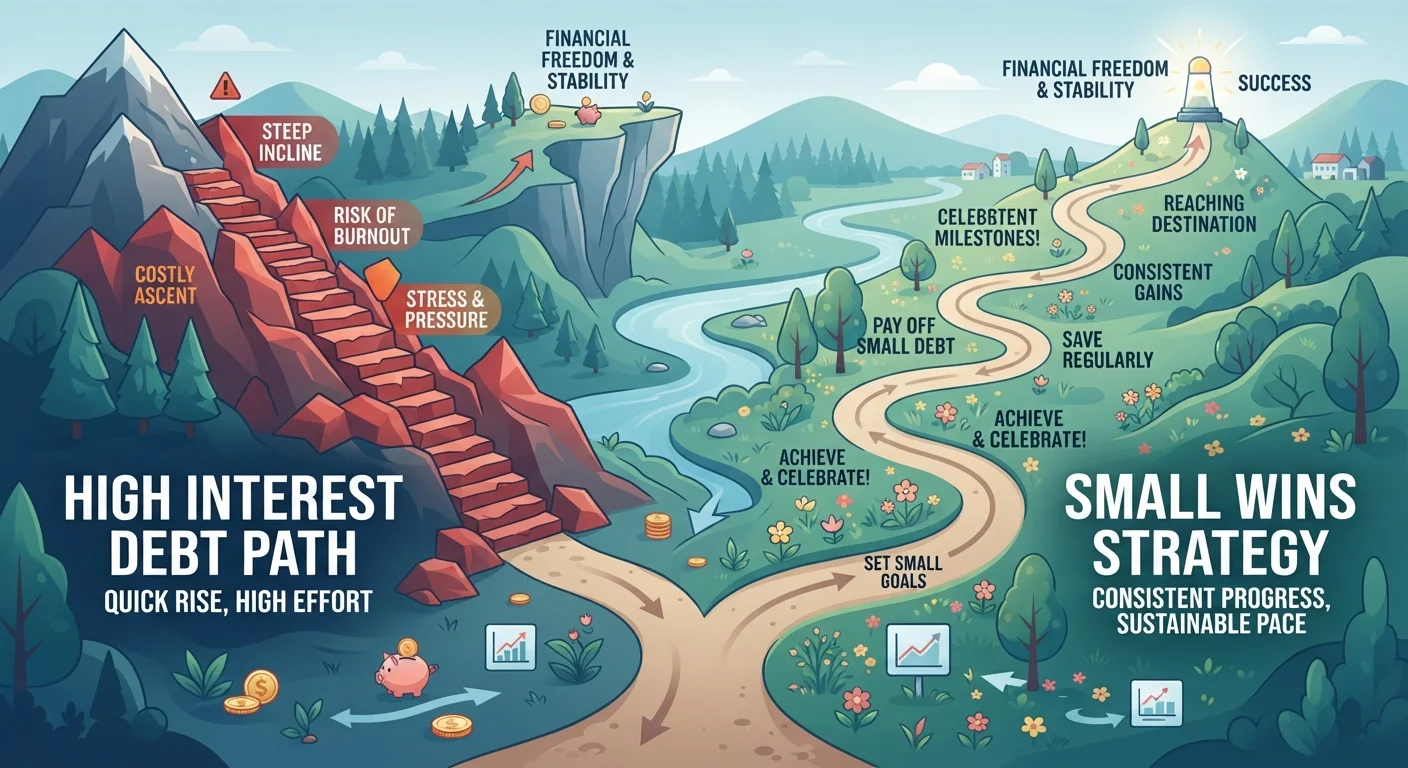
Paying off smaller balances quickly delivers tangible milestones that reinforce the habit of repayment, making it easier to maintain momentum over months or years.
If your debts are similar in interest rate but vary widely in balance size
Debt Snowball
When rates are close, the mathematical difference is small, so the motivational advantage of clearing accounts quickly may outweigh the marginal interest savings of the avalanche.
If you are analytically motivated and comfortable tracking long-term financial progress
Debt Avalanche
The avalanche rewards patience with measurably lower interest costs - a satisfying outcome for those who stay energized by data rather than milestone emotions.
How Each Strategy Works
Both the debt avalanche and debt snowball share the same core mechanic: you make minimum payments on all your debts, then direct any extra money toward one target debt each month. The difference lies entirely in how you rank those targets.
Debt Avalanche: List your debts by interest rate, highest to lowest. Every extra dollar you can apply goes toward the debt at the top of that list. Once it's paid off, the money you were putting toward it - minimums plus extra - rolls into the next highest-rate debt. This continues until all balances reach zero.
Debt Snowball: List your debts by balance, smallest to largest, regardless of interest rate. Extra payments go to the smallest balance first. Once that account is cleared, the full payment amount cascades to the next smallest. The growing payment amount is the "snowball" rolling forward.
Because both methods require identifying a monthly surplus to apply to debt, they work best alongside a structured budget. Our budgeting fundamentals guide can help you find that number if you haven't already.
| Criterion | Debt Avalanche | Debt Snowball |
|---|---|---|
| Repayment order | Highest interest rate first | Smallest balance first |
| Total interest paid | Lower overall cost | Potentially higher cost |
| Time to first payoff | Longer (if largest debt has highest rate) | Faster (small balances clear quickly) |
| Psychological benefit | Gradual; satisfaction is number-driven | Early wins reinforce motivation |
| Best debt profile | Wide rate spread across debts | Multiple small balances to eliminate |
| Complexity | Requires tracking APRs carefully | Simple; sorted by balance amount |
The Real Difference: Cost vs. Consistency
The avalanche's mathematical advantage is well established. By reducing the principal on high-interest debt sooner, you slow the rate at which interest accrues across your entire debt load. Depending on your balances and rates, the savings can range from modest to substantial - sometimes hundreds or even thousands of dollars over the repayment period.
However, cost efficiency alone doesn't determine which strategy succeeds. Research in behavioral economics has consistently found that people tend to underestimate the psychological difficulty of long financial commitments. If your highest-interest debt also carries your largest balance, the avalanche can mean months - sometimes years - pass before you eliminate a single account. For many people, that gap in visible progress erodes motivation.
~$1,000+
Potential interest savings with avalanche
Illustrative estimates suggest the avalanche can save a meaningful amount in interest compared to the snowball, depending on balance sizes and rate differences - exact figures vary by individual debt profile.
1 in 3
Americans carrying credit card debt month to month
Federal Reserve data consistently shows a significant share of U.S. households carry revolving credit card balances, underscoring the widespread relevance of structured repayment strategies.
The snowball addresses this by engineering early wins. Clearing a small balance in the first few weeks or months creates a concrete confirmation that the plan is working. That experience of success has been shown to reinforce follow-through on financial goals - which matters more than marginal interest savings if the alternative is abandoning the plan entirely.
For a deeper look at habit systems that support long-term repayment, see strategies for making debt repayment stick.
Choosing What Works for Your Situation
There is no universally correct choice. The right method depends on your debt profile, your personality, and how you respond to financial stress.
Consider the avalanche if: your highest-interest debts are manageable in size and could be eliminated within a reasonable timeframe; you find satisfaction in tracking numbers and projected savings; or the interest rate spread across your debts is wide enough to make the cost difference meaningful.
Consider the snowball if: your highest-interest debt is also your largest balance and a long payoff timeline feels discouraging; you've tried repayment plans before and struggled to maintain them; or you simply find that seeing accounts close keeps you engaged.
Some people also use a hybrid approach - targeting one or two small balances first to build momentum, then shifting to the highest-rate debt for the remainder. This isn't a formal method, but it reflects a practical reality: you can adapt these frameworks to your circumstances.
If you're weighing whether to prioritize debt over savings at the same time, this overview on saving while carrying debt walks through the key trade-offs. And if you're exploring other ways to restructure what you owe, comparing consolidation loans and balance transfer cards covers two common tools worth understanding.
Both strategies fit within the broader framework explored in The Saving and Debt Playbook, which covers repayment planning alongside savings goals in one place.
This article is for general informational purposes only and does not constitute personalized financial advice. Consult a qualified financial professional for guidance tailored to your specific situation.