

Key Takeaways
Option A
New York City
The fast-moving, walk-everywhere urban classic.
Best for: Travelers who want world-class museums, dense neighborhoods, public transit, and a city that never stops moving.
Option B
Los Angeles
The sprawling, sun-soaked capital of laid-back cool.
Best for: Travelers who enjoy beach culture, outdoor dining, driving between distinct neighborhoods, and a more relaxed pace.
If you want to travel without renting a car
New York City
NYC's subway, buses, and walkable streets make it genuinely easy to navigate without a vehicle. LA's public transit system exists but is not practical for most tourist itineraries.
If you're chasing outdoor space, beach access, and sunshine
Los Angeles
LA offers beaches, hiking trails, and warm weather most of the year - something NYC simply can't match given its climate and geography.
If you want deep cultural immersion in museums, theater, and street life
New York City
NYC's concentration of world-renowned museums, Broadway shows, diverse food scenes, and constant street-level activity is unmatched in the US.
If you prefer a more relaxed, indoor-outdoor dining and lifestyle experience
Los Angeles
LA's mild climate means restaurants with open-air patios, rooftop bars, and casual food truck culture thrive year-round in a way NYC can't sustain.
If this is your first major US city trip and you want an iconic, all-in-one experience
New York City
The sheer density of famous landmarks, neighborhoods, and experiences packed into a small geographic area makes NYC the more efficient single-destination choice.
The Feel of Each City: Pace, Density, and Energy
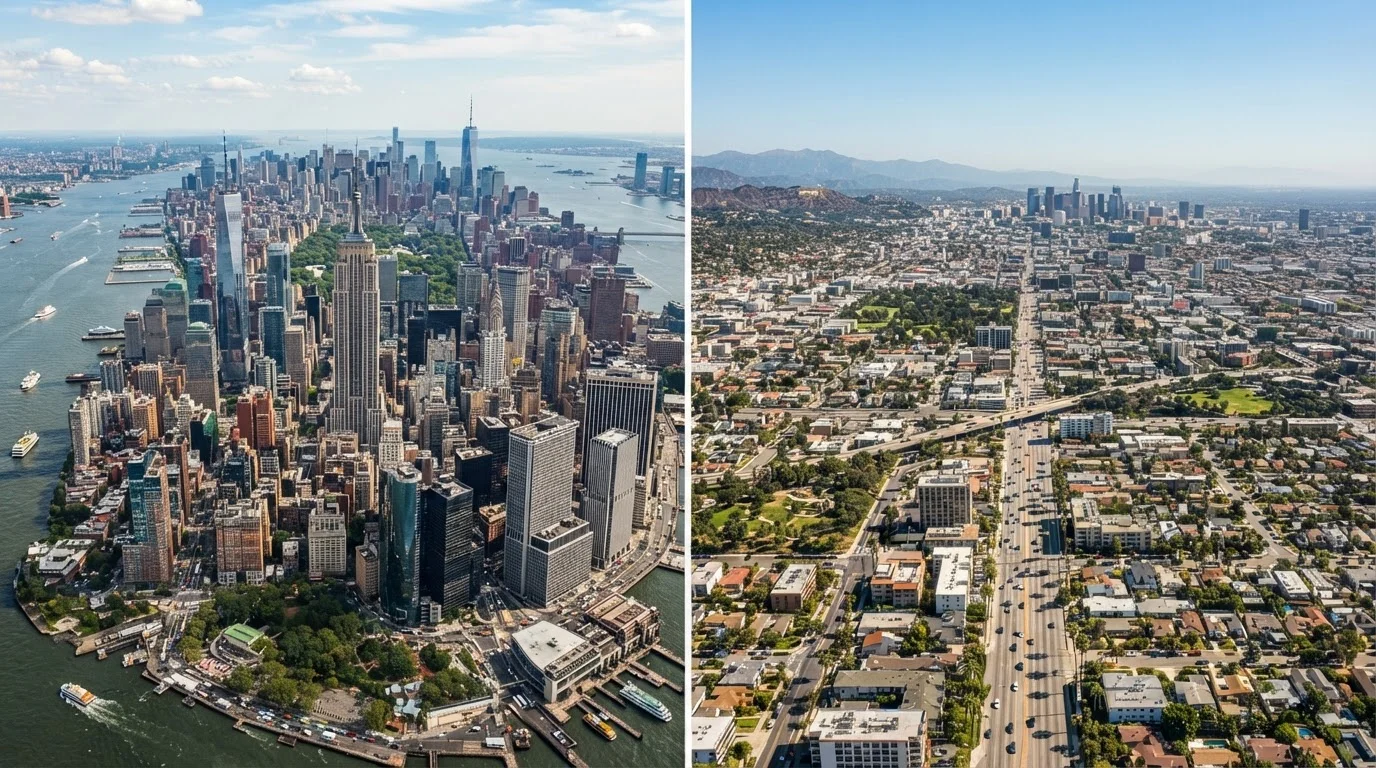
Arriving in New York City, you'll feel the city's intensity almost immediately. Streets are crowded, sidewalks move fast, and the sheer density of people, buildings, and sound is unlike anywhere else in the US. Midtown Manhattan alone contains more skyscrapers than most entire countries. That compression creates an energy that many travelers find exhilarating - and others find exhausting.
Los Angeles operates on a completely different frequency. The city sprawls across roughly 500 square miles, and its neighborhoods - from Silver Lake to Santa Monica to Koreatown - feel almost like separate towns. Nobody is rushing past you on the sidewalk because, in many parts of LA, there are no sidewalks worth mentioning. Life unfolds in cars, on terraces, and along the coast.
Neither vibe is better - they're genuinely different experiences. If you're the kind of traveler who gets energized by density and motion, NYC is your city. If you want space, sun, and the freedom to meander at your own pace, LA rewards that instinct.
| Criterion | New York City | Los Angeles |
|---|---|---|
| Getting around | Subway + walking | Car essential |
| City size / density | Compact and vertical | Vast and horizontal |
| Weather | Four full seasons | Mild, mostly sunny |
| Biggest travel cost | Hotel accommodation | Car rental and parking |
| Beach access | Limited, requires travel | Abundant, close to city |
| Nightlife and entertainment pace | Late-night, 24/7 energy | Earlier, more relaxed |
| Outdoor hiking | Day trips required | Trails within city limits |
Getting Around: Transit vs. Car Culture
This is perhaps the most practically important difference for first-time visitors. New York's subway system runs 24 hours a day and connects virtually every major attraction. You can land at JFK, hop on a train, and reach Midtown in under an hour without a rental car, a map app, or any real stress. Walking between neighborhoods is not only possible - it's one of the best ways to discover the city.
In Los Angeles, you will almost certainly need a car. The metro system has expanded significantly in recent years, but the geography of LA makes transit slow and impractical for covering multiple neighborhoods in a day. Driving, however, means contending with some of the worst traffic congestion in the country. Budget extra time for any driving you plan, especially during morning and evening rush hours, which can stretch well beyond the typical commute window.
Driving in LA: Plan for Traffic
Los Angeles traffic is not a stereotype - it's a practical travel variable. Distances that look short on a map can take 45 minutes or more during peak hours. If you're scheduling activities across different neighborhoods in a single day, build in generous buffer time and consider using navigation apps that show real-time traffic conditions. Rideshares are widely available but surge pricing applies during busy periods.
If you're planning to explore America's natural landscapes before or after your city stop, our guide to visiting US national parks covers what to expect at popular park destinations within reach of both coasts.
Cost, Weather, and What to Actually Expect
Both cities are expensive by US standards, but the cost structure differs. In NYC, accommodation is the biggest hit - hotel rooms in central Manhattan are consistently costly, and even budget options command premium prices. Food, however, spans the full range, from $2 pizza slices to Michelin-starred tasting menus.
In LA, accommodation is somewhat more varied, but car rental, parking, and gas add up quickly. Dining culture leans toward casual - even high-end LA restaurants often feel more relaxed than their NYC counterparts.
~500 sq mi
Geographic size of Los Angeles
Los Angeles covers roughly 500 square miles, compared to New York City's approximately 302 square miles - making LA feel dramatically more spread out.
472
NYC subway stations
New York City's subway system has 472 stations, making it one of the most extensive urban rail networks in the world.
~285 days
Sunny days per year in LA
Los Angeles averages roughly 285 sunny days per year, according to general US climate data - a sharp contrast to New York's variable four-season climate.
Weather is a significant practical consideration. New York experiences genuine four-season weather: hot, humid summers; cold winters with occasional snow; and beautiful but unpredictable springs and falls. Los Angeles is famously mild, with most of the year offering warm, sunny days. That said, wildfire smoke can affect air quality in certain seasons, and coastal neighborhoods experience more marine fog than the inland valleys.
Packing differently for each city isn't optional - it's essential. NYC in January requires a real winter coat; LA in January might mean a light jacket at night and a T-shirt by noon.