

Key Takeaways
Why Organisation Makes or Breaks a Trip
Scattered confirmation emails, forgotten reservation numbers, mismatched flight times — these aren't rookie mistakes. They happen to experienced travelers too, usually because the planning process sprawls across too many places. A solid organisational system doesn't need to be elaborate; it just needs to be consistent and accessible when you need it most.
Whether you're juggling a solo weekend getaway or coordinating a multi-city family trip, the fundamentals are the same: keep your key information centralised, keep it accessible offline as well as online, and keep your system simple enough that you'll actually maintain it. For a broader look at how planning phases connect, see our guide to the anatomy of a well-planned trip.
Below are six approaches that real travelers rely on — each with genuine advantages and honest trade-offs.
A dedicated travel spreadsheet
Spreadsheets remain one of the most flexible organisational tools available. A single shared document can hold flight details, accommodation addresses, confirmation numbers, daily schedules, budget tracking, and packing notes — all in one place. Tabs let you separate categories without losing the big picture.
The main advantage is customisation: you can structure it exactly to your trip's needs. The trade-off is setup time, and spreadsheets don't send reminders or sync automatically with your bookings. They work best for planners who enjoy the process and want full control over how information is structured.
One well-structured spreadsheet can replace a dozen scattered notes and emails.
A travel-specific app
Apps designed for itinerary management can automatically parse confirmation emails and organise flights, hotels, and car rentals into a timeline. Many work offline, which matters when you're in an airport with spotty Wi-Fi. Some sync across devices, making them practical for group travel.
The limitation is that automatic parsing isn't perfect — always verify that imported details are accurate. These apps also vary in how well they handle non-standard bookings like tours, ferries, or accommodations booked through local operators. Check that any app you rely on works in the regions you're visiting before you're dependent on it.
Travel apps shine when automatic email parsing works correctly — always verify the details they pull in.
A physical travel notebook or planner
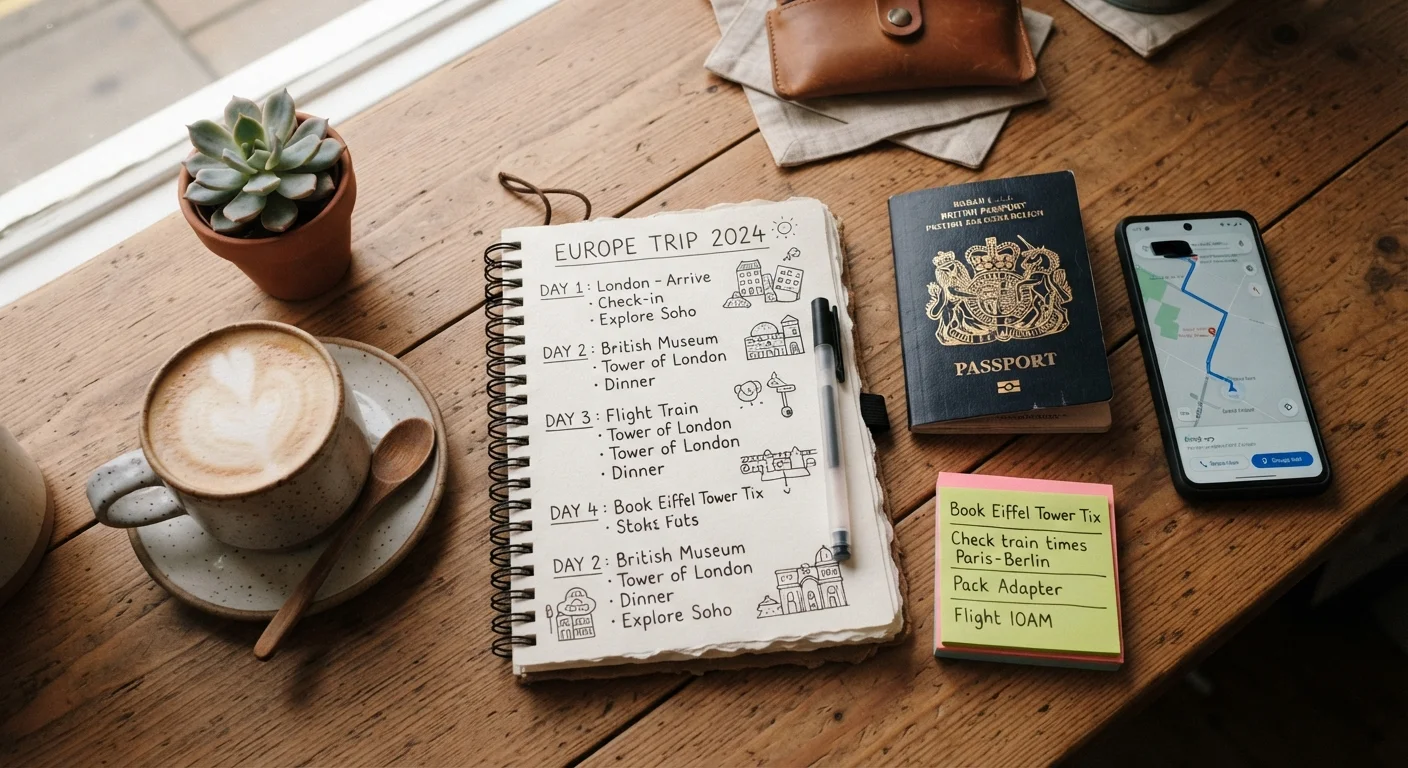
There's a reason analog methods persist: they don't need a battery, they don't crash, and writing things down can improve retention. A dedicated notebook for each trip — with key dates, addresses, local emergency numbers, and a rough daily outline — gives you a reliable backup that works anywhere.
The obvious downside is that it's not searchable and can't be shared easily. Handwritten notes are most valuable as a complement to digital tools rather than a replacement. Consider keeping a printed one-page summary of critical information (flight numbers, hotel addresses, emergency contacts) that folds into your passport holder.
A printed one-page summary of critical trip details is the backup that never runs out of battery.
Email folders and labels
For travelers who don't want to adopt a new tool, a well-maintained email system can do a lot of the heavy lifting. Creating a dedicated folder or label for each trip and moving every confirmation there immediately after booking keeps everything findable without learning new software.
The risk is relying solely on email for access — international roaming issues, spam filters, and account access problems can all cut you off at critical moments. Always download or screenshot key confirmations so you have them locally on your device, independent of your email connection.
Download key confirmations locally — don't bet your trip on uninterrupted email access.
A shared document for group trips
When multiple people are travelling together, a collaborative document — something all travelers can view and edit in real time — prevents the information asymmetry that creates friction. One person shouldn't be the sole keeper of every booking detail. Shared docs let everyone know the plan, check in on logistics, and contribute notes.
Establish clear editing conventions early: who updates what, and how changes are flagged. An uncontrolled shared document where everyone edits freely can become chaotic fast. Assign one person as the primary owner who has final say on the master version.
In group travel, shared access to the plan prevents one person from becoming an unavoidable bottleneck.
A layered approach combining tools
Many experienced travelers settle on a combination: a digital tool for active itinerary management, a spreadsheet or document for budget and research notes, and a printed backup of the essentials. Each layer serves a different function, and together they cover the gaps that any single tool leaves.
The key is keeping the layers consistent — if you update a booking, update it everywhere. A layered system only works if it stays in sync. For more on how planning decisions interact with packing choices, our carry-on packing method guide covers how a clear plan makes packing far less chaotic.
A layered system only works if all layers stay in sync — update everywhere when anything changes.
Building a System That Holds Up on the Road
The method you choose matters less than how reliably you use it. A colour-coded spreadsheet abandoned after the first booking is worse than a simple notes app you check every day. Whichever approach resonates, build in one habit: do a full review of all bookings, documents, and logistics 48 to 72 hours before departure. That buffer catches errors while there's still time to fix them.
Do a Pre-Departure Audit
Set a calendar reminder for 48–72 hours before departure to review every booking, document, and logistics detail in your system. Cross-check passport expiry, confirm accommodation check-in procedures, and verify transport connections. Catching a mismatch at this stage is far less stressful than discovering it at the airport.
If you're travelling with family, the complexity of your organisational needs multiplies quickly — our article on travelling with children covers what the planning process looks like when kids are in the mix. And for a complete end-to-end planning walkthrough, Trip Planning from Start to Finish covers every stage from initial research to departure day.