

Key Takeaways
Our Verdict
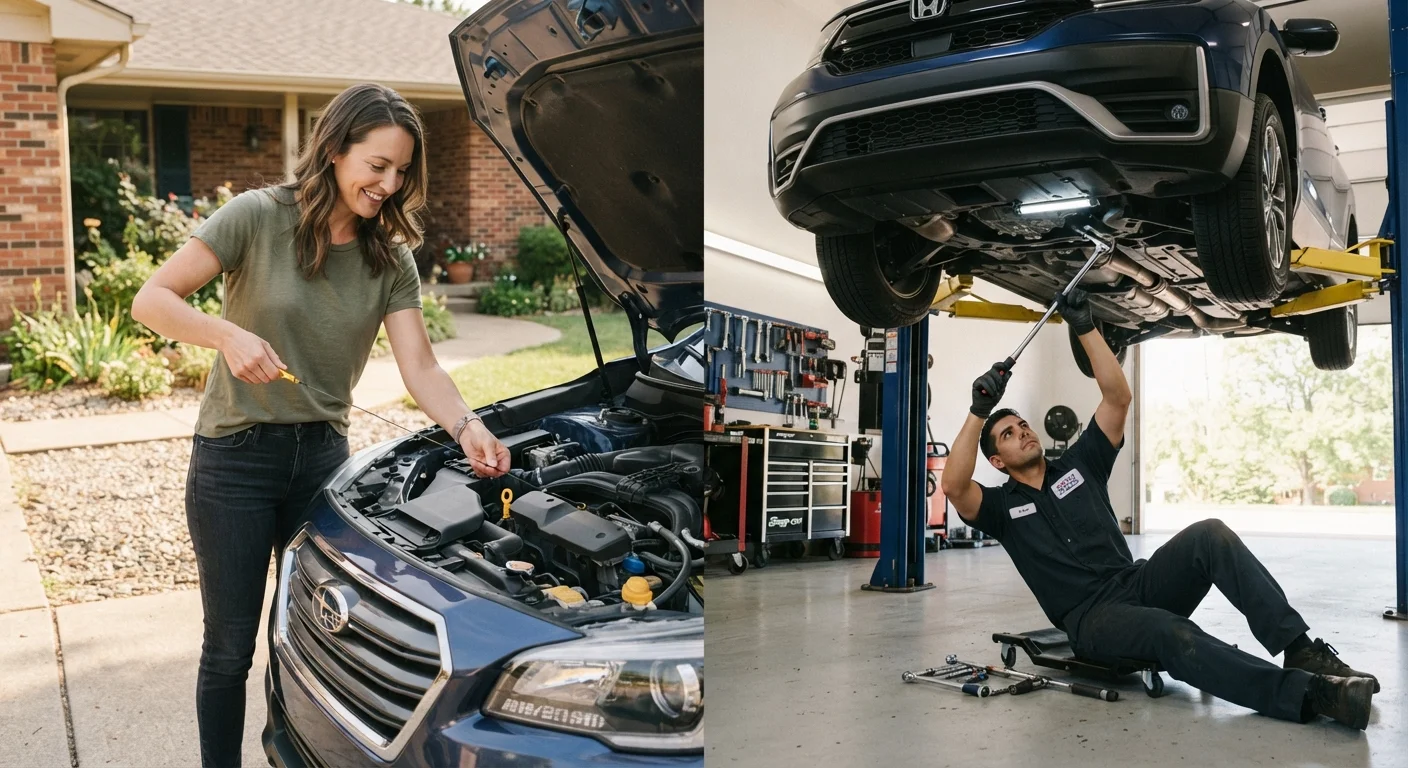
DIY maintenance makes sense for predictable, low-risk tasks that require basic tools and no specialist knowledge. A qualified garage is the right call whenever safety systems, complex electronics, or structural components are involved. Knowing which is which is the most valuable skill a driver can develop.
| Best for | Recommended |
|---|---|
| Drivers comfortable with basic mechanical tasks | DIY maintenance |
| Work involving brakes, steering, or suspension | Professional garage |
| Newer vehicles under manufacturer warranty | Professional garage |
| Routine checks and consumable replacements | DIY maintenance |
What DIY Maintenance Actually Covers
Plenty of routine upkeep falls well within the capability of an average driver with basic tools and a couple of hours. These tasks share a common profile: they're low-risk if done incorrectly, require no specialist equipment, and follow clear, documented steps.
Reliable DIY candidates include:
- Engine oil and filter changes - the classic home mechanic task, manageable with a drain pan, socket set, and the right oil grade from your manual.
- Air filter replacement - both engine and cabin filters are typically accessible without tools on most vehicles.
- Wiper blade swaps - straightforward and clearly described in every owner's manual.
- Checking and topping off fluids - oil, coolant, brake fluid, power steering fluid, and washer fluid. See our guide on fluid checks you can do at home for a step-by-step walkthrough.
- Tire pressure checks - a $15 gauge and two minutes per tire can meaningfully affect safety and fuel economy.
- Battery terminal cleaning - removing corrosion with a wire brush is safe with gloves and eye protection.
Start With Your Owner's Manual
Before attempting any maintenance task, consult your vehicle's owner's manual. It specifies correct fluid grades, filter part numbers, torque settings, and service intervals tailored to your exact model. Following manufacturer guidance also helps preserve any remaining warranty coverage. This one habit prevents a large proportion of DIY mistakes.
Understanding which tasks belong in this category - and committing to doing them consistently - also helps you stay ahead of seasonal demands. Our seasonal car maintenance guide maps these checks to the time of year they matter most.
When a Professional Garage Is the Right Call
Some jobs look approachable on a tutorial video but carry real risks when performed without the right tools, training, or workspace. The defining characteristic of garage-worthy work is that an error doesn't just mean a failed repair - it can mean a dangerous one.
Don't Guess With Safety-Critical Systems
Brakes, steering, and suspension directly determine whether you can control your vehicle in an emergency. Incorrect installation of brake pads, caliper bolts torqued to the wrong specification, or disturbed suspension geometry can cause catastrophic failure with no warning. If you're uncertain about any step, stop and consult a qualified mechanic - the cost of a professional repair is always less than the cost of an accident.
Tasks that consistently warrant professional handling include:
- Brake system repairs - pad, rotor, caliper, and brake line work requires precise torque specifications and bleeding procedures. Errors here have direct consequences for stopping distance.
- Timing belt or chain replacement - incorrect installation can cause catastrophic engine damage. This is among the most consequential services on any vehicle's schedule.
- Suspension and steering components - wheel alignment and geometry must be measured with calibrated equipment after any suspension work.
- Transmission service and clutch replacement - complex, labour-intensive, and requiring specialist knowledge of the specific gearbox design.
- Airbag and restraint system work - accidental deployment during repairs can cause serious injury. Always a professional job.
- Advanced diagnostics - a basic OBD-II scanner can pull fault codes, but interpreting live data and pinpointing root causes on modern vehicles often needs workshop-grade equipment.
For a broader view of what your car's service schedule actually includes - and which items are genuinely non-negotiable - see Understanding Your Car's Service Schedule.
The Grey Area: Knowing Your Own Limits
Between the obvious DIY wins and the clear professional jobs lies a band of tasks where the right answer depends on you. Brake pad replacement, for example, is well within reach for an experienced home mechanic with proper tools and a vehicle lifted safely on jack stands - but it's not a task to attempt for the first time without guidance or in a poorly equipped setting.
| Task | DIY-Friendly | Go to a Garage | |
|---|---|---|---|
| Engine oil & filter change | Yes - standard skill | If lacking space or tools | N/A |
| Tire pressure & rotation | Pressure: yes; rotation: possible | Rotation requires a lift | N/A |
| Wiper blade replacement | Yes - minutes, no tools needed | Rarely necessary | N/A |
| Brake pad & rotor service | Experienced DIYers only | Recommended for most drivers | N/A |
| Timing belt/chain replacement | Not recommended | Always - precision critical | N/A |
| Cabin air filter replacement | Yes - simple access | Not needed | N/A |
| Check engine light diagnosis | Code reading only with OBD-II scanner | Full diagnosis and repair | N/A |
| Coolant flush | Possible with care | Preferred for pressurised systems | N/A |
A few honest questions worth asking before starting any task:
- Do I have the right tools? Torque wrenches, lifting equipment, and diagnostic scanners are non-negotiable for certain jobs - improvising around them creates risk.
- Can I safely support the vehicle? Never work under a car supported only by a hydraulic jack. Proper jack stands are essential.
- Will this affect my warranty? Some manufacturer or extended warranties require service records from approved workshops. Verify before you start.
- What's the consequence of getting it wrong? A poorly fitted air filter is an inconvenience. A poorly fitted brake caliper is a safety hazard.
It's also worth separating fact from folklore before acting on received wisdom. Our article on car maintenance myths covers several common misconceptions that lead drivers to over-service or under-service their vehicles. And if you're thinking about the longer-term financial picture, The Hidden Costs of Deferred Car Maintenance explains how skipping either type of upkeep can compound into expensive problems down the road.