

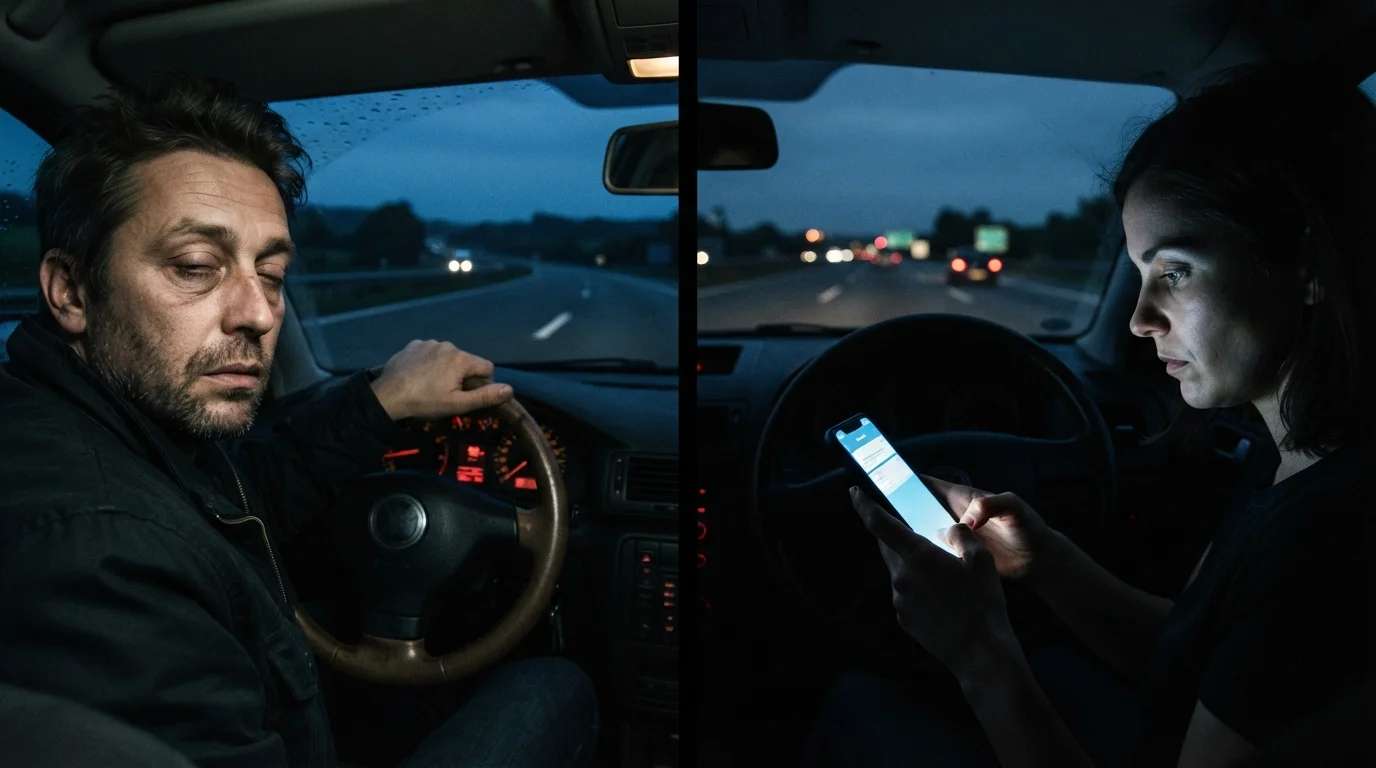
Key Takeaways
Option A
Driver Fatigue
The silent, cumulative threat that creeps in unnoticed.
Best for: Understanding when your body's need for rest has crossed into a genuine driving hazard.
Option B
Distracted Driving
The external, moment-to-moment attention thief.
Best for: Recognizing how brief diversions - visual, cognitive, or manual - can have catastrophic consequences.
If you regularly drive long distances or work irregular shift hours
Driver Fatigue awareness
Long hauls and disrupted sleep schedules are the primary contributors to fatigue-related crashes. Prioritize sleep planning and scheduled rest stops over relying on alertness in the moment.
If you find yourself reaching for your phone, eating, or managing passengers while driving
Distracted Driving awareness
These habits introduce the most common form of preventable impairment for everyday commuters. Identifying and eliminating in-car distractions is the most direct action most drivers can take.
If you drive frequently after dark or on monotonous interstate routes
Driver Fatigue awareness
Low-stimulation environments and reduced visibility accelerate fatigue onset, even when a driver feels otherwise alert. Plan accordingly with adequate pre-trip sleep.
Two Different Causes, The Same Deadly Result
Driver fatigue and distracted driving are often mentioned in the same breath - and for good reason. Both impair the cognitive and physical abilities required to drive safely, and both dramatically increase the risk of a crash. But conflating them misses something important: they work differently, they feel different from the inside, and they demand different countermeasures.
Understanding what sets these two threats apart - and where they overlap - is a foundational piece of being a genuinely safer driver. As part of a complete approach to safe driving, distinguishing between these impairments helps you recognize them in yourself and act before a close call becomes a collision.
| Criterion | Driver Fatigue | Distracted Driving |
|---|---|---|
| Primary cause | Sleep deprivation, prolonged wakefulness | External stimuli, device use, in-car activity |
| Onset | Gradual, cumulative | Immediate, moment-to-moment |
| Self-awareness of impairment | Often unrecognized until severe | Driver typically aware but underestimates risk |
| Types of impairment | Cognitive, perceptual, physical | Visual, manual, cognitive (one or all three) |
| Highest-risk conditions | Night, early morning, long monotonous routes | Any time a device or distraction is present |
| Prevention strategy | Adequate sleep, planned rest stops | Device discipline, in-car rules, focus habits |
| Quick fix effectiveness | None - caffeine only delays symptoms | High - putting down the phone works immediately |
Driver Fatigue: What's Actually Happening in Your Brain
Fatigue is a physiological state - not a mood or a choice. When the brain is sleep-deprived or has been sustaining attention for an extended period, core functions begin to degrade: reaction time slows, hazard perception dulls, and decision-making becomes less accurate. Research consistently shows that being awake for 18 hours produces impairment comparable to a blood alcohol concentration of 0.05%, and 24 hours of wakefulness approaches 0.10% - above the legal limit in every US state.
One of the most dangerous characteristics of fatigue is that drivers tend to underestimate how impaired they are. Microsleeps - involuntary sleep episodes lasting two to ten seconds - can occur without the driver's awareness. At highway speeds, even a two-second microsleep means traveling roughly 175 feet with no conscious control of the vehicle.
Fatigue risk spikes during overnight hours, early morning, and mid-afternoon, and intensifies on long, monotonous routes. Night driving compounds fatigue risk in ways that daytime conditions don't - reduced stimulation, lower visibility, and the body's natural circadian dip work together. And contrary to popular belief, caffeine and window-cracking offer only limited, temporary relief. Sleep is the only genuine remedy.
~100,000
Annual drowsy-driving crashes (NHTSA estimate)
The National Highway Traffic Safety Administration estimates approximately 100,000 police-reported crashes annually are directly attributed to driver drowsiness.
5 seconds
Average eyes-off-road time per text
NHTSA data indicates that reading or sending a text message diverts a driver's eyes from the road for roughly five seconds on average.
~175 ft
Distance traveled in a 2-second microsleep at highway speed
At 60 mph, a two-second microsleep - too brief for most drivers to notice - means traveling nearly 175 feet with no conscious control.
Distracted Driving: The Three Forms of Attention Theft
Distraction is an external disruption to attention - and it comes in three distinct types that can occur individually or simultaneously:
- Visual distraction: Taking your eyes off the road (reading a text, checking a GPS).
- Manual distraction: Removing your hands from the wheel (eating, adjusting controls).
- Cognitive distraction: Mentally disengaging from the driving task (emotionally intense conversations, daydreaming).
Texting is considered particularly dangerous because it involves all three simultaneously. The National Highway Traffic Safety Administration (NHTSA) reports that reading or sending a text takes a driver's eyes off the road for approximately five seconds - enough time at 55 mph to cover the length of a football field.
Importantly, cognitive distraction persists even when the phone is put down. Hands-free calls carry real cognitive risk - the conversation itself draws mental resources away from the driving environment. Distraction, unlike fatigue, can strike an alert, well-rested driver in an ordinary moment.
Where They Overlap - and Where They Diverge
Both impairments slow reaction time, narrow situational awareness, and reduce the driver's ability to respond to sudden hazards. Stopping distance is directly tied to reaction time, and even fractions of a second matter at speed. Both also share a troubling tendency toward overconfidence: fatigued drivers believe they're more alert than they are, and distracted drivers underestimate the attention cost of what they're doing.
The key difference is onset and awareness. Fatigue builds gradually and is often invisible to the driver until it's severe. Distraction is typically immediate, external, and - in principle - more consciously controllable. A driver choosing to pick up a phone is making a decision; a driver slipping into microsleep may not realize it's happening at all.
This distinction matters for prevention. Managing fatigue requires systemic habits: consistent sleep, trip planning, and willingness to pull over and rest. Managing distraction requires behavioral discipline in the moment - silencing devices, establishing car rules, and resisting the pull of notifications. The habits that separate genuinely safe drivers address both, because neither threat is something you can improvise your way around once you're already behind the wheel.
A Note on 'Drowsy Driving Myths'
Common beliefs - like opening a window, turning up the radio, or drinking coffee - are widely cited as fatigue countermeasures, but research does not support them as reliable solutions. They may produce a brief sensation of alertness without restoring the cognitive performance that sleep deprivation has degraded. Several driving safety myths, including the idea that caffeine 'cures' fatigue, persist despite the evidence. If you feel genuinely drowsy, pulling off the road safely and resting - even briefly - is the only evidence-supported action.