

| ABS Mandatory in U.S. | Required on all new passenger cars since 2000 (FMVSS 135) |
| ESC Mandatory in U.S. | Required on all new passenger vehicles since model year 2012 (FMVSS 126, NHTSA) |
| ABS Activation Feel | Rapid pulsing or vibration in the brake pedal |
| ESC Rollover Reduction | Significant reduction in fatal single-vehicle rollover risk (NHTSA research findings) |
| Shared Foundation | All three systems rely on wheel-speed sensors at each wheel |
| Traction Control Disabling | Some vehicles allow temporary TC disable for specific off-road use (Varies by vehicle - check owner's manual) |
Three Systems, One Goal: Keeping You in Control
Anti-lock Braking (ABS), Electronic Stability Control (ESC), and Traction Control are three of the most important active safety technologies fitted to modern vehicles - yet most drivers have only a vague idea of what each one actually does. Understanding how they work isn't just trivia; it helps you respond correctly when they activate, instead of fighting them.
| ABS Mandatory in U.S. | Required on all new passenger cars since 2000 (FMVSS 135) |
| ESC Mandatory in U.S. | Required on all new passenger vehicles since model year 2012 (FMVSS 126, NHTSA) |
| ABS Activation Feel | Rapid pulsing or vibration in the brake pedal |
| ESC Rollover Reduction | Significant reduction in fatal single-vehicle rollover risk (NHTSA research findings) |
| Shared Foundation | All three systems rely on wheel-speed sensors at each wheel |
| Traction Control Disabling | Some vehicles allow temporary TC disable for specific off-road use (Varies by vehicle - check owner's manual) |
All three systems share a common foundation: wheel-speed sensors that monitor how fast each wheel is rotating. When the data from those sensors falls outside expected parameters, the relevant system intervenes - often in milliseconds, faster than any human reflex.
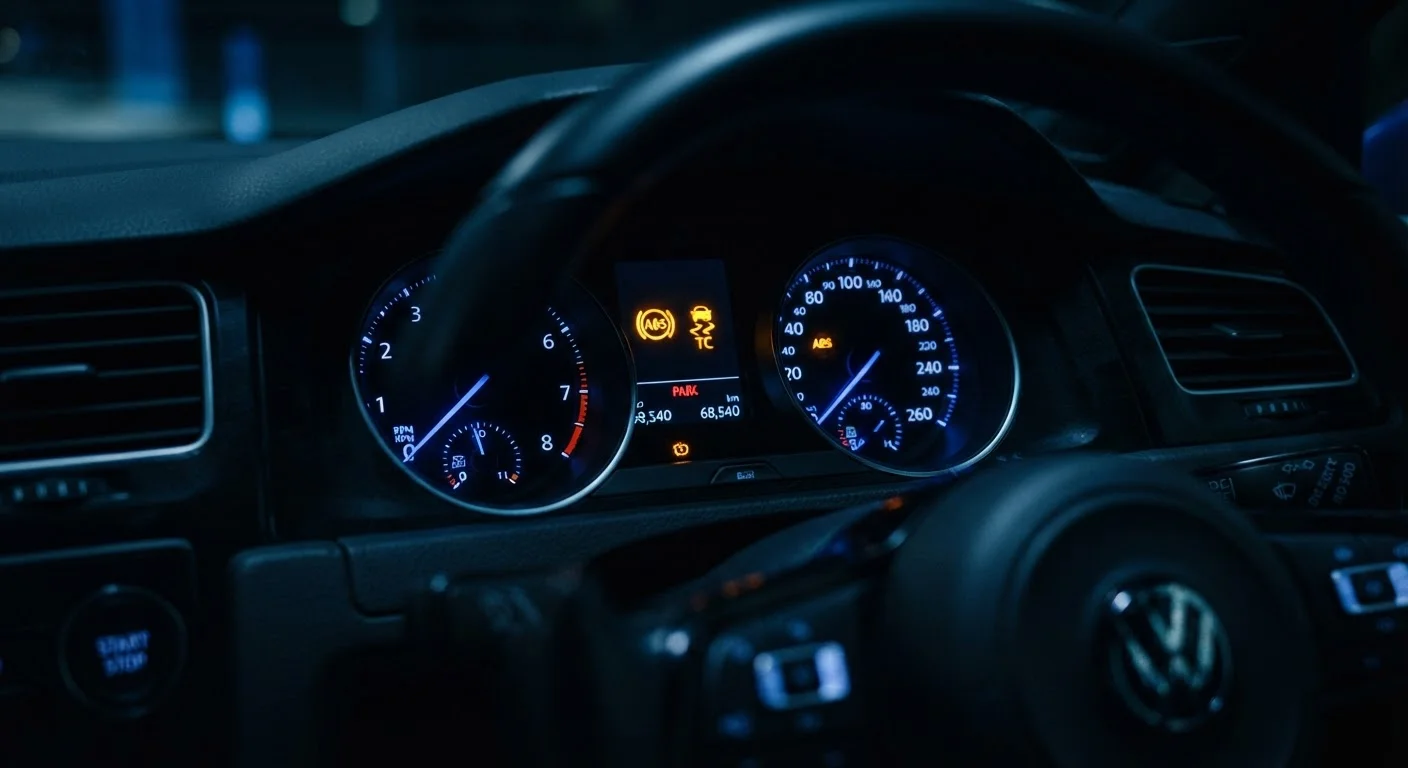
If you've ever seen a dashboard warning light for one of these systems and weren't sure whether to be concerned, our guide to warning lights explains what those indicators mean and when to seek service.
ABS: Why Your Brake Pedal Pulses
Anti-lock Braking System (ABS) prevents your wheels from locking up when you apply the brakes hard. A locked wheel skids rather than rolls, which dramatically reduces your ability to steer. ABS rapidly modulates brake pressure - releasing and reapplying it many times per second - so each wheel continues to rotate just enough to maintain steering grip.
When ABS activates, you'll feel a rapid pulsing or vibration in the brake pedal. This is normal and expected. The correct response is to keep firm, steady pressure on the pedal and steer around the obstacle. Many drivers instinctively lift off the brake when they feel the pulse - which defeats the system. Trust it, and keep pressing.
ABS is most valuable on wet, icy, or gravel surfaces where sudden braking would otherwise send you into an uncontrolled skid. On very loose gravel or deep snow, ABS may actually extend stopping distance slightly compared to a locked wheel - a known trade-off for the benefit of retained steering control.
Traction Control: Preventing Wheelspin at Takeoff
Traction Control (TC) addresses the opposite problem from ABS: instead of preventing wheels from locking during braking, it prevents driven wheels from spinning freely during acceleration. When one wheel spins faster than the others - a sign it has lost grip - the system either reduces engine power, applies braking to that wheel, or both, until traction is recovered.
You'll typically notice traction control activating when pulling away on ice, wet pavement, or loose surfaces. A dashboard light (usually labeled TC or TCS) may flash briefly, and you might feel the engine momentarily back off. This is the system doing its job.
ABS (Anti-lock Braking System)
A safety system that prevents wheels from locking during hard braking by rapidly modulating brake pressure. This preserves the driver's ability to steer while stopping.
ESC (Electronic Stability Control)
A computerized safety technology that detects and reduces loss of traction when a vehicle begins to skid. It selectively applies individual wheel brakes and may reduce engine power to keep the vehicle on the intended path.
Traction Control
A system that limits wheel spin during acceleration by reducing engine power or applying braking to a spinning wheel, helping the driver maintain grip when pulling away on slippery surfaces.
Yaw Sensor
A device used by ESC that measures the rate at which a vehicle rotates around its vertical axis, helping the system detect a developing skid before the driver may notice it.
Oversteer
A handling condition where the rear of the vehicle slides outward in a corner, causing the car to rotate more than the driver intended. ESC can detect and counteract this.
Understeer
A handling condition where the front wheels lose grip in a corner and the vehicle pushes wider than intended. ESC can also help reduce this by cutting engine torque and applying selective braking.
Some drivers disable traction control intentionally in specific off-road situations or when stuck in deep snow - rocking a vehicle sometimes requires deliberate wheelspin. Consult your owner's manual for guidance on when and how your vehicle allows TC to be turned off, and re-enable it for normal driving conditions.
ESC: The System That Catches a Skid Before It Happens
Electronic Stability Control (ESC) - sometimes called Electronic Stability Program (ESP) or Dynamic Stability Control (DSC) depending on the manufacturer - is the most sophisticated of the three. It builds on ABS and traction control hardware, adding a yaw sensor (which detects rotation around the vehicle's vertical axis) and a steering angle sensor.
ESC continuously compares where the driver is steering with where the vehicle is actually going. If those two diverge - say, the rear of the car begins to slide outward in a corner (oversteer), or the front pushes wide (understeer) - ESC selectively applies braking to individual wheels to bring the vehicle back in line. Engine torque may also be reduced.
ESC has been mandatory on all new passenger vehicles sold in the U.S. since the 2012 model year, a federal requirement under FMVSS 126. Research from the National Highway Traffic Safety Administration (NHTSA) has consistently found that ESC significantly reduces the risk of fatal single-vehicle rollovers and loss-of-control crashes.
When ESC activates, you may hear a subtle clicking or grinding from the brakes, see the ESC warning light flash, and feel momentary deceleration. The right response is the same as with ABS: don't panic, keep your eyes on the intended path, and steer smoothly toward it.
What These Systems Cannot Do
It's essential to understand that ABS, traction control, and ESC are intervention systems, not prevention systems. They can help manage a loss of control once it starts, but they cannot overcome the fundamental limits of physics. Driving too fast for road conditions, following too closely, or entering a corner far above the safe speed can create situations that exceed what any system can correct.
These technologies work best when the driver maintains appropriate speed, smooth steering inputs, and adequate following distance - creating a margin of safety within which the systems can actually help. Think of them as a safety net, not a substitute for attentive driving.
Regular maintenance also matters. ABS and ESC rely on wheel-speed sensors, brake components, and steering systems that must be in good working order. A fault in any of these can disable the system - which is exactly why a warning light for ABS or ESC should prompt a prompt inspection by a qualified mechanic.