

| Warning light colors | Red = immediate, Amber = soon, Green/Blue = informational |
| OBD-II standard applies to | All cars sold in the US from 1996 onward (US EPA OBD-II mandate) |
| TPMS required by law in | All new US passenger vehicles from model year 2008 (TREAD Act, NHTSA) |
| Flashing vs. steady CEL | Flashing = urgent (active misfire); steady = schedule service |
| Oil pressure light response | Pull over and stop engine immediately |
| Recommended tire pressure location | Driver's door jamb sticker or owner's manual |
Why Warning Light Colors Matter
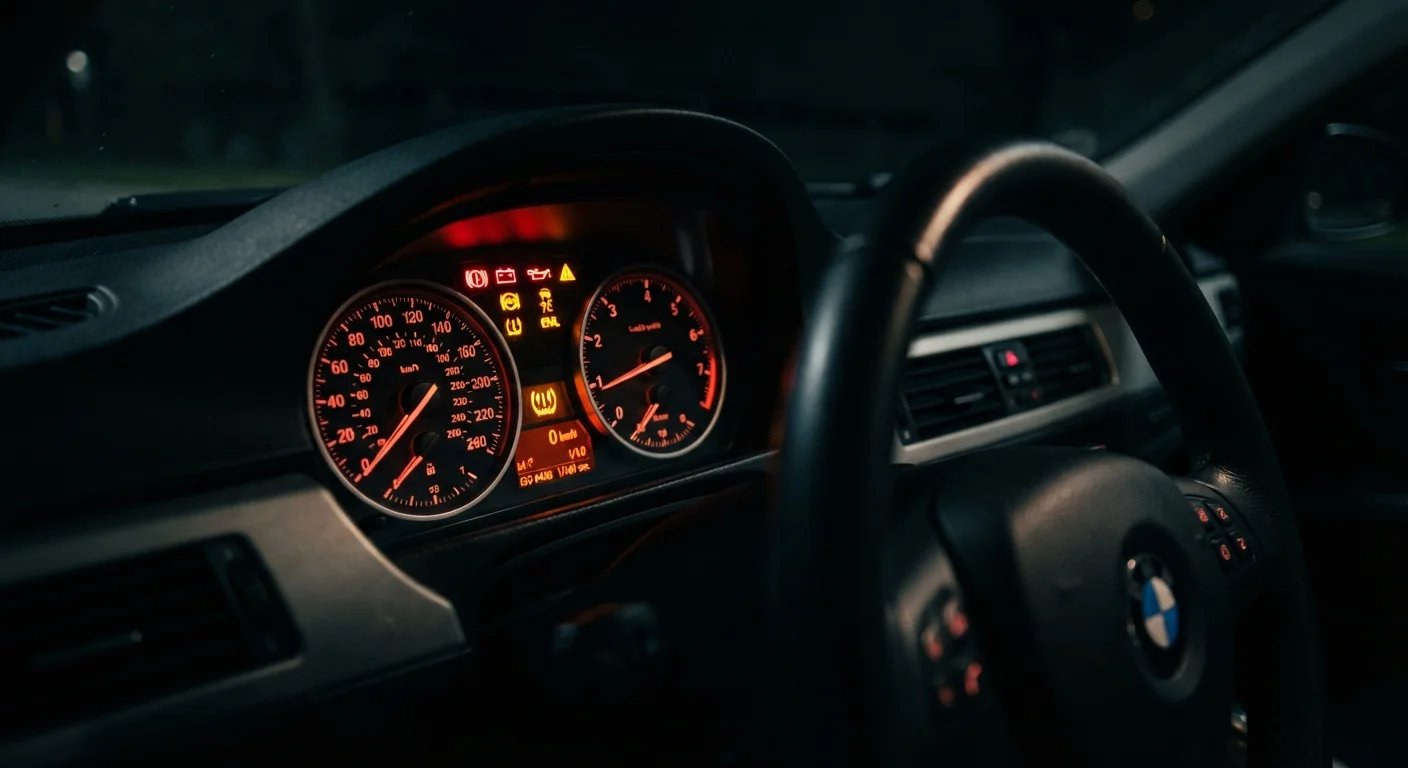
Before diving into individual symbols, understand the color system most vehicles use. Red lights signal an immediate or serious condition - stop driving as soon as it's safe to do so. Amber or yellow lights mean something needs attention soon but isn't necessarily an emergency. Green and blue lights are informational, confirming that a feature is active (high beams, turn signal, cruise control).
This three-tier system is fairly standardized across modern vehicles, though exact symbols can vary by make and model. Your owner's manual remains the definitive reference for your specific car - keep it in the glove box.
| Warning light colors | Red = immediate, Amber = soon, Green/Blue = informational |
| OBD-II standard applies to | All cars sold in the US from 1996 onward (US EPA OBD-II mandate) |
| TPMS required by law in | All new US passenger vehicles from model year 2008 (TREAD Act, NHTSA) |
| Flashing vs. steady CEL | Flashing = urgent (active misfire); steady = schedule service |
| Oil pressure light response | Pull over and stop engine immediately |
| Recommended tire pressure location | Driver's door jamb sticker or owner's manual |
The Most Common Warning Lights Explained
Here's a plain-language breakdown of the dashboard icons drivers encounter most often.
CEL (Check Engine Light)
A dashboard indicator triggered when the vehicle's onboard diagnostic system (OBD-II) detects a fault. It can range from minor issues like a loose gas cap to significant engine or emissions problems.
TPMS
Tire Pressure Monitoring System. A sensor-based system that alerts the driver when one or more tires fall significantly below the recommended air pressure, which is printed on the door jamb sticker.
OBD-II
On-Board Diagnostics, second generation. A standardized system in vehicles built after 1996 that monitors engine and emissions systems and stores fault codes readable by a diagnostic scanner.
Alternator
A generator driven by the engine that keeps the battery charged while the car is running. A failing alternator is a common cause of the battery warning light illuminating.
ABS
Anti-Lock Braking System. Prevents wheel lockup during hard braking by rapidly pulsing brake pressure, helping the driver maintain steering control in emergency stops.
ESC
Electronic Stability Control. A safety system that detects and reduces loss of traction by selectively applying brakes to individual wheels, helping keep the car on its intended path.
Check Engine (CEL): An amber engine outline that can mean almost anything from a loose gas cap to a misfiring cylinder. A steady light usually means schedule a diagnostic soon. A flashing check engine light is more urgent - it often indicates an active misfire that could damage the catalytic converter. Don't ignore a flashing CEL; have the vehicle inspected promptly.
Tire Pressure (TPMS): A cross-section of a tire with an exclamation point. All four tires (and your spare, on many vehicles) have pressure sensors. When one tire drops roughly 25% below the recommended pressure, this light triggers. Check and correct tire pressure before driving further. See our seasonal maintenance guide for how temperature swings affect tire pressure throughout the year.
Battery / Charging System: A red battery outline. This means the charging system isn't keeping the battery topped up - often a failing alternator or a bad connection. If this comes on while driving, minimize electrical load (turn off AC, radio) and head to a shop. For signs that trouble was building before the light appeared, see signs your car battery is on its way out.
Oil Pressure: A red oil can icon. This is one of the most serious lights on your dashboard. Low oil pressure can cause catastrophic engine damage within minutes. Pull over safely, turn off the engine, and check the oil level. Do not continue driving until the cause is identified.
Temperature Warning: A red thermometer in liquid. Your engine is overheating. Pull over immediately, turn off the engine, and do not open the radiator cap while hot. Let the engine cool before checking coolant levels.
ABS (Anti-Lock Brakes): An amber or red circle with "ABS" inside. Your standard braking still works, but the anti-lock system is compromised. Avoid hard braking situations and have it diagnosed. Learn more about how this system protects you in our guide: what ABS and traction control actually do in an emergency.
Traction Control / ESC: A car with wavy lines beneath it. When flashing, it simply means the system is actively working to maintain grip - normal in slippery conditions. When illuminated steadily, the system is disabled or has a fault.
TPMS Reset Required: Distinct from the pressure-low icon, this appears after a tire rotation or replacement as a reminder to recalibrate the sensors. Consult your owner's manual for the reset procedure.
Your dashboard can also communicate through sound and sensation - for a fuller picture, read our guide on noises, smells, and sensations that deserve attention.
When to Act Immediately vs. Schedule a Visit
Not every warning light demands a roadside stop, but some absolutely do. Use this simple framework:
- Stop now: Oil pressure, engine temperature, red battery light while driving, flashing check engine light.
- Schedule within 24-48 hours: Steady check engine light, ABS or ESC fault, brake system warning.
- Monitor and address soon: TPMS alert, service reminder lights (oil life, maintenance due).
When in doubt, err on the side of caution. A diagnostic scan at a qualified shop costs far less than delayed repairs. Many auto parts retailers also offer free code-reading services for check engine lights, which can help you understand the fault before booking a repair appointment.
This article is for general informational purposes. Always consult a qualified mechanic for diagnosis and repair of any vehicle fault.