

Key Takeaways
Glycaemic Index (GI)
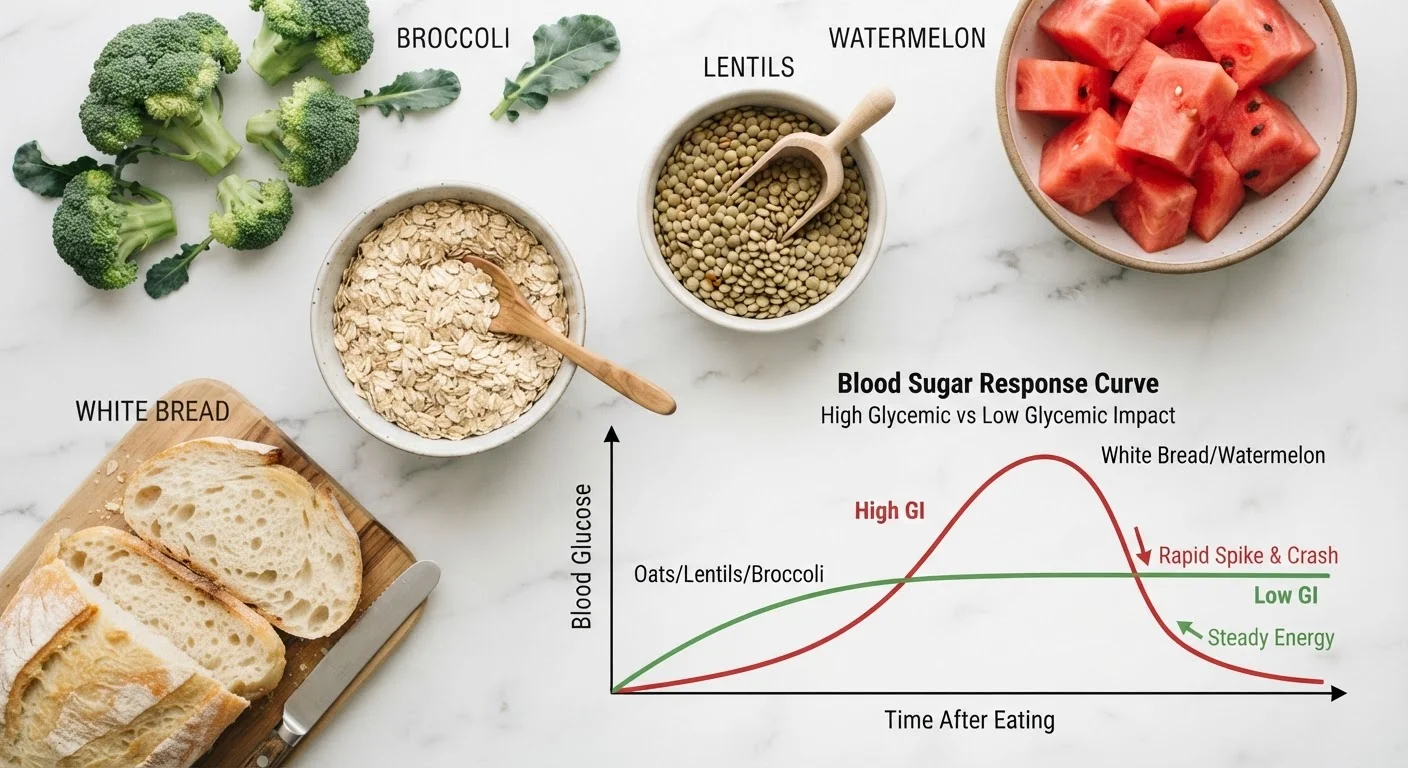
The glycaemic index is a numerical scale, typically from 0 to 100, that ranks carbohydrate-containing foods based on how quickly they raise blood glucose levels after eating. Pure glucose is used as the reference point and assigned a score of 100. Foods with a high GI cause a faster, sharper rise in blood sugar, while low-GI foods produce a slower, more gradual response.
GI values are determined by feeding measured portions of a food containing 50 grams of available carbohydrate to human volunteers and tracking their blood glucose response over two hours, relative to the glucose standard.
How the Glycaemic Index Was Developed
The glycaemic index was introduced in the early 1980s by Dr. David Jenkins and colleagues at the University of Toronto as a way to quantify how different carbohydrate-containing foods affect blood sugar. Before GI, the prevailing assumption was simple: sugars raised blood glucose quickly and starches raised it slowly. Systematic testing revealed the picture was far more complex.
To generate a GI score, researchers give test subjects a portion of food containing 50 grams of digestible carbohydrate, then measure blood glucose at intervals over two hours. That response is compared to the response from consuming 50 grams of pure glucose. The result is expressed as a percentage - a food with a GI of 50 triggers roughly half the glucose response of pure glucose.
This research-derived framework has since been adopted widely in nutrition science, public health guidance, and food labelling initiatives, though its practical application remains more nuanced than a single number might suggest.
What the GI Score Actually Tells You
A GI score tells you one specific thing: the relative speed at which a standardised portion of a food raises blood glucose compared to glucose itself. That is genuinely useful information - particularly for understanding how different carbohydrate foods are metabolised.
0-55
Low glycaemic index range
Foods in this range are considered low GI according to the classification system developed by GI researchers and used in nutrition science.
70+
High glycaemic index threshold
Foods scoring 70 or above on the GI scale are classified as high GI, indicating a faster blood glucose response relative to pure glucose.
~20%
Individual GI variation range
Research indicates that GI values for the same food can vary by roughly 20% or more between individuals due to biological differences.
For example, rolled oats have a GI of approximately 55 (low), while white bread scores around 75 (high), and boiled white rice falls somewhere in the middle. These differences reflect how readily the carbohydrates in each food are broken down and absorbed into the bloodstream.
For context around carbohydrate quality more broadly, see our article on dietary fibre and why it matters - fibre content is one of the key factors that influences a food's GI score.
Where the Glycaemic Index Falls Short
Despite its utility, GI has well-documented limitations that make it an incomplete tool when used in isolation.
- Portion size is ignored. GI is calculated from a fixed 50g carbohydrate load, which often doesn't match realistic serving sizes. Watermelon has a high GI of around 72, but a typical portion contains so little carbohydrate that its actual blood sugar impact is modest. This is why researchers developed glycaemic load (GL), which multiplies GI by the grams of carbohydrate per serving.
- Food combinations change the picture. Eating carbohydrates alongside fats, proteins, or fibre significantly slows digestion and blunts glucose spikes. GI scores are measured for individual foods eaten in isolation - not as part of a mixed meal.
- Cooking and ripeness matter. A ripe banana has a higher GI than an unripe one. Al dente pasta has a lower GI than overcooked pasta. These variables mean published GI scores are averages across conditions.
- Individual responses vary. Emerging research, including work published in the journal Cell, has demonstrated that two people eating identical foods can have dramatically different blood glucose responses, shaped by gut microbiome, genetics, and metabolic factors.
“The glycaemic index is a useful concept, but people should not think of it as the be-all and end-all of diet quality. The overall dietary pattern matters far more than any single food's GI score.”
— Walter Willett, Professor of Epidemiology and Nutrition, Harvard T.H. Chan School of Public Health
Understanding how to interpret a food's full nutritional profile - beyond GI - is covered in our guide to reading nutrition labels.
Using GI as One Tool Among Many
The glycaemic index is best understood as one dimension of nutritional information, not a comprehensive health verdict. A food with a low GI score is not automatically nutritious - and a food with a high GI score is not automatically harmful. Nutrient density, fibre content, protein, healthy fats, vitamins, and minerals all factor into a food's overall contribution to health.
For most people, focusing on whole foods, adequate fibre intake, and balanced meals will naturally moderate blood glucose responses - without needing to calculate GI values for every food. For individuals managing conditions such as type 2 diabetes or insulin resistance, GI can be a valuable part of a broader conversation with a registered dietitian or healthcare provider.
The science of nutrition is rarely reducible to a single number, and GI is no exception. Treating it as educational context rather than a prescriptive rule tends to be the most balanced approach.
This article is for general informational and educational purposes only and does not constitute medical or dietary advice. Consult a qualified healthcare professional or registered dietitian for guidance tailored to your individual health needs.