

Key Takeaways
Why Small Bathrooms Reward Targeted Upgrades
A small bathroom is one of the most rewarding rooms to improve. Because the square footage is limited, each change - a better light fixture, a larger mirror, coherent hardware - registers immediately. You don't need a full gut renovation to make a meaningful difference. In fact, targeted low-disruption upgrades often deliver better returns on both time and money than major overhauls.
This list focuses on changes that most homeowners (and many renters) can complete without contractors, permits, or weeks of disruption. Each one addresses a real functional or visual weakness common to compact bathrooms. If you're considering something more extensive, our complete guide to renovation planning is a useful reference before committing to larger scope.
Start with a single-afternoon project
If you're unsure where to begin, recaulking and replacing hardware are ideal first projects - they're inexpensive, reversible, and deliver immediate visual results. Completing one visible improvement often builds the momentum to tackle more.
Six Upgrades Worth Doing
Upgrade Your Lighting Strategically
Poor lighting is one of the most common complaints in small bathrooms - and one of the easiest to fix. A single overhead fixture often creates flat, shadowy light that makes the room feel cave-like. Consider adding a wall-mounted sconce on either side of the mirror instead of, or in addition to, overhead lighting. Side-mounted lights reduce unflattering shadows and make the space feel more open and finished.
If you're not ready to rewire, plug-in sconces with a cord cover offer a surprisingly convincing alternative. For overhead fixtures, switching to a brighter LED bulb with a color temperature around 3000-3500K (warm white) improves the room's atmosphere without touching wiring. Always consult a licensed electrician for any hardwired changes - bathroom circuits have specific safety requirements under the National Electrical Code.
Side-mounted mirror lighting eliminates shadows and makes small bathrooms feel instantly more polished.
Maximize the Mirror
A larger mirror isn't just a vanity feature - it actively makes a bathroom feel bigger by reflecting light and depth. If your current mirror is a small builder-grade rectangle, replacing it with one that spans most of the vanity width is a low-effort, high-impact swap. No tile work, no plumbing - just new hardware on the wall.
For renters or those avoiding wall damage, an oversized leaning mirror placed on the counter or against a wall achieves a similar effect. Frameless mirrors tend to read as more spacious; framed options can add character. Either way, the reflective surface does real work in a tight room. Our guide on what actually makes rooms feel more spacious explores why mirrors and light beat many popular space tricks.
A full-width mirror over the vanity is one of the cheapest ways to visually double a bathroom's space.
Go Vertical with Storage
Floor space is precious in a small bathroom. The solution is almost always to look up. Floating shelves installed above the toilet - a zone that's typically wasted - can hold towels, toiletries, and decorative items without encroaching on usable floor area. A slim over-door organizer adds comparable capacity with zero wall anchors.
Recessed medicine cabinets offer another option: they replace a flat mirror while adding concealed storage without protruding into the room. Many can be surface-mounted if cutting into the wall isn't feasible. For renters, tension-pole corner shelving units work surprisingly well and leave no marks. When planning wall-mounted shelves, always locate studs or use appropriate hollow-wall anchors rated for the load - bathroom shelves carrying bottles and jars need secure fixing.
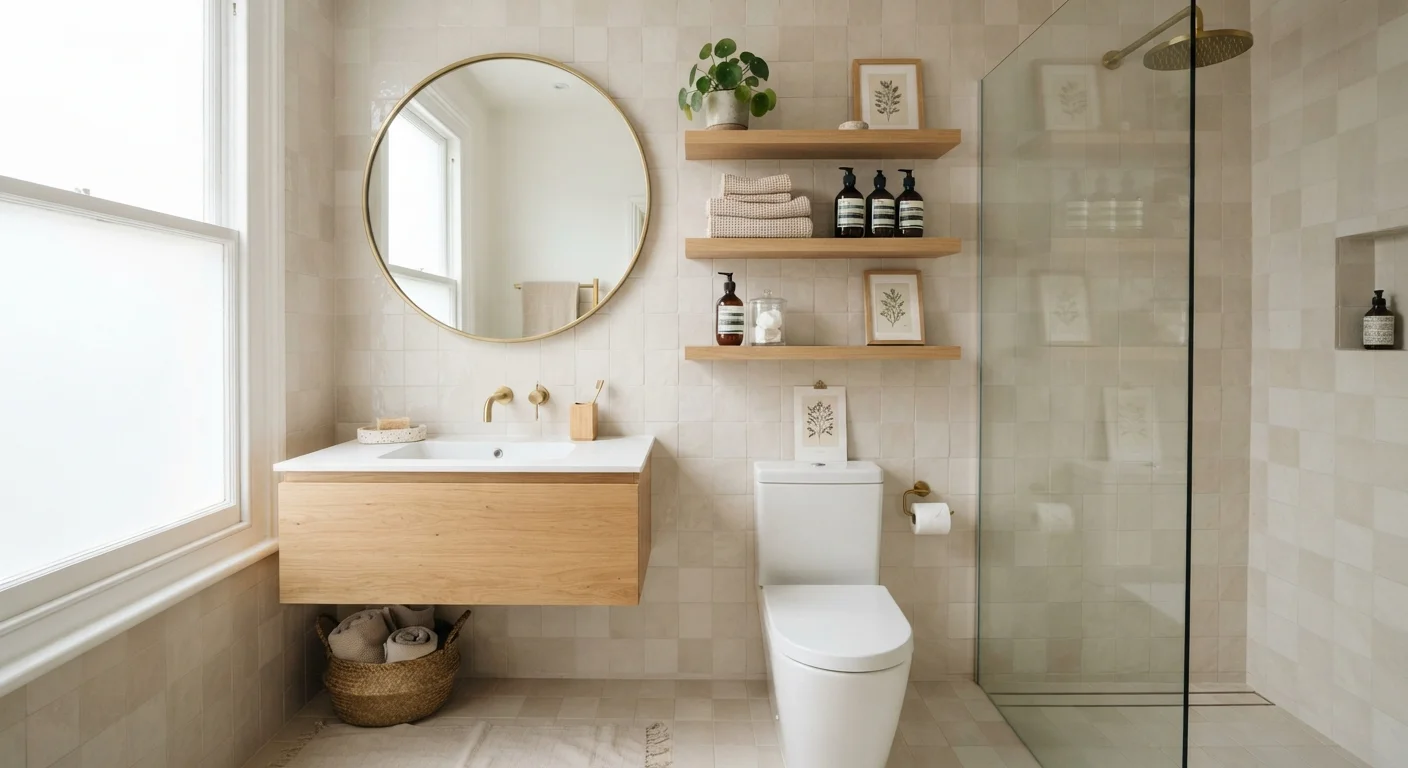
The space above the toilet is prime vertical real estate that most small bathrooms completely ignore.
Regrout, Recaulk, and Refresh
Worn grout and cracked caulk make a bathroom look tired regardless of its size or fixtures. Regrouting tile - or even cleaning and sealing existing grout - can make a dated bathroom look freshly renovated. Grout pens are an accessible starting point for minor discoloration; for significant deterioration, removing and replacing grout with a grout saw and fresh mix is a manageable weekend project.
Caulk around the tub, shower base, and vanity backsplash should be replaced whenever it shows cracking, peeling, or discoloration. Fresh caulk costs a few dollars and takes an afternoon. Our weekend caulking guide covers the technique in detail. Beyond aesthetics, intact caulk prevents water intrusion that can cause serious structural damage over time - making this one of the most practical upgrades on this list.
Fresh caulk and clean grout can make a bathroom look renovated without changing a single fixture.
Swap Hardware and Fixtures
Towel bars, toilet paper holders, cabinet pulls, and faucets are easy to overlook - but dated or mismatched hardware pulls the whole room down visually. Replacing these items requires only basic tools and no permits. Choosing a consistent finish (brushed nickel, matte black, oil-rubbed bronze) across all hardware immediately unifies the space and signals intentional design.
Faucet replacement is a slightly larger project but still within reach for most confident DIYers - particularly with modern push-fit supply lines. If you're uncertain about any connection involving water supply lines or shutoff valves, it's worth having a licensed plumber handle it to avoid leaks. Small changes like a new toilet seat, a matching soap dispenser, or coordinated towels complete the effect at minimal cost.
Mismatched hardware is one of the most overlooked reasons a bathroom feels unfinished - and the easiest to fix.
Use Paint and Removable Wallpaper Wisely
Color choice genuinely affects how a small bathroom feels. Light, cool neutrals - soft whites, pale grays, warm creams - reflect light and keep the space feeling open. That said, a single bold accent wall (especially behind the vanity mirror) can add personality without overwhelming a small room. Bathroom-specific paint with mildew resistance is worth selecting, given the humidity these spaces endure.
For renters or those unwilling to commit to a full paint job, peel-and-stick removable wallpaper has improved substantially in quality. Applied to a single wall or the interior of a niche, it adds texture and pattern without permanent alteration. Our rental-friendly decorating ideas article covers this and similar reversible approaches in more depth.
Bathroom-specific paint with mildew resistance is a practical choice that most general decorating advice overlooks.
When to Call a Professional
Most upgrades on this list are DIY-friendly, but some bathroom work falls outside safe DIY territory. Any changes to electrical circuits, plumbing supply lines, or load-bearing walls require licensed professionals and, in many jurisdictions, permits. Always verify local building codes before starting work that goes beyond surface-level improvements. The cost of professional help is almost always less than the cost of fixing an unsafe shortcut.
Putting It All Together
You don't need to tackle all six upgrades at once. Prioritize by what bothers you most: if the room feels dark, start with lighting. If storage is the problem, go vertical first. Working through improvements incrementally - and choosing ones that don't require undoing previous work - keeps the process manageable and the results cumulative.
The principles that apply here translate to other rooms as well. For broader decorating context, our guide to styling small living rooms covers similar layout and spatial thinking for other constrained spaces. A thoughtful approach to a small bathroom consistently outperforms a hasty renovation - and leaves you with a room that genuinely works for daily life.