

Key Takeaways
Creates hard spending limits by design
Once the envelope is empty, the decision is made for you. This removes the temptation to rationalize small overages that quietly derail monthly budgets.
Makes spending feel tangible and real
Physically handling cash activates a stronger psychological response than digital payments. Research in consumer behavior consistently shows that cash payments tend to be more deliberate than card transactions.
Simple enough to start without tools
You need only envelopes, a pen, and your paycheck. No app subscription, no learning curve - making it accessible regardless of tech comfort level.
Naturally prevents category overspending
Unlike a general budget you review at month-end, envelope budgeting flags overspending before it happens, since the envelope empties in real time as you spend.
Builds category-level spending awareness
Allocating money into labeled categories forces you to think about how much you actually spend on groceries, gas, or dining - often revealing patterns people haven't noticed before.
Cumbersome in a cashless-payment world
Most everyday spending now happens by card, app, or online transfer. Maintaining physical cash envelopes requires regular ATM trips and deliberate cash management that feels out of step with modern life.
Doesn't cover fixed bills naturally
Rent, insurance, and loan payments don't fit neatly into envelopes since they're usually paid digitally. The method works best alongside a separate system for fixed recurring expenses.
Time-intensive to set up and maintain
Sorting cash each payday, reconciling envelopes, and making change when categories overlap takes consistent effort - a barrier that leads many people to quit after the first month.
Carrying cash poses security risks
Lost or stolen cash is not recoverable the way a blocked debit card can be. People relying on large amounts of physical cash for monthly spending take on a real financial risk.
Inflexible when genuine needs shift mid-month
An unexpected car repair or medical co-pay may require robbing one envelope to fund another, which can feel like the system is broken even when it's working as intended.
Our Verdict
Envelope budgeting remains a genuinely effective method for people who struggle with overspending in variable categories. Whether you use physical cash or a digital equivalent, the underlying discipline of allocating money before you spend it is its true strength. The system does require consistent effort and works best when paired with a clear picture of your income and fixed expenses.
Best for people who frequently overspend in day-to-day categories and want a concrete, visual system to regain control of their discretionary spending.
How the Envelope Method Works
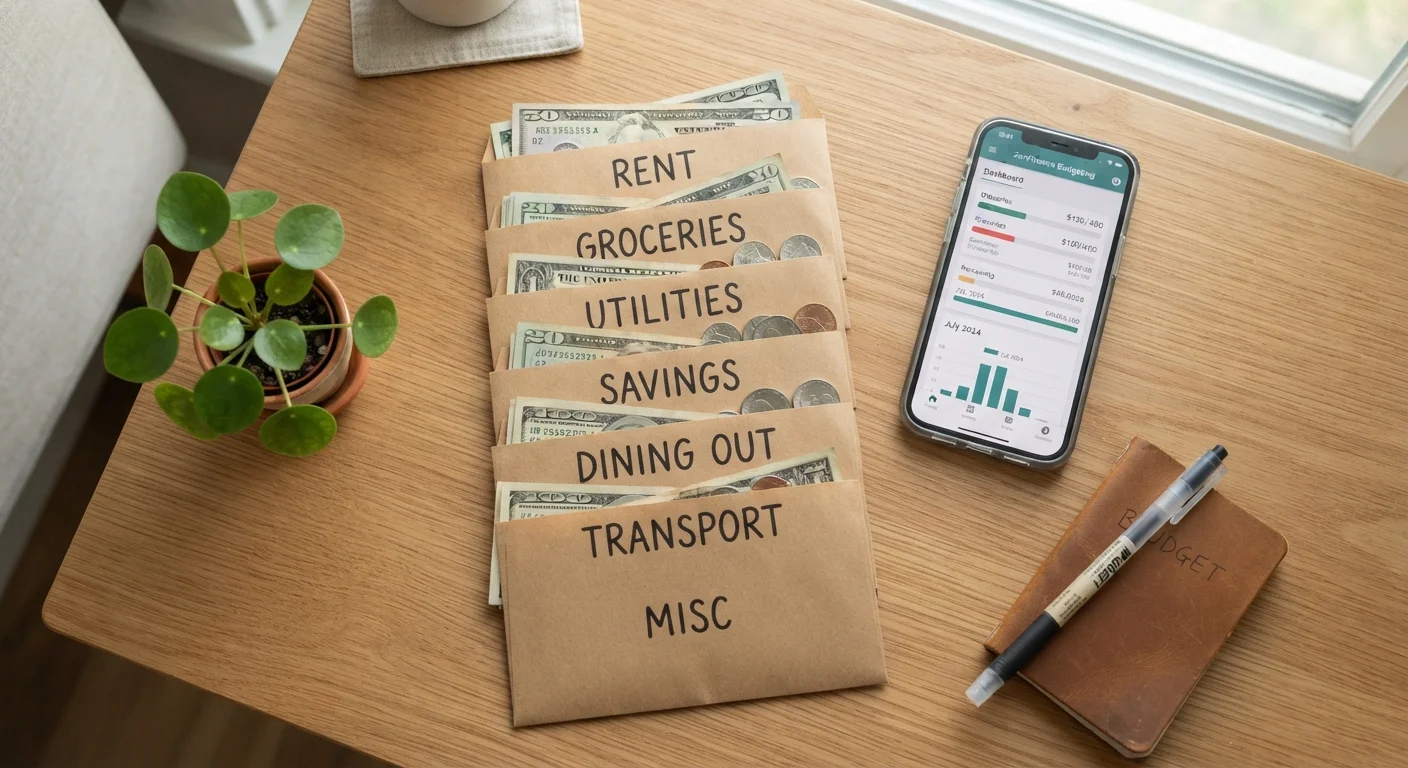
The envelope budgeting method is straightforward in design. Each payday, you divide your income into physical envelopes - one for each spending category, such as groceries, gas, dining out, and entertainment. You only spend what's in each envelope. When an envelope is empty, spending in that category stops until the next pay period.
The system was popularized in an era of cash-dominant spending, but its logic is rooted in a timeless idea: money you can see and touch feels more real than numbers on a screen. This tangible connection is what gives the method its behavioral edge over looser tracking approaches.
If you're newer to budgeting and want to understand foundational terms like discretionary spending or net income, the budgeting glossary covers these clearly before you build any system. For a broader look at how envelope budgeting compares to other frameworks, see popular budgeting methods compared.
The Real Advantages of Envelope Budgeting
Envelope budgeting's staying power comes from several concrete strengths that many other methods don't replicate as naturally.
Creates hard spending limits by design
Once the envelope is empty, the decision is made for you. This removes the temptation to rationalize small overages that quietly derail monthly budgets.
Makes spending feel tangible and real
Physically handling cash activates a stronger psychological response than digital payments. Research in consumer behavior consistently shows that cash payments tend to be more deliberate than card transactions.
Simple enough to start without tools
You need only envelopes, a pen, and your paycheck. No app subscription, no learning curve - making it accessible regardless of tech comfort level.
Naturally prevents category overspending
Unlike a general budget you review at month-end, envelope budgeting flags overspending before it happens, since the envelope empties in real time as you spend.
Builds category-level spending awareness
Allocating money into labeled categories forces you to think about how much you actually spend on groceries, gas, or dining - often revealing patterns people haven't noticed before.
~1 in 3
US adults without a monthly budget
According to a Gallup survey, roughly one-third of American adults do not maintain any kind of household budget, highlighting how many people could benefit from structured spending systems.
Up to 20%
More spent when paying by card vs. cash
Consumer behavior studies have found that people can spend meaningfully more when using cards compared to cash, supporting the behavioral argument for physical envelope budgeting.
The system also creates a natural check-in rhythm. Opening an envelope mid-month and seeing only $12 left for groceries is a hard, immediate signal - no spreadsheet math required. That instant feedback loop is difficult to replicate with passive bank statement reviews.
The Drawbacks You Should Know
Despite its strengths, envelope budgeting has meaningful limitations that cause many people to abandon the method after a few weeks.
Cumbersome in a cashless-payment world
Most everyday spending now happens by card, app, or online transfer. Maintaining physical cash envelopes requires regular ATM trips and deliberate cash management that feels out of step with modern life.
Doesn't cover fixed bills naturally
Rent, insurance, and loan payments don't fit neatly into envelopes since they're usually paid digitally. The method works best alongside a separate system for fixed recurring expenses.
Time-intensive to set up and maintain
Sorting cash each payday, reconciling envelopes, and making change when categories overlap takes consistent effort - a barrier that leads many people to quit after the first month.
Carrying cash poses security risks
Lost or stolen cash is not recoverable the way a blocked debit card can be. People relying on large amounts of physical cash for monthly spending take on a real financial risk.
Inflexible when genuine needs shift mid-month
An unexpected car repair or medical co-pay may require robbing one envelope to fund another, which can feel like the system is broken even when it's working as intended.
It's also worth noting that the method doesn't inherently help you grow savings or invest - it focuses on spending control, not wealth building. For a fuller financial plan, envelope budgeting is usually one layer among several, not a complete solution.
Do Digital Envelope Apps Actually Work?
Several budgeting apps replicate the envelope structure without requiring physical cash. These tools let you create virtual "envelopes" or categories funded from your account balance, and they track spending against each allocation in real time.
What to Look for in a Digital Envelope App
When evaluating digital envelope tools, look for features like automatic transaction syncing, the ability to set category caps, and rollover controls that let you carry unused funds forward. Many tools also allow you to set up multiple accounts within one household budget, which can be useful for shared finances. Because apps vary widely in data-sharing practices, review the privacy policy before linking your bank account.
Digital envelope systems remove most of the friction of the cash-only approach. You can pay by card, split a restaurant bill normally, and still have your spending deducted from the appropriate virtual envelope automatically. This makes the method workable for everyday modern spending.
The trade-off is that the psychological weight of handing over physical cash disappears. Tapping a card doesn't feel like the same commitment, which can reduce the behavioral impact that makes the original method effective. Whether the digital version works for you depends largely on how disciplined you are when cash isn't physically leaving your hands.
For a direct side-by-side comparison, cash envelopes vs. digital budget categories walks through when each format tends to work best. And if you're weighing envelope budgeting against structured percentage-based approaches, the 50/30/20 rule vs. zero-based budgeting offers a useful contrast.
This article is for general informational purposes only and does not constitute personalized financial advice. Consult a qualified financial professional for guidance tailored to your individual circumstances.