
Cash Envelopes vs. Digital Budget Categories: Choosing the Right System for You

Key Takeaways
Option A
Cash Envelopes
The tactile, analog method that makes spending limits feel real.
Best for: People who overspend on discretionary categories and benefit from a physical, visual spending limit.
Option B
Digital Budget Categories
The flexible, tech-powered approach for modern, card-based spending.
Best for: People who manage most expenses digitally and want real-time tracking without handling physical cash.
If you regularly overspend on groceries, dining out, or entertainment
Cash Envelopes
Physical cash creates a firm ceiling. When the envelope is empty, spending in that category stops - no exceptions and no workarounds.
If most of your spending runs through debit cards, credit cards, or auto-pay
Digital Budget Categories
Trying to convert card-based expenses to cash adds friction without adding value. Digital categories track these transactions automatically and accurately.
If you're building a budget for the first time and want simplicity
Cash Envelopes
No apps, no setup, no syncing - just labeled envelopes and a spending limit. The straightforward structure helps new budgeters stay consistent early on.
If you travel frequently or manage household bills alongside variable spending
Digital Budget Categories
Digital systems handle subscriptions, utility estimates, and irregular expenses in one view, something physical envelopes can't replicate cleanly.
If you've tried budgeting before but never stuck with it
Cash Envelopes
The tangible nature of cash spending tends to improve follow-through. Starting with just two or three envelope categories keeps the system manageable.
How Each System Actually Works
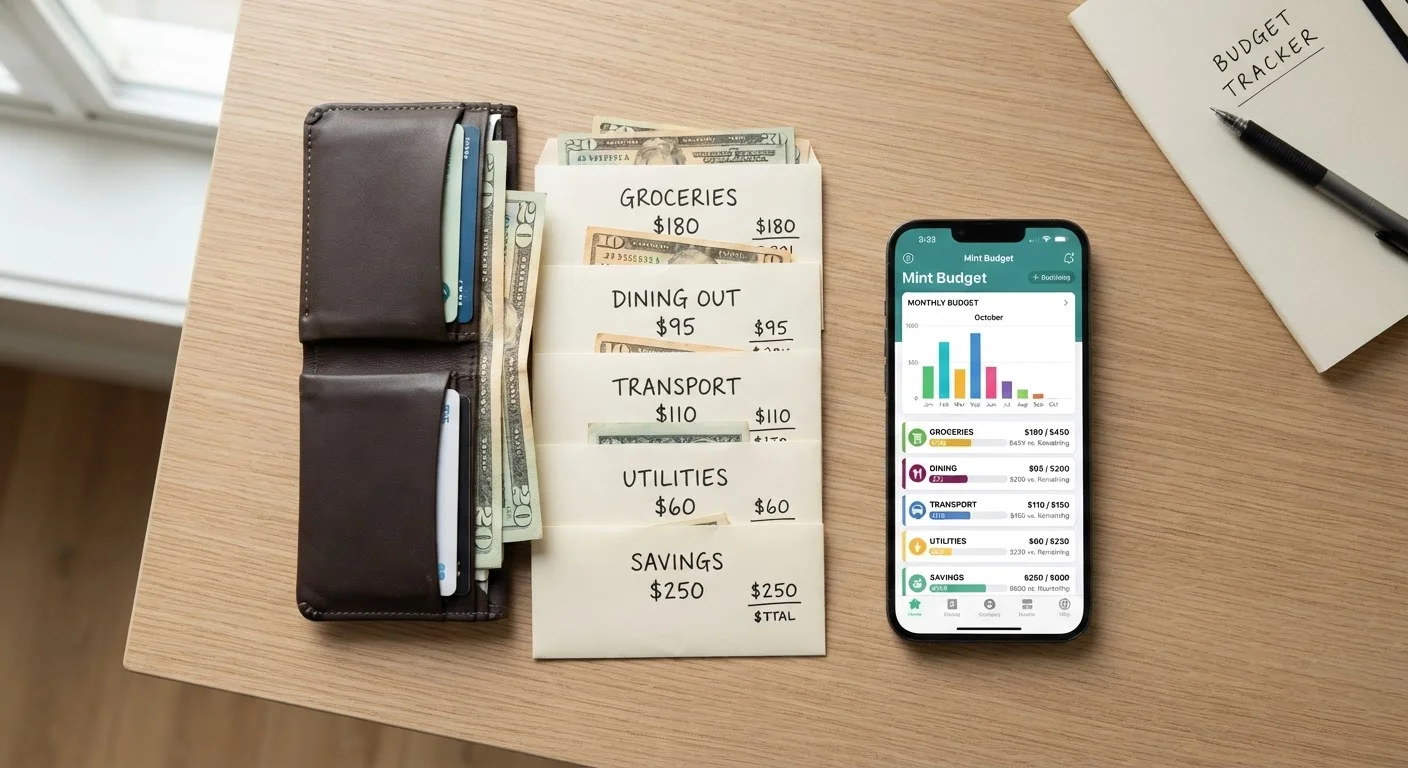
The cash envelope method divides your spending money into physical envelopes, one per category. Common categories include groceries, gas, dining out, and personal spending. You fund each envelope at the start of a pay period, and when the cash is gone, that category is closed until the next funding cycle. No transfers, no overdrafts - the limit is structural.
Digital budget categories work on the same underlying principle - allocating a set dollar amount to each spending area - but exist entirely in software. Apps and spreadsheets connect to your bank accounts or allow manual transaction entry, automatically sorting spending into pre-defined categories and showing real-time balances. The logic mirrors the envelope system, but the execution is screen-based and card-compatible.
Both methods reflect a broader zero-based budgeting philosophy: every dollar gets assigned a job before it's spent. If you're weighing full budgeting frameworks beyond just the tracking method, comparing zero-based budgeting with the 50/30/20 rule can help clarify which structure fits your financial situation.
Head-to-Head: Key Differences
The two systems diverge most sharply in how they enforce limits and handle modern payment habits. Here's a direct comparison across the dimensions that matter most for everyday use.
| Criterion | Cash Envelopes | Digital Budget Categories |
|---|---|---|
| Spending limit enforcement | Automatic - empty envelope stops spending | Awareness-based - alerts, but no hard stop |
| Works with card payments | No - cash only | Yes - syncs with cards and bank accounts |
| Setup time | Low - envelopes and cash only | Moderate - app setup, account linking |
| Handles fixed bills/autopay | Poorly - not practical | Well - tracks all transaction types |
| Psychological friction on spending | High - cash feels tangible | Low - digital transactions feel abstract |
| Historical data and reporting | None - manual tracking only | Strong - charts, trends, category history |
| Best budget phase | Starting out or breaking overspending habits | Maintaining and optimizing an established budget |
One nuance worth noting: cash envelopes work best for discretionary, variable spending - the categories where overspending is most common. They're not practical for bills paid by autopay, online subscriptions, or rent. Digital categories, by contrast, handle both fixed and variable expenses equally well, but they rely entirely on the user's willingness to review and respond to data rather than feeling a physical constraint.
The Psychology Behind Each Method
Research in behavioral economics consistently finds that people spend less when using physical cash compared to cards. The act of handing over bills registers as a more concrete loss than a card swipe, which creates a natural brake on discretionary spending. This effect - sometimes called the "pain of paying" - is the primary reason cash envelopes remain effective even in a largely cashless society.
83%
Higher spending with cards vs. cash
A widely cited MIT study found participants were willing to spend significantly more when paying by credit card compared to cash in auction settings, illustrating the pain-of-paying effect.
~$200
Average monthly discretionary overspend
A recurring finding across consumer financial surveys is that most households underestimate variable discretionary spending by $150-$250 per month before tracking it formally.
Digital systems don't replicate this friction, but they offer something different: transparency and historical data. Seeing a month of categorized spending in one view can be genuinely revelatory, particularly for people who underestimate how much small recurring expenses accumulate. A $6 daily coffee purchase, for instance, becomes much more visible as a $180 monthly line item in a budget dashboard.
For a detailed look at how the envelope method holds up in today's card-first world - including whether digital envelope apps bridge the gap - envelope budgeting in a digital world examines the method's real strengths and limits in depth.
Mixing Both Systems - and Choosing What Sticks
For many households, the most effective approach isn't a binary choice. A practical hybrid uses cash envelopes for two or three high-risk discretionary categories - the ones where past budgets have broken down - while managing fixed bills, subscriptions, and online purchases through a digital system. This captures the psychological benefit of cash where it matters most, without the impracticality of carrying envelopes for everything.
Regardless of which method you use, the habit that drives results is the same: reviewing your spending regularly and adjusting category amounts when life changes. A budget that worked six months ago may need recalibrating after a pay change, a new expense, or a shift in priorities.
If you're still exploring which broader framework makes the most sense for your income and goals, a comparison of popular budgeting methods covers the full range of approaches - from pay-yourself-first to value-based budgeting - and what each suits best.
This article is for general informational and educational purposes only and does not constitute personalized financial advice. Consult a licensed financial professional for guidance specific to your situation.