
Reading Your Cat's Body Language: What Tail Position, Ears, and Eyes Are Telling You

| Primary communication mode | Posture, movement, and facial expression |
| Number of distinct ear positions | Roughly 32 individual ear muscle positions documented (Animal behavior research) |
| Slow blink function | Signals relaxation and trust; reinforces social bond (Scientific Reports, 2020) |
| Tail-up greeting | Indicates friendly, confident social approach |
| Belly exposure meaning | High trust signal - not necessarily an invitation to touch |
Why Feline Body Language Is Its Own Language
Cats communicate primarily through posture, movement, and subtle facial cues rather than vocalizations. Understanding this silent vocabulary helps you respond appropriately to your cat's needs - whether that's offering reassurance, stepping back to give space, or recognizing when something might be wrong. Unlike dogs, cats evolved as both predator and prey, which shapes a communication style built on restraint and nuance.
Body language signals rarely appear in isolation. A single flattened ear means far less than flattened ears combined with a low tail and constricted pupils. Read your cat as a whole picture, not a checklist. If you're ever uncertain whether a behavioral shift reflects emotion or health, recognizing the subtle signs that warrant a vet visit is a useful next step.
| Primary communication mode | Posture, movement, and facial expression |
| Number of distinct ear positions | Roughly 32 individual ear muscle positions documented (Animal behavior research) |
| Slow blink function | Signals relaxation and trust; reinforces social bond (Scientific Reports, 2020) |
| Tail-up greeting | Indicates friendly, confident social approach |
| Belly exposure meaning | High trust signal - not necessarily an invitation to touch |
Tail Position: The Mood Barometer
The tail is one of the most expressive parts of a cat's body. Each position carries consistent meaning across most domestic cats.
- Tail held high, tip slightly curved: Confidence and a friendly greeting. A cat approaching with a high, gently hooked tail is typically relaxed and social.
- Tail quivering upright: Intense positive excitement - often seen when greeting a trusted person or just before spraying, so context matters.
- Tail tucked low or between legs: Fear, submission, or discomfort. A cat in this posture wants to appear smaller and less threatening.
- Tail puffed (piloerection): Fear or aggression. The cat is trying to look larger in response to a perceived threat.
- Slow, wide tail lashing: Agitation or conflict - a signal to disengage before the cat escalates.
- Gentle, rhythmic tail tip twitching: Mild interest or concentration, often seen while a cat watches prey or a moving object.
Tail signals differ markedly between species. Dogs communicate tail position and wag speed quite differently, so don't transpose canine interpretations onto cats.
Ears and Eyes: The Emotional Close-Up
Ear positions shift rapidly and convey emotion with precision:
- Forward and upright: Alert, curious, engaged - the cat is paying positive attention.
- Rotated sideways ("airplane ears"): Anxiety or mild irritation. This is an early warning before more obvious defensive signals appear.
- Flat against the skull: Fear or defensive aggression. Do not attempt to handle a cat with fully flattened ears.
Pupil size is equally revealing, though it must be interpreted alongside lighting conditions:
- Slow blink: Relaxation and trust. Returning a slow blink to your cat is widely recognized by animal behaviorists as a way to reinforce social bonding.
- Fully dilated pupils in normal light: Fear, excitement, or high arousal - context determines which.
- Constricted pupils with a tense body: Offensive aggression. A cat with narrow pupils and a rigid posture is signaling readiness to act.
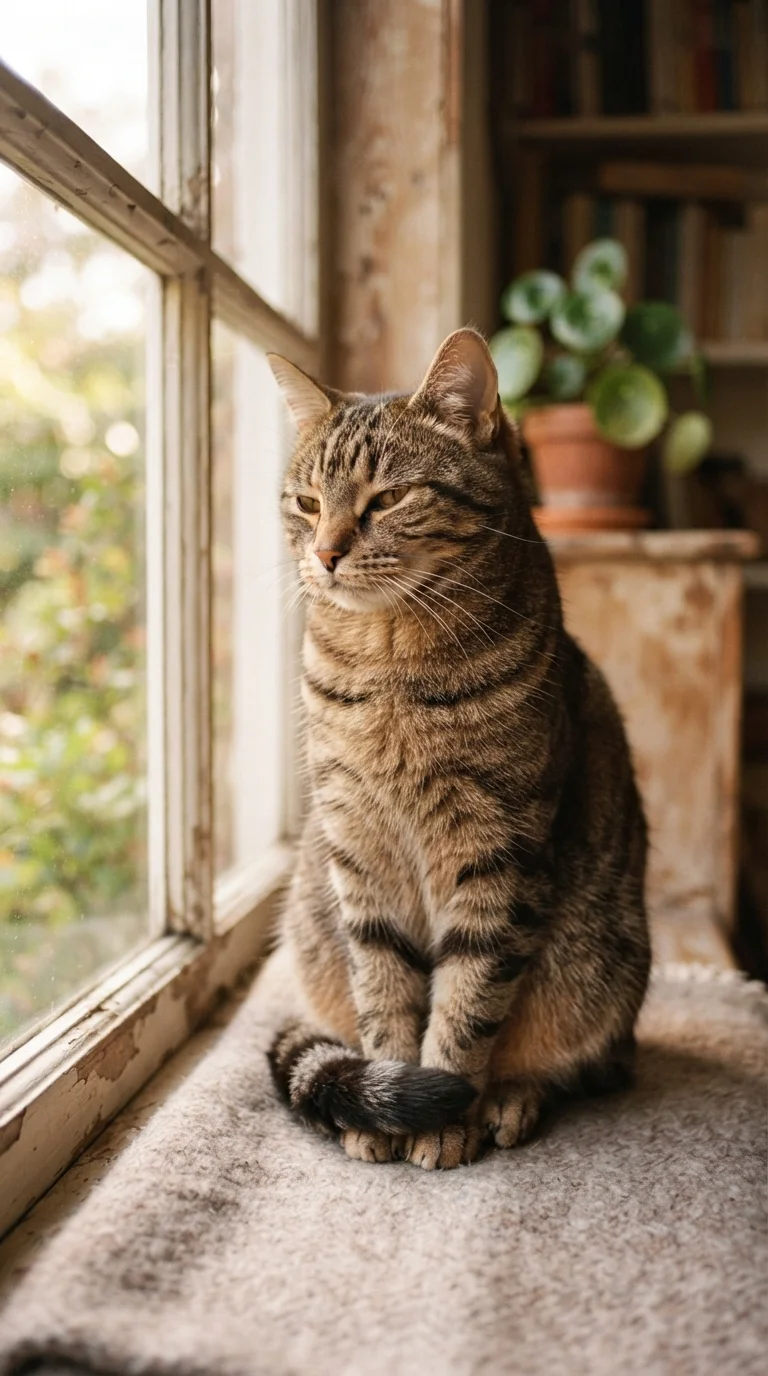
- Half-closed, soft eyes: Contentment and ease.
Piloerection
The involuntary raising of fur along the spine and tail, making the cat appear larger. It occurs in response to fear or aggression and is controlled by the autonomic nervous system.
Affiliative behavior
Social actions that reinforce bonds between individuals, such as grooming, head-bunting, or slow blinking. In cats, these behaviors signal trust and positive social connection.
Pupil dilation
The enlargement of the dark center of the eye in response to low light, excitement, fear, or arousal. In bright conditions, dilated pupils typically indicate a strong emotional state rather than a lighting response.
Slow blink
A deliberate, relaxed closing and reopening of the eyes directed at another individual. Animal behaviorists associate it with positive emotional states and social trust between cats and their owners.
Understanding these cues becomes especially important in multi-cat households or when introducing environmental changes. For a comprehensive look at keeping cats mentally healthy, see the Indoor Cat Handbook on environment and enrichment. And if your cat's body language frequently suggests stress, understanding the causes and evidence-informed ways to help is the logical follow-up.
Overall Posture: Reading the Whole Body
Individual signals gain meaning when combined with full-body posture. Key patterns to recognize:
- Loaf position (legs tucked, eyes half-closed): Contentment and security. The cat is not on alert.
- Belly exposed, legs splayed: High trust - but this does not automatically mean an invitation for a belly rub. Many cats expose their belly as a trust signal while still objecting to touch there.
- Crouched low, body tense: Fear or preparation to flee. Approach slowly and avoid direct eye contact, which cats can interpret as a threat.
- Rolling and rubbing: Social affiliative behavior, scent marking, and an invitation to interact.
Older cats may show subtler signals as mobility decreases with age. Ageing changes how cats express and experience discomfort, making it worthwhile to recalibrate your reading of a senior cat's body language over time.
This article is intended as general educational information about feline behavior and is not a substitute for professional veterinary or animal behaviorist guidance. If your cat shows sudden or significant changes in behavior, consult a licensed veterinarian.