

Key Takeaways
Why Indoor Living Requires Active Management
Cats kept exclusively indoors are protected from many serious hazards - traffic, predators, infectious disease spread by feral populations, and parasite exposure. Studies consistently indicate that indoor cats have significantly longer average lifespans than cats with outdoor access. For a deeper look at those trade-offs, see our comparison of indoor and outdoor cat lifestyles.
However, removing outdoor access also eliminates a major source of physical exercise, sensory novelty, and instinct-driven behavior. Without deliberate environmental design and owner involvement, an indoor cat is at meaningful risk of obesity, muscle loss, boredom-driven stress, and associated behavioral problems. The home environment must work harder to compensate - and that requires a structured, consistent approach from the owner.
10-15 yrs
Average indoor cat lifespan
Veterinary sources broadly cite indoor cats living 10-15 years on average, compared to 2-5 years for feral or fully outdoor cats.
~50%
US cats estimated to be overweight
The Association for Pet Obesity Prevention has estimated that approximately half of domestic cats in the US are overweight or obese.
2×/day
Recommended interactive play sessions
Feline behaviorists widely recommend two interactive play sessions of 10-15 minutes daily to meet a typical indoor cat's activity needs.
Designing a Cat-Friendly Space
Cats are three-dimensional animals. In the wild, height provides both predatory advantage and escape from threats. Replicating that in a home means offering vertical space - cat trees, wall-mounted shelves, and stable furniture cats can climb safely. Aim for multiple height levels accessible from different entry points so cats have genuine choice.
Equally important are hiding and resting spots. Cats need enclosed or semi-enclosed spaces where they can retreat without being disturbed. Covered beds, cardboard boxes, and enclosed cat furniture all serve this function. Providing at least one hiding spot per cat reduces low-level stress substantially.
Scratching surfaces must be available in multiple locations - both vertical posts and horizontal pads - because scratching is a marking behavior tied to territory, not simply nail maintenance. Inadequate scratching outlets result in furniture damage and chronic frustration.
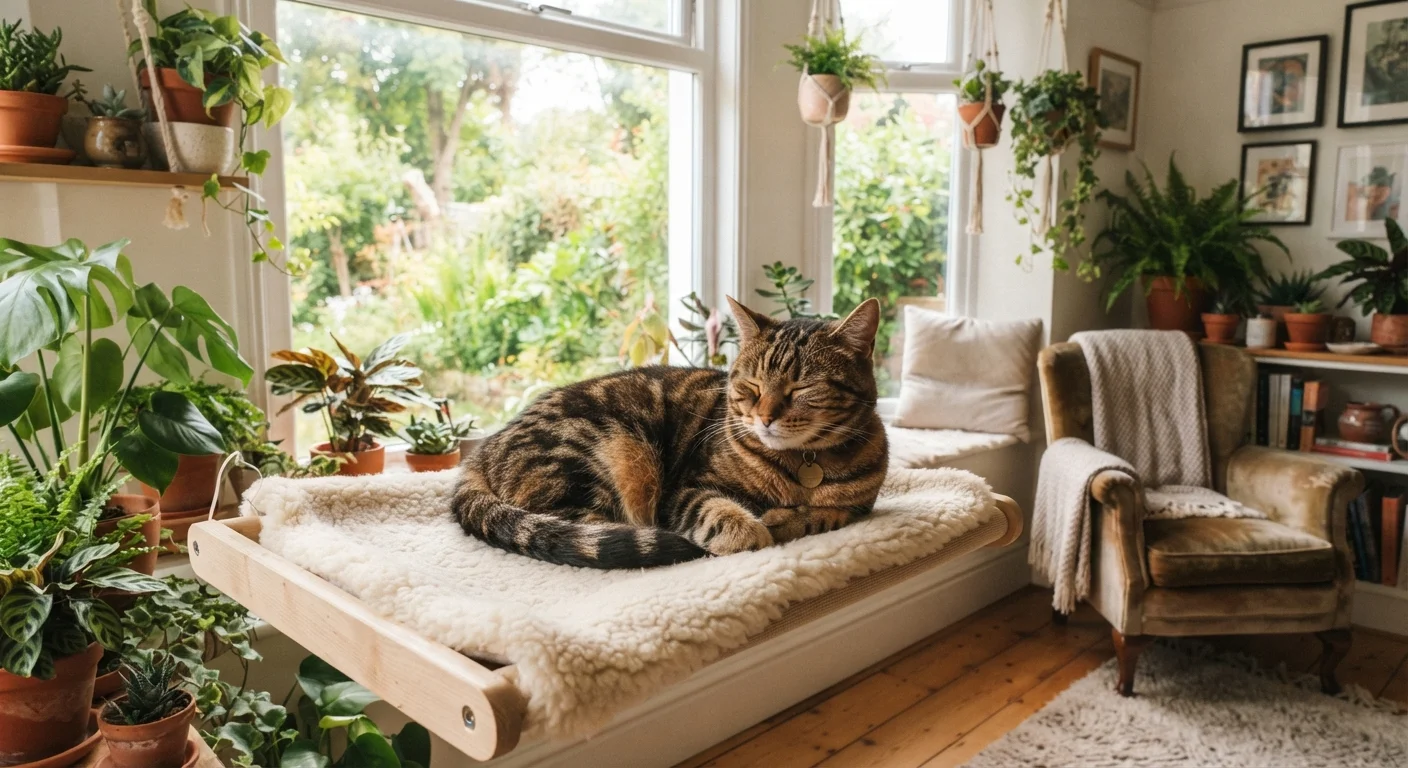
Window access is underappreciated. A perch near a window with an outdoor view provides hours of passive sensory stimulation, particularly if a bird feeder is positioned nearby. If you keep indoor plants, ensure all species are non-toxic to cats; the ASPCA maintains a well-regarded reference list of toxic and non-toxic plants.
Place multiple scratching posts near spots where your cat already stretches or rests - cats scratch partly to mark territory, so placement next to sleeping areas is more effective than tucking a post in a corner.
Cats preferentially scratch in socially significant locations. Positioning posts near resting or entry areas increases use and reduces furniture damage.
End each interactive play session by letting your cat 'catch' the toy and then offering a small food treat or meal - this completes the predatory sequence and reduces post-play restlessness.
The hunt-catch-eat sequence is hardwired in feline behavior. Interrupting it before the 'eat' phase can leave cats in a state of frustrated arousal.
Enrichment: Mental and Physical Stimulation
Enrichment is not optional for indoor cats - it is a welfare requirement. The goal is to engage a cat's predatory sequence: stalk, chase, pounce, catch, and consume. Interactive wand toys are the most effective tools for this because they allow the owner to mimic prey movement unpredictably. Two sessions per day of 10-15 minutes each is a broadly accepted baseline supported by feline behaviorists.
Puzzle feeders convert mealtime into a cognitive exercise. Even simple food puzzles slow eating (reducing regurgitation risk) and occupy a cat's problem-solving capacity. Rotating puzzle types every few weeks prevents habituation.
Rotation of toys overall is important: cats habituate quickly to static objects. Storing some toys and reintroducing them after a week or two restores novelty without cost. Scent enrichment - such as cat-safe herbs like valerian or silver vine (alternatives to catnip for cats that don't respond to it) - adds another sensory dimension.
Social play and human interaction remain central. Understanding what your cat is communicating during play and rest helps you calibrate the intensity and timing of sessions appropriately. Our article on reading your cat's body language explains the key signals to watch for. For multi-cat homes, see our multi-cat household checklist to ensure resources and space are properly distributed.
Nutrition for Indoor Cats
Indoor cats expend less energy than outdoor cats by a meaningful margin, making calorie management critical. Obesity is among the most common preventable conditions seen in indoor cats and is associated with diabetes, joint disease, and hepatic lipidosis. Feeding measured portions rather than free-feeding is the most reliable way to manage intake across all life stages.
Diet quality matters as much as quantity. Cats are obligate carnivores - they require nutrients, including taurine and arachidonic acid, that are found only in animal tissue. Our guide on what cats actually need to eat covers these requirements in detail, and our wet food vs. dry food comparison helps you choose a format that suits your cat's specific needs.
Hydration is a practical concern, particularly on dry diets. Many cats have low thirst drives and are prone to subclinical dehydration. Offering wet food, a water fountain, or multiple water stations in different locations can meaningfully increase daily water intake.
Preventive Health and Veterinary Care
A common misconception is that indoor cats don't need annual veterinary visits or core vaccinations. In reality, indoor cats can be exposed to pathogens on clothing, through open windows, or during emergency boarding situations. Core vaccines - typically feline herpesvirus, calicivirus, and panleukopenia (the FVRCP combination) - are recommended by most veterinary guidelines regardless of lifestyle.
Parasite prevention also applies indoors. Fleas can enter on owners' clothing, and intestinal parasites can be transmitted through various indirect routes. Your veterinarian can advise on an appropriate prevention protocol based on your specific situation and regional risk factors.
Dental disease is particularly prevalent in domestic cats and often goes unnoticed until it is severe. Regular oral examinations, and ideally tooth brushing with cat-safe enzymatic toothpaste, reduce long-term risk. Cats should receive a full physical exam at minimum once yearly; senior cats (broadly, those over 10-11 years) typically benefit from twice-yearly visits. For age-related adjustments to care, our article on senior cat care outlines what to expect and monitor.
Don't Skip Vet Visits for Indoor Cats
Many serious conditions in cats - dental disease, hypertension, hyperthyroidism, early kidney disease - develop silently and are only detectable through physical examination and routine bloodwork. Assuming an indoor cat is healthy because it 'doesn't go outside' delays diagnosis and treatment. Annual wellness exams are the single most effective preventive tool available to cat owners.
Recognizing Stress and Boredom Early
Behavioral changes are often the first sign that an indoor cat's needs are not being met. Common indicators include over-grooming (leading to bald patches), increased vocalization, destructive scratching beyond normal levels, house soiling outside the litter box, and sudden aggression or withdrawal.
Not all of these behaviors are purely behavioral in origin - many have medical differentials. A cat that suddenly stops using the litter box, for instance, may have a urinary tract condition. Always rule out physical causes with a veterinary assessment before attributing behavioral changes solely to environment or enrichment deficits.
Litter box management is foundational: the standard guideline is one box per cat plus one extra, scooped at minimum once daily. Covered boxes, specific litter textures, and box placement near high-traffic areas are common reasons cats reject a box. Small adjustments frequently resolve the problem.
An indoor cat that is physically healthy, mentally stimulated, and living in a well-structured environment will display relaxed, confident body language, maintain a stable weight, and engage readily with its owners. Meeting that standard is the practical benchmark for good indoor cat care.
This article provides general information for educational purposes and does not constitute veterinary advice. Always consult a licensed veterinarian for guidance specific to your cat's health and circumstances.