

The Legal Weight of a Speed Limit Sign
A statutory speed limit is a hard legal ceiling set by law. Exceeding it - regardless of conditions, traffic, or your own judgment - is a criminal traffic offense subject to fines, points on your license, or disqualification. In the United States, statutory limits are established by state law and enforced by posted signs. The most common national benchmarks are 25 mph in school zones, 55-65 mph on rural interstates, and up to 80 mph on certain western highways - but state and local authorities may post lower limits as they see fit.
Driving at or below the posted statutory limit does not automatically make you immune from enforcement. Officers can still issue citations for driving too fast for conditions - meaning that doing 55 mph on an icy freeway posted at 55 mph can still be unlawful. This "basic speed law," recognized in most states, requires drivers to travel at a speed that is reasonable and prudent given visibility, traffic, and road surface at that moment. For a deeper look at how speed translates into physical stopping distance, see our guide to stopping distances.
Advisory Speeds: Guidance, Not Law
Yellow diamond signs bearing a speed figure - often seen before sharp curves, freeway ramps, or steep descents - are advisory speed signs. They are not statutory limits. They represent the speed at which engineers determined a typical vehicle can safely navigate a specific feature under normal, dry conditions. Exceeding an advisory speed is not automatically a traffic violation, but if you exceed it and lose control, that figure becomes powerful evidence of negligent driving in any civil or criminal proceeding.
Think of advisory speeds as data, not commands. A 35 mph curve advisory means an average car, on a dry road, with an alert driver, should be comfortable at that speed. Add rain, a loaded vehicle, worn tires, or distraction, and the safe speed drops well below that figure. Our article on matching speed to road conditions explains how each weather type changes that equation specifically.
Statutory speed limit
A speed ceiling established by legislation and enforced by law. Exceeding it constitutes a traffic offense regardless of road or weather conditions.
Advisory speed
An engineering-recommended speed for a specific road feature (curve, ramp, descent) shown on yellow signs. It is not a legal limit but carries weight in collision investigations.
Variable speed limit (VSL)
An electronically displayed speed limit that changes in real time based on traffic, weather, or incidents. It carries the same legal force as a fixed statutory sign.
Basic speed law
A legal principle, recognized in most US states, requiring drivers to travel at a speed that is reasonable and prudent for current conditions, even if below the posted limit.
Time-conditional sign
A speed limit sign that is legally active only during specified hours or when specific conditions (such as flashing lights) are present, as indicated on the sign itself.
Variable Speed Limit Signs: Dynamic and Legally Binding
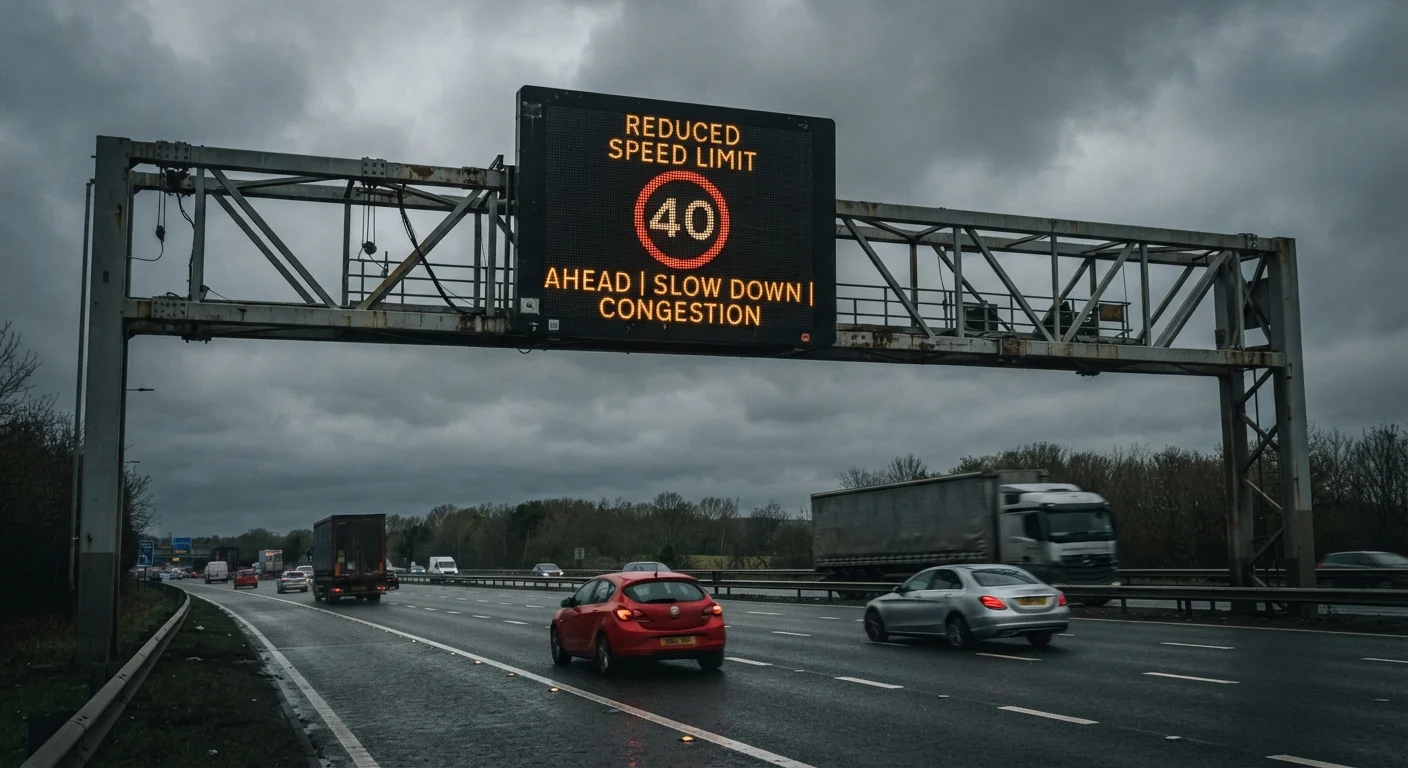
Variable speed limit (VSL) signs - also called dynamic speed limit signs - are electronic overhead displays common on managed highways, urban expressways, and work zones. Unlike fixed signs, they change in real time to reflect congestion, weather events, incidents, or construction activity. In the states and corridors where they are deployed (including portions of I-95, I-270, and several state-managed corridors), the speed displayed is legally enforceable the moment it appears, to the same degree as any fixed statutory sign.
A common driver error is treating a VSL reading lower than the fixed posted limit as merely advisory. It is not. When a variable sign reads 45 mph on a road normally posted at 65 mph, 45 mph is your legal limit at that moment. Some systems display a blank panel when the statutory maximum applies; others show the statutory maximum itself. Cameras and automated enforcement are increasingly used at VSL installations - a slower-moving traffic environment does not mean reduced monitoring.
For new or less experienced drivers heading onto high-speed roads for the first time, our motorway driving introduction covers the practical habits that make gantry signs and lane signals easier to interpret in real time.
School Zones, Work Zones, and Time-Conditional Signs
Some statutory limits only apply during specified periods, which introduces a distinct category of sign literacy. School zone limits - typically 15-25 mph - are active when children are present or during defined arrival and dismissal hours shown on the sign itself. Work zone limits apply when workers are present and are frequently doubled in fine amount by state law. Neither of these is advisory: exceeding them during their active window carries full legal consequence.
Time-conditional signs require you to read the entire sign, not just the number. A panel reading "WHEN FLASHING" means the limit is only active when the amber lights are operating. "7 AM - 4 PM SCHOOL DAYS" defines the window precisely. If in doubt, apply the lower limit - the cost of unnecessary caution is negligible compared to the cost of misreading. Understanding this kind of conditional signage is part of the broader safe-driving foundation covered in our complete safe driving resource.
Minimum Speed Limits Also Apply
Some highways post both a maximum and a minimum speed limit. Traveling significantly below the minimum - particularly on interstates and expressways - can also be a ticketable offense and creates a serious rear-end collision risk. Variable message signs may display temporary minimum speeds during congestion management operations. Always scan the full sign for both figures.