

Key Takeaways
Why Speed Limits Aren't the Whole Story
Speed limits are the law - and staying within them is non-negotiable. But limits are set for ideal conditions: dry roads, good visibility, and normal traffic flow. When conditions change, the limit stays the same. Your responsibility is to adjust.
Under US traffic law, drivers are expected to travel at a speed that is reasonable and prudent for actual conditions. That means if you're doing 55 mph in thick fog on a 55 mph road and hit something you couldn't see in time to stop, the legal limit offers no protection. You were still going too fast for conditions.
Understanding how rain, ice, fog, and glare each affect your car - and what to do about it - is a foundational safe-driving skill. See also our guide to speed limits, advisory speeds, and variable signs for a clear breakdown of what different road signs legally require.
The 'Reasonable and Prudent' Standard
Most US states require drivers to operate at a speed that is 'reasonable and prudent' for actual road and traffic conditions - regardless of the posted limit. Driving at the limit in hazardous weather doesn't automatically mean you were driving safely. Adjust based on what you can see and how much road your car actually needs to stop.
Rain: Reduced Grip and Spray
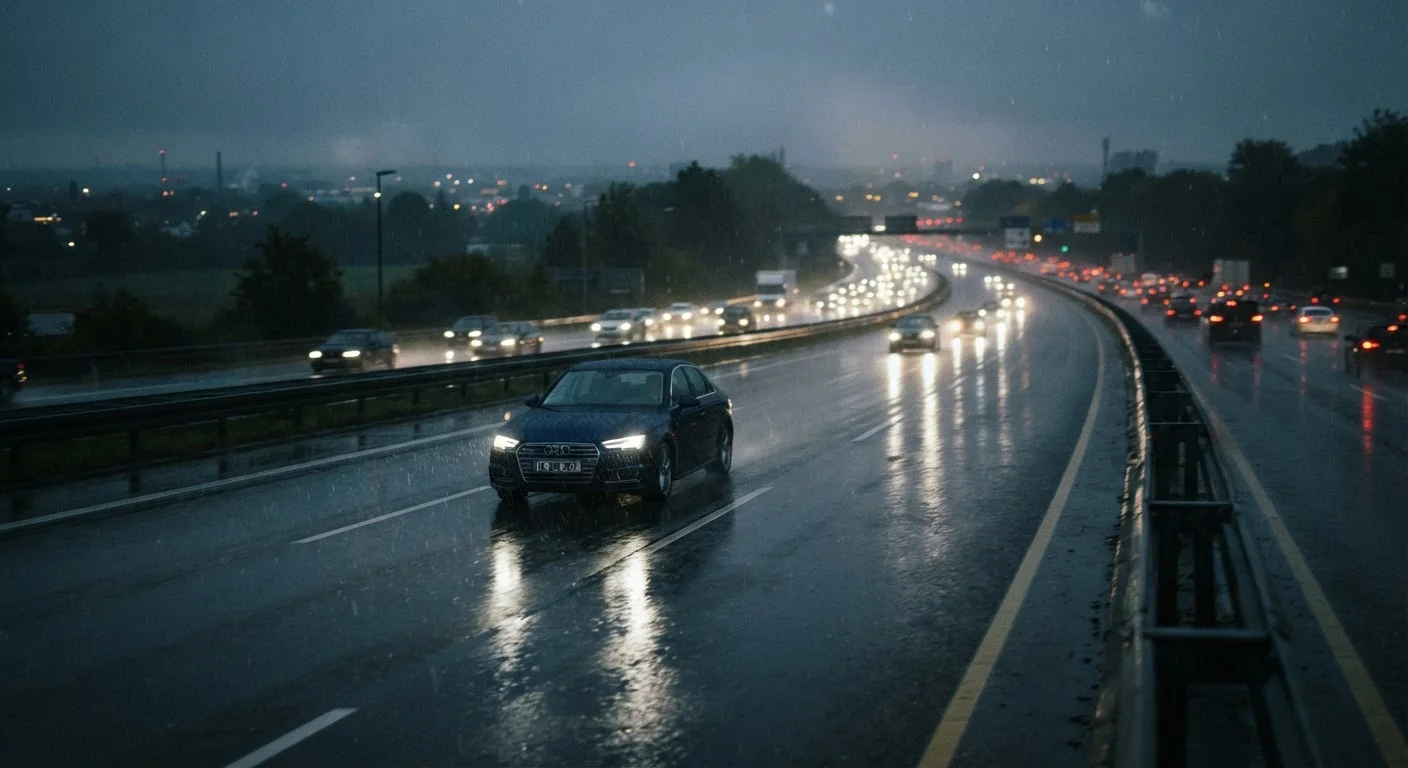
Water on the road surface reduces tire friction significantly. Light rain can be especially deceptive because it lifts oil and dust from the asphalt, creating a slick film before enough rain falls to wash it away. Heavy rain adds the risk of aquaplaning - when a layer of water builds under the tire faster than it can be displaced, causing the tire to lose contact with the road entirely.
In wet conditions, the general guidance from road safety authorities is to reduce your speed by at least 10 mph below the posted limit on open roads, and more on curves or unfamiliar roads. Increase your following distance from the standard 2-second rule to at least 4 seconds. This gives your brakes more time to work on a surface with less grip. If you notice your steering feels light or unresponsive, ease off the throttle gently - don't brake sharply. Our companion article on skids, aquaplaning, and traction loss explains exactly what to do if grip disappears beneath you.
Ice and Snow: A Different Category of Risk
Ice is the most unforgiving road surface a driver can encounter. On dry pavement, a car traveling at 30 mph typically needs around 75 feet to stop. On ice, that distance can stretch to 10 times longer under similar conditions. This isn't a small adjustment - it's a fundamental change in vehicle behavior.
Black ice - a thin, transparent glaze of ice on the road - is particularly hazardous because it's nearly invisible. It forms most readily on bridges, overpasses, shaded areas, and road surfaces that cool faster than the surrounding air. If the outside temperature is near or below 32°F and roads look merely damp, treat them as potentially icy.
Black Ice Gives Almost No Warning
Black ice forms on road surfaces that look merely wet but are actually frozen. It's most common on bridges, overpasses, and shaded road sections when air temperatures hover near freezing. If your car suddenly feels unusually quiet and your steering feels light, you may be on ice. Do not brake suddenly - ease off the throttle and steer straight until you regain traction.
In snowy or icy conditions, slow down well before you need to stop, brake gently and early, and avoid sudden steering inputs. If your vehicle has ABS, apply firm, steady brake pressure and let the system work - do not pump the pedal. Leave a following distance of at least 8-10 seconds.
Fog: When the Road Ahead Disappears
Fog is one of the leading causes of multi-vehicle pileups. The core problem is perceptual: drivers tend to maintain a speed at which they feel comfortable, but that speed often far exceeds their actual stopping distance within visible range. If you can only see 200 feet ahead, you must be traveling at a speed that allows you to stop within 200 feet - regardless of what feels normal.
Use low-beam headlights in fog, not high beams. High beams reflect off water droplets and reduce visibility further. Activate fog lights if your vehicle has them. If fog is dense - below roughly a quarter-mile visibility - reduce your speed substantially, increase following distance to 6 or more seconds, and avoid the temptation to use other vehicles' taillights as a reference point. That habit encourages dangerous tailgating at speed.
Reduced visibility conditions share important characteristics with nighttime driving. Our article on night driving and what it demands beyond headlights covers how experienced drivers adapt when they can't see far ahead.
Bright Sun: The Underestimated Hazard
Clear, sunny days feel safe - and statistically they involve fewer accidents per mile. But sun glare can be temporarily blinding, particularly during the low-angle morning and evening sun when it shines directly into your windshield. Glare reduces your ability to see pedestrians, cyclists, traffic signals, and vehicles ahead.
High-contrast shadows - from bridges, trees, or buildings - can also momentarily mask hazards after your eyes have adjusted to bright light. When driving into direct sun, reduce speed slightly, use your sun visor, wear quality polarized sunglasses, and ensure your windshield is clean inside and out. A dirty or scratched windshield dramatically worsens glare.
Adjusting for conditions is part of the broader skillset covered in our complete safe-driving foundation guide, which addresses hazard perception and defensive driving across all road environments.
Putting It Into Practice
The common thread across all adverse conditions is the same: create more time and space. That means slowing down before you feel you have to, increasing following distance, and scanning further ahead so you can respond to hazards earlier.
Check conditions before you leave
Before getting behind the wheel, take 30 seconds to check local weather. Note temperature (is freezing possible?), precipitation type, and any fog or visibility advisories. This shapes your mindset before you encounter conditions on the road.
Set your speed below the posted limit when conditions warrant
In rain, reduce speed by at least 10 mph. In snow or ice, reduce by 25-35% or more depending on severity. In heavy fog, drive at a speed at which you can stop within your visible distance. In sun glare, a 5-10 mph reduction during the most blinding angles is prudent.
Increase your following distance
In dry conditions, the 2-second following rule is a baseline. In rain, use 4 seconds. In fog or snow, use 6-10 seconds. Count the gap from when the vehicle ahead passes a fixed point to when your front bumper reaches the same point.
Adjust your lights and visibility equipment
In rain or fog, use low-beam headlights - even in daylight. Activate rear fog lights if fitted. In bright sun, clean your windshield and use your visor and sunglasses. Ensure your wipers are functioning; worn blades smear rather than clear.
Brake, steer, and accelerate with deliberate smoothness
In any low-grip condition, sudden inputs - hard braking, sharp steering, rapid acceleration - are more likely to cause a skid or loss of control. Apply brakes gradually and early. Steer steadily. Accelerate gently coming out of turns or stops.
Building these habits when conditions are only mildly challenging - light rain, hazy sunshine - makes them automatic when conditions become genuinely dangerous. If you're newer to highway driving, our guide on motorway driving for new licence holders covers how to apply these principles at higher speeds with heavier traffic.