

| Primary regulatory body for food labels | U.S. Food and Drug Administration (FDA) (FDA.gov) |
| Definition of 'low fat' | 3 grams of fat or less per serving (FDA nutrient content claim regulations) |
| Definition of 'high' in nutrient claims | 20% or more of the Daily Value per serving (FDA nutrient content claim regulations) |
| Definition of 'good source' | 10%-19% of the Daily Value per serving (FDA nutrient content claim regulations) |
| 'Natural' - formally defined by FDA? | No - no formal FDA definition exists for most foods (FDA) |
| 'Organic' oversight body | USDA National Organic Program (NOP) (USDA.gov) |
| Definition of 'calorie-free' | Fewer than 5 calories per serving (FDA nutrient content claim regulations) |
| '0g trans fat' - does it mean zero? | No - less than 0.5g per serving may still be present (FDA) |
The Regulatory Landscape: Who Sets the Rules
When you pick up a packaged food item, the claims on its label exist within a legal framework - but not every phrase carries the same level of oversight. In the United States, the Food and Drug Administration (FDA) governs most nutrition and health claims on conventional food packaging. The USDA oversees meat, poultry, and egg products, as well as the national organic certification program.
The FDA distinguishes among three main claim types. Nutrient content claims describe the amount of a nutrient using terms like 'low,' 'high,' or 'reduced.' Health claims link a food or nutrient to a disease or health condition. Structure/function claims describe a nutrient's role in normal body function. Each type carries a different level of regulatory scrutiny and pre-approval requirements.
| Primary regulatory body for food labels | U.S. Food and Drug Administration (FDA) (FDA.gov) |
| Definition of 'low fat' | 3 grams of fat or less per serving (FDA nutrient content claim regulations) |
| Definition of 'high' in nutrient claims | 20% or more of the Daily Value per serving (FDA nutrient content claim regulations) |
| Definition of 'good source' | 10%-19% of the Daily Value per serving (FDA nutrient content claim regulations) |
| 'Natural' - formally defined by FDA? | No - no formal FDA definition exists for most foods (FDA) |
| 'Organic' oversight body | USDA National Organic Program (NOP) (USDA.gov) |
| Definition of 'calorie-free' | Fewer than 5 calories per serving (FDA nutrient content claim regulations) |
| '0g trans fat' - does it mean zero? | No - less than 0.5g per serving may still be present (FDA) |
For a deeper look at interpreting all the figures behind these claims, see how to read a nutrition label.
Regulated Claims: What the Definitions Actually Mean
Several common packaging terms carry precise, enforceable definitions under FDA regulations. Knowing them helps you read labels accurately rather than relying on general impressions.
- Low fat: 3 grams of fat or less per serving.
- Low sodium: 140 milligrams of sodium or less per serving.
- Reduced : At least 25% less of that nutrient compared to a reference food.
- High / Excellent source: 20% or more of the Daily Value per serving.
- Good source: 10%-19% of the Daily Value per serving.
- Calorie-free: Fewer than 5 calories per serving.
- Sugar-free: Less than 0.5 grams of sugar per serving.
- 0g trans fat: Less than 0.5 grams per serving - meaning trace amounts may still be present.
Serving Size Shapes Every Claim
All nutrient content claims are calculated per serving, and the FDA standardizes serving sizes to reflect amounts people typically consume. If you eat more than one serving, the nutrient totals multiply accordingly. Always check the serving size on the Nutrition Facts panel alongside any front-of-package claim to get an accurate picture of what you are actually consuming.
Authorized health claims - such as those linking calcium and bone health - go through FDA review before they can appear on packaging. Qualified health claims are permitted when evidence is promising but not conclusive, and must carry a disclaimer to that effect. For more on how nutrition evidence is often oversimplified, see common nutrition myths.
Nutrient Content Claim
A label statement that characterizes the level of a nutrient in a food, such as 'low sodium' or 'high fiber.' The FDA defines specific criteria that must be met before these terms can legally appear on packaging.
Health Claim
A statement that links a food or nutrient to a reduced risk of a disease or health condition. Most health claims must be authorized by the FDA before appearing on a label.
Structure/Function Claim
A claim describing how a nutrient or ingredient supports normal body structure or function (e.g., 'calcium builds strong bones'). These do not require FDA pre-approval but must be truthful and not misleading.
Daily Value (DV)
A reference amount set by the FDA used on Nutrition Facts labels to show how much of a nutrient one serving provides relative to a general daily intake benchmark.
Qualified Health Claim
A health claim supported by emerging but not conclusive scientific evidence. These must include a disclaimer acknowledging the limited nature of the supporting research.
Organic
A USDA-regulated term indicating a product was produced following specific federal standards, including restrictions on synthetic pesticides and genetically modified organisms (GMOs).
Loosely Used Terms: Where Regulation Is Absent
Some of the most eye-catching claims on food packaging fall outside firm regulatory definitions, giving manufacturers significant latitude in how they are applied.
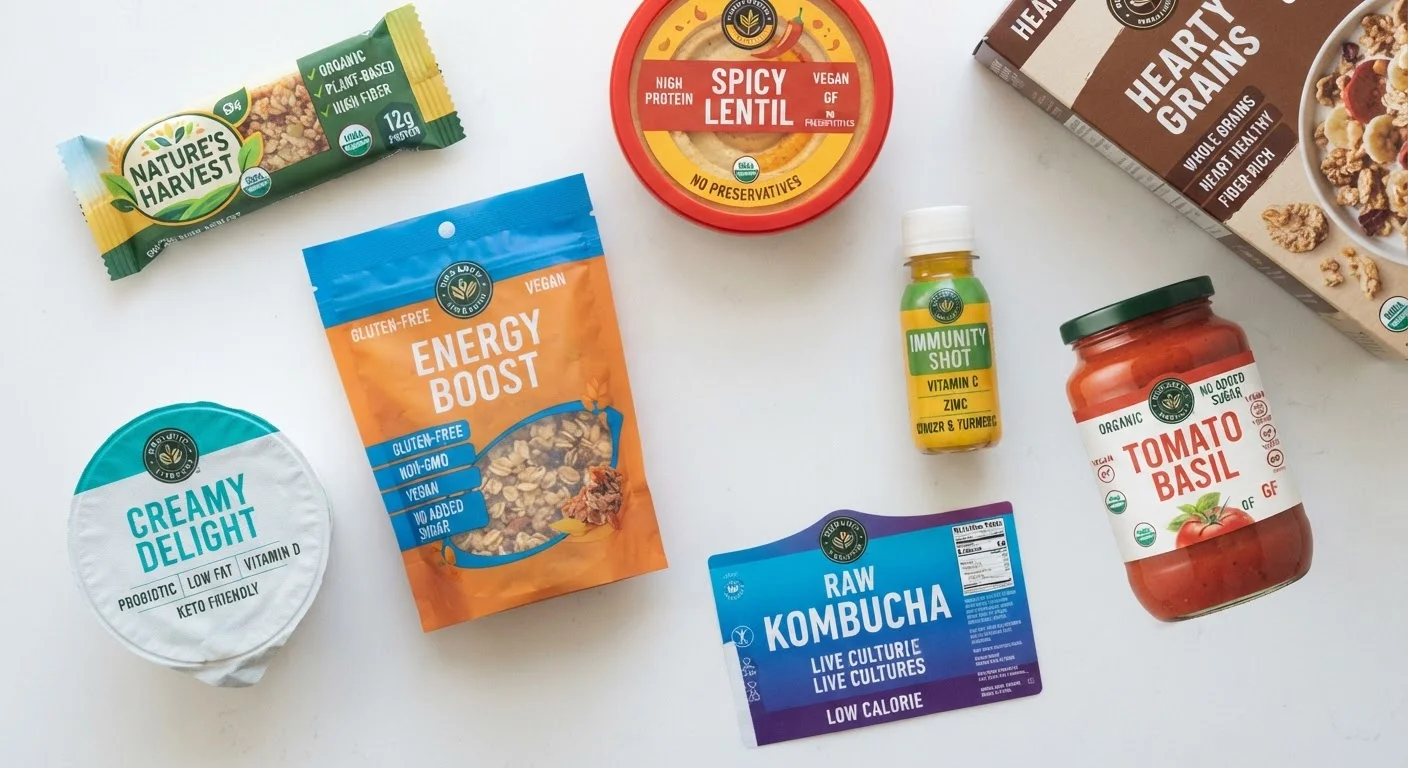
'Natural' is the clearest example. The FDA has acknowledged it lacks a formal definition for 'natural' on most food labels. While the agency has informally indicated the term should mean nothing artificial or synthetic was added, no binding rule enforces this. Products labeled 'natural' may still contain highly processed ingredients, added sugars, or elevated sodium.
'High-protein' has a regulatory pathway as a nutrient content claim when a product meets the 20%-DV threshold, but the phrase also appears on packaging in ways that function more as marketing than as a precise nutritional statement. Checking the Nutrition Facts panel remains the most reliable method for evaluating protein content. For broader context on protein sources and quality, see plant vs. animal protein.
Terms like 'clean,' 'wholesome,' 'artisan,' and 'simple' carry no federal definitions. They function as marketing language and can be used without meeting any nutritional criteria.
'Organic' is a notable exception to this pattern - it is tightly regulated by the USDA's National Organic Program. Products must meet specific production standards, with tiered rules distinguishing '100% organic,' 'organic' (at least 95% organic ingredients), and 'made with organic ' (at least 70%).
Understanding which claims are defined and which are not gives you a more reliable basis for comparing products - without depending on front-of-pack impressions alone. See also frameworks nutrition scientists use for balanced eating for context on how overall dietary patterns matter more than any single nutrient claim.
This article is for general informational purposes only and does not constitute dietary or medical advice. Consult a registered dietitian or qualified healthcare provider for guidance tailored to your individual health needs.