

Key Takeaways
What Makes Two Plants Good Neighbors?
Companion planting - the practice of growing different plants in close proximity for mutual benefit - has roots in both indigenous agricultural tradition and modern horticultural research. The concept is appealing: instead of fighting your garden's ecosystem, you work with it. But not every pairing sold as a "companion" actually delivers measurable results.
The mechanisms behind effective pairings fall into a few clear categories: chemical deterrence (where one plant's scent or compounds repel insects), physical disruption (where dense foliage confuses or blocks pests), nutrient contribution (where one plant enriches soil for its neighbor), and pollinator attraction (where flowering plants draw beneficial insects). Understanding which mechanism a pairing relies on helps you set realistic expectations - and spot gardening folklore that's more myth than method.
It's worth noting that companion planting is most effective when combined with healthy soil, appropriate watering, and good cultural practices. If you're also considering how to build organic soil health, our guide to organic gardening covers the realistic trade-offs involved. With that grounding in place, here are the pairings that genuinely earn their place in the garden.
Tomatoes and Basil
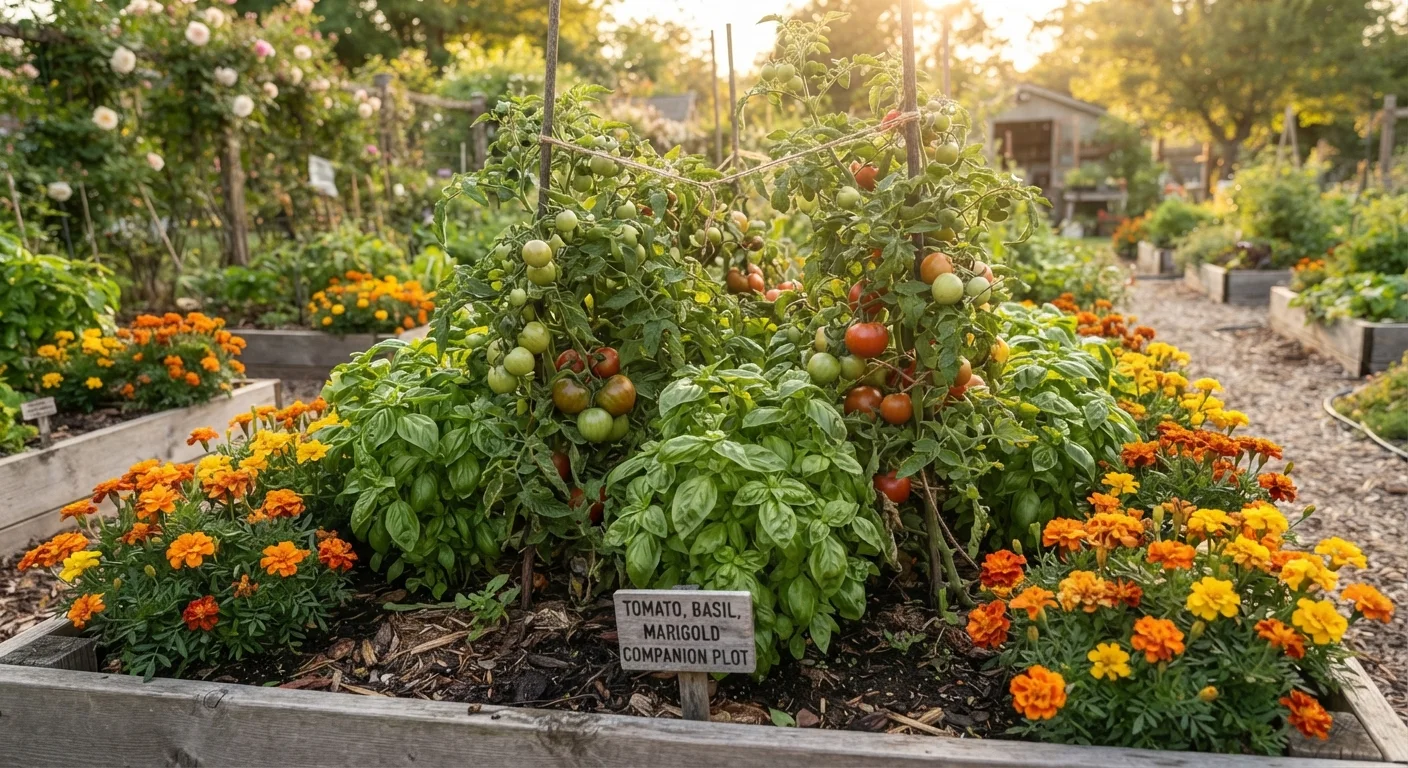
This is perhaps the most popular companion pairing in American home vegetable gardens - and it holds up reasonably well under scrutiny. Basil produces volatile compounds, including linalool and estragole, that some research suggests may repel thrips and aphids. While the evidence isn't conclusive enough to treat basil as a complete pest shield, many gardeners report noticeably fewer whitefly problems when basil grows at the base of tomato plants.
Practically, this pairing makes excellent use of vertical space: tomatoes grow tall and shading basil helps it avoid bolting in hot summer conditions. Both plants also share similar water and fertility needs, making combined care straightforward. The culinary bonus - having both ingredients at arm's reach - doesn't hurt either.
Basil's volatile compounds may deter common tomato pests, and both plants share similar growing conditions.
The Three Sisters: Corn, Beans, and Squash
Originating with Indigenous agricultural practice in North America, the Three Sisters combination is one of the most thoroughly observed and respected polyculture systems in existence. Each plant plays a distinct role: corn provides a vertical structure for beans to climb; beans fix atmospheric nitrogen through root-dwelling bacteria, enriching soil for the other two; and squash spreads wide, shading the ground to suppress weeds and retain soil moisture.
Research published in agricultural journals has consistently found that intercropped Three Sisters plots produce higher combined yields per unit of land than the same plants grown separately - a concept measured as the Land Equivalent Ratio. This isn't folklore: it reflects real, complementary resource use. If you're growing in limited space, this system is one of the most efficient approaches available.
The Three Sisters system produces higher combined yields per area than growing each crop separately.
Carrots and Onions (or Chives)
The traditional claim is that carrot fly (Psila rosae) is confused or deterred by the strong sulfur scent of onion family plants, while onion fly is similarly deterred by the scent of carrots. The interplanting of these two crops has been studied, and while results are mixed, some trials have found measurable reductions in carrot fly damage when chives or onions are interplanted at sufficient density.
The key qualifier is density: a few chives scattered among a carrot row are unlikely to provide meaningful protection. Alternating rows or a roughly 1:1 planting ratio appears to give the best chance of the aromatic masking effect working. As a low-effort, low-risk pairing with culinary value on both sides, it's a sensible choice even if the pest deterrence is partial rather than complete.
Alternating rows of carrots and onion family plants gives the best chance of aromatic pest deterrence.
Brassicas and Dill or Nasturtiums
Brassicas - including cabbage, broccoli, kale, and Brussels sprouts - are notoriously attractive to cabbage worms and aphids. Two companion strategies address this from different angles. Dill, when allowed to flower, attracts parasitic wasps that prey on caterpillar pests, making it a banker plant that supports biological control agents. Nasturtiums, meanwhile, are often used as a trap crop: aphids strongly prefer them over brassicas, concentrating pest pressure in one easy-to-manage location.
Using nasturtiums as a trap crop does require follow-through - you'll need to remove or destroy heavily infested nasturtium plants before aphid populations migrate. But as a targeted, chemical-free strategy, it's well-regarded among organic growers. These approaches pair well with the broader principles covered in our organic gardening overview.
Nasturtiums act as a trap crop by drawing aphids away from nearby brassicas.
Marigolds and Almost Everything
French marigolds (Tagetes patula) have a well-documented effect on certain soil nematodes - microscopic worms that damage root systems. Studies have shown that growing marigolds as a dense cover crop and then turning them into the soil can meaningfully reduce nematode populations. They also produce the compound alpha-terthienyl, which is toxic to nematodes in the root zone.
The airborne pest deterrence claims - that marigold scent repels whiteflies or tomato hornworm - are less consistent in research, though some gardeners find them useful. As a low-maintenance flowering annual that attracts pollinators, supports soil health, and adds visual color to vegetable beds, marigolds are among the best-supported and most versatile companion plants available. They also work well in containers if you're growing herbs on a patio - see our herb container gardening guide for context.
French marigolds have documented soil nematode-suppressing effects when grown densely and incorporated into soil.
Beans and Potatoes
This pairing is rooted in mutual pest deterrence: beans are said to repel the Colorado potato beetle, while potatoes are said to deter Mexican bean beetles. The evidence for both claims is largely observational rather than from controlled trials, so treat it as a promising pairing rather than a proven one.
What's more reliably beneficial is the nitrogen contribution beans make to the surrounding soil. Potatoes are heavy feeders, and having nitrogen-fixing legumes nearby can support overall soil fertility - a benefit that's well-established in agricultural practice. For gardeners interested in building soil quality long-term, pairing this with good composting habits can compound the effect. Our composting guide covers how to make the most of finished compost in planting areas.
Beans' nitrogen-fixing roots provide reliable soil fertility support for nearby heavy-feeding potatoes.
Using Companion Planting Wisely
Companion planting is a rewarding strategy, but it's worth keeping expectations calibrated. Even the best-supported pairings don't guarantee pest-free gardens - they shift the odds in your favor. If you've been misled by overblown claims before, our garden pest myths guide can help you separate folklore from fact.
Start Small and Keep Notes
Rather than redesigning your entire garden around companion planting at once, introduce one or two pairings per season. Keep a simple garden journal noting pest pressure, plant vigor, and any observable differences near companion-planted areas. Over two or three seasons, you'll build a clear picture of what actually works in your specific soil and climate conditions.
Spacing matters more than many gardeners realize. Companion plants placed too far apart lose much of their effect - aromatic deterrents work best within a few feet of the target crop. At the same time, planting too densely can create humidity and airflow problems. Start with one or two pairings in your next season, observe the results, and expand from there. Companion planting, like all good gardening, rewards close attention over time.
For gardeners thinking about garden structure, the raised beds vs. in-ground planting comparison is worth reading - bed type can influence how effectively companion arrangements are maintained and managed season to season.