

Key Takeaways
Summary
24 items · 20-40 minutes
Why the Environment Determines Multi-Cat Success
Most inter-cat conflict in homes is not about personality clashes - it is about resource scarcity and inadequate territory. Cats are a solitary-origin species; they evolved to control a home range and all the resources within it. When forced to share space without adequate provision, competition is a predictable result, not an individual character flaw.
This checklist helps you audit the key environmental factors that veterinary behaviorists and feline welfare researchers consistently identify as drivers of household tension: litter access, food and water distribution, territory structure, and the management of introductions. Use it before adding a new cat to your home, and revisit it if you notice signs of stress or conflict developing.
For anyone bringing a kitten into an existing cat household for the first time, this checklist complements the practical setup guidance you will need in those critical first weeks.
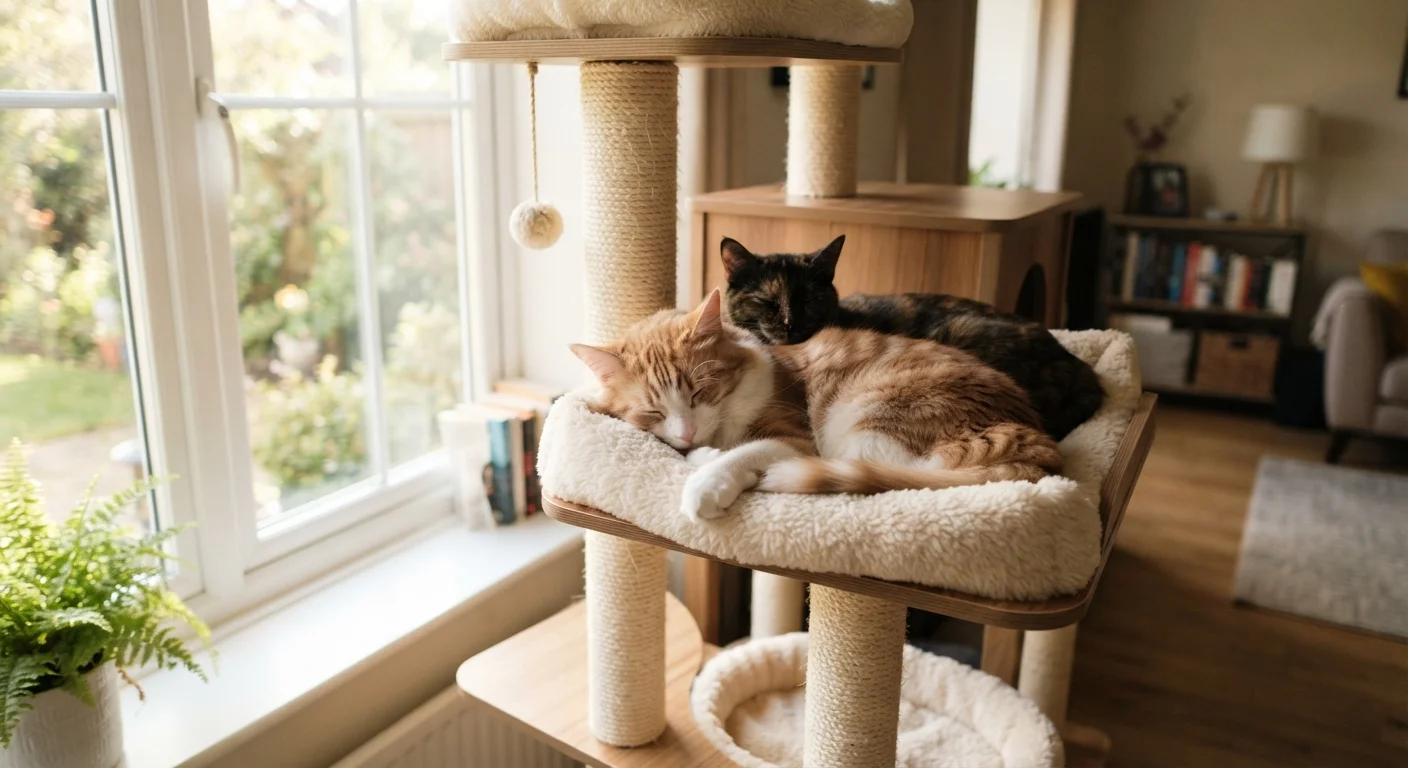
Cat tree or multi-level tower
Creates vertical territory so cats can establish hierarchy and personal space without floor-level confrontations.
Additional litter boxes
Ensures each cat has private, unguarded access to elimination areas at all times.
Separate food and water bowls
Eliminates resource guarding around food and water, a primary driver of inter-cat conflict.
Baby gate or room divider
Allows safe scent and visual introductions between cats without enabling physical contact too early.
Scratching posts (multiple)
Provides cats with legitimate scent-marking and claw-maintenance outlets distributed across the home.
Pheromone diffuser
May help reduce general anxiety during introductions or following household changes, used as a supplement to environmental management.
How to Use This Checklist
Work through each group in order. Items marked must are non-negotiable for basic feline welfare - address any gaps immediately. Items marked should represent strongly recommended practices that significantly reduce conflict risk. Items labelled nice to have are optional enhancements worth considering once core needs are met.
Be honest in your assessment. A common mistake is assuming that because cats appear to tolerate each other, the environment is adequate. Low-level chronic stress - shown through subtle signals rather than outright fighting - is just as damaging to feline welfare as open aggression.
Litter Box Setup
Food and Water Resources
Space and Territory
Introduction and Integration
Conflict Monitoring and Prevention
Litter Boxes and Food: The Most Common Conflict Triggers
If you have ever wondered why a previously settled cat starts eliminating outside the box, the answer is frequently social. One cat may be blocking access to the litter area - not necessarily by sitting in front of it, but simply by patrolling nearby. The same dynamic applies to food. A cat who eats quickly and then hovers near a housemate's bowl creates measurable stress even without a single aggressive act.
The practical guidelines in this checklist - separate bowls, distributed boxes, spatial separation - are grounded in how cats perceive and use shared space. Our detailed guide to litter box placement and hygiene covers the specifics of positioning, litter depth, and cleaning routines that keep all cats consistently using their boxes.
Never Force Cats to Share Resources
Removing extra litter boxes or bowls to encourage cats to 'learn to share' is a common mistake that nearly always worsens stress and aggression. Cats are not socially obligated to share core resources the way dogs are. Maintaining surplus resources is one of the most effective and evidence-supported strategies in multi-cat management.
Sudden Aggression Needs Veterinary Attention
A previously tolerant cat that becomes unexpectedly aggressive toward a housemate may be in pain or experiencing an underlying illness. Redirected aggression - triggered by an outdoor cat seen through a window - can also appear without warning. Do not assume behaviour change is purely social; a veterinary check is always worthwhile.
Recognising Conflict and Knowing When to Seek Help
Overt fighting is easy to identify, but most tension in multi-cat households is expressed indirectly. Watch for cats that no longer share a room comfortably, individuals who stop grooming themselves, changes in eating or drinking patterns, and any increase in vocalisation - especially low growling that seems to come from nowhere. These are signs that the social environment is failing the animals involved.
Enrichment and environmental complexity play a meaningful role in keeping indoor cats mentally occupied and less likely to redirect frustration toward housemates. If you have a senior cat in the household, also consider reviewing how ageing changes a cat's territorial and social needs, since older cats are often more sensitive to household disruption than younger ones.
Incompatibility Is a Real Outcome
Not every cat pairing will succeed, regardless of how carefully the environment is managed. Chronic stress in one or both cats - evidenced by persistent hiding, elimination outside the box, or ongoing physical altercations - is a welfare concern that should be taken seriously. A certified applied animal behaviorist can assess whether the cats can live together safely, and rehoming one cat may sometimes be the most humane option. This is not a failure; it is a responsible decision.
This article provides general information about cat care and multi-cat household management. It is not a substitute for professional veterinary or veterinary behaviorist advice. If your cats are experiencing ongoing conflict or stress-related health changes, consult a qualified veterinarian or certified applied animal behaviorist.