

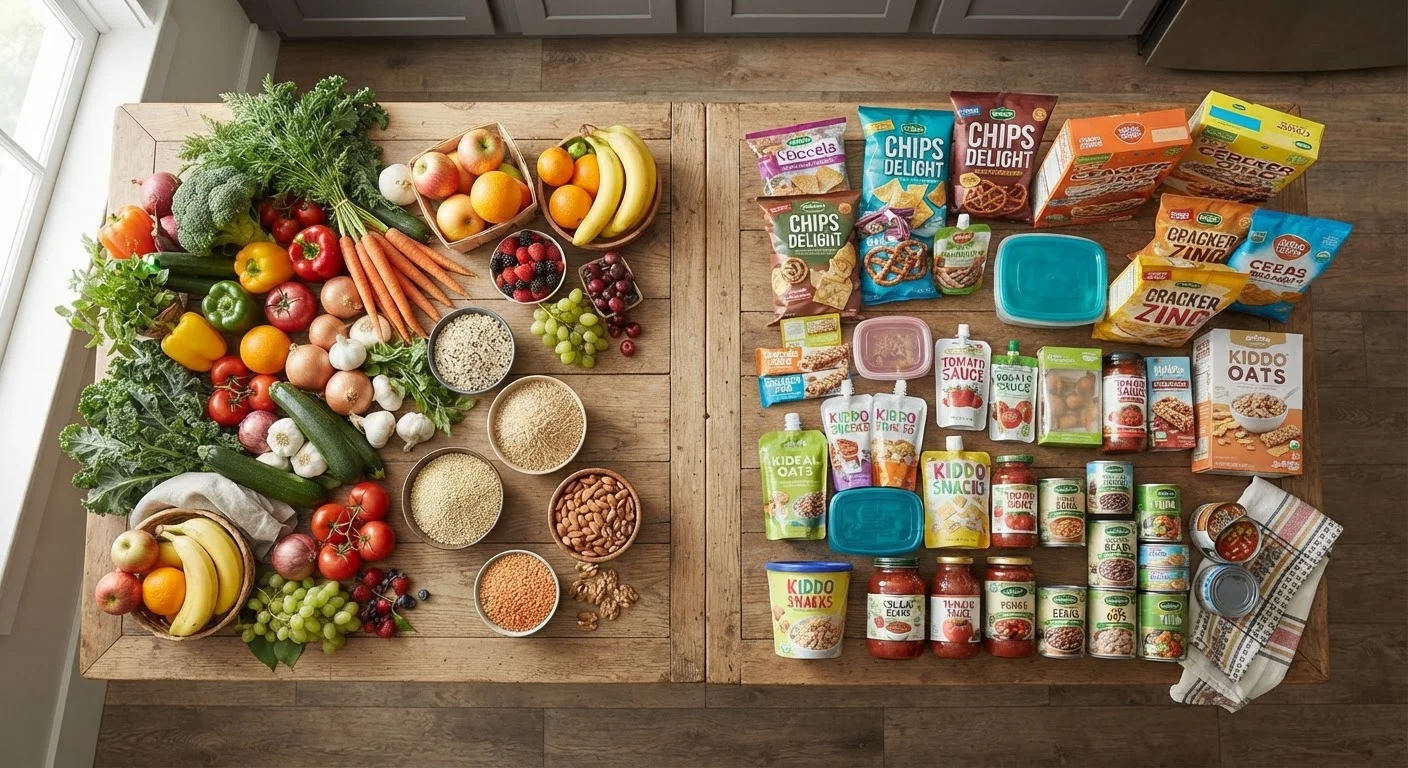
Key Takeaways
Option A
Whole Foods
Foods as close to their natural state as possible.
Best for: Maximizing nutrient density and minimizing added ingredients across a varied diet.
Option B
Processed Foods
Foods altered from their original state through manufacturing or preparation.
Best for: Convenience and accessibility, though quality varies dramatically across processing levels.
If you want to maximize fiber and micronutrient intake
Whole Foods
Whole foods retain their natural fiber matrix and a broader range of vitamins and minerals that are often reduced or lost during industrial processing.
If accessibility, budget, or time constraints are a priority
Processed Foods
Minimally or moderately processed options such as canned beans, frozen vegetables, or fortified cereals can still contribute meaningfully to a balanced diet.
If you are trying to reduce sodium and added sugar intake
Whole Foods
Whole foods contain little to no added sodium or sugar, making it easier to stay within general dietary guidance without careful label scrutiny.
Defining the Terms: It's Not as Simple as It Sounds
The phrase "whole foods" generally refers to foods that have undergone minimal or no processing - think fresh vegetables, raw nuts, whole grains in their intact form, and unprocessed meats. The idea is that the food reaches you in roughly the same state it left the farm or ocean.
"Processed foods," however, cover an enormous range. By the broadest definition, almost everything humans eat has been processed in some way - washing, cooking, fermenting, milling, or freezing all qualify as processing. The more useful framework, developed by Brazilian researchers and widely cited in public health literature, is the NOVA classification, which divides foods into four groups based on the extent and purpose of their processing: unprocessed or minimally processed foods, processed culinary ingredients, processed foods, and ultra-processed foods.
Ultra-processed products - items like packaged snack cakes, reconstituted meat products, flavored chips, and many fast-food items - are formulated largely from industrial ingredients, with little resemblance to any original whole food. This category is the one public health researchers most consistently link to concerns about diet quality.
About the NOVA Classification System
NOVA is a research framework, not a regulatory standard adopted by the FDA or USDA. It is widely used in nutrition epidemiology to study diet patterns at a population level. While it provides a useful lens, it does not replace individualized dietary assessment. Researchers continue to debate how best to define and measure food processing in health studies.
Nutritional Trade-Offs at Each Level of Processing
The nutritional gap between a whole food and its ultra-processed counterpart is usually significant. Processing can strip out dietary fiber, reduce heat-sensitive vitamins such as vitamin C and folate, and increase sodium and added sugar content substantially. For example, a whole grain kernel contains the bran, germ, and endosperm; refining it into white flour removes much of the fiber and several B vitamins, which is why many refined grain products are subsequently fortified.
That said, some processing genuinely improves nutrition. Canning tomatoes increases the availability of lycopene, an antioxidant. Fermenting milk into yogurt introduces beneficial bacteria. Freezing vegetables shortly after harvest can preserve nutrients that degrade during long fresh-produce supply chains. The key is where on the spectrum a product sits - and what has been added or subtracted.
| Criterion | Whole Foods | Ultra-Processed Foods |
|---|---|---|
| Fiber content | Naturally high; intact fiber matrix | Often low; fiber removed or absent |
| Added sugar | None added | Frequently high levels added |
| Sodium | Naturally low | Often very high for preservation or flavor |
| Micronutrient retention | Generally high | Often reduced; may be partially fortified |
| Ingredient list length | One ingredient or very few | Typically long, with industrial additives |
| Shelf life | Usually short | Extended via preservatives or packaging |
| Convenience | Requires preparation | Ready to eat or quick to prepare |
For practical guidance on interpreting what's on a product's label, reading a nutrition label carefully can reveal exactly how much sodium, added sugar, or fiber a product actually contains.
Why the Line Gets Blurry - and What That Means for Consumers
Marketing complicates the picture considerably. Terms like "natural," "clean," or "minimally processed" appear on packaging without any consistent federal regulatory definition. A product marketed as natural may still contain high levels of added sodium or refined sugars. Understanding which nutrition claims carry formal definitions and which remain loosely used is an important consumer skill.
Nutrient composition also varies within categories. Whole foods are not automatically superior in every context - a handful of raw almonds and a heavily salted almond snack mix both start from the same source, but their nutritional profiles diverge sharply after processing. Similarly, protein quality is not simply a function of whether a food is whole or processed; the source and completeness of protein matter independently of processing level.
Dietary fat offers another illustration. The fat in a whole avocado behaves differently from partially hydrogenated oils used in some processed products. Different fat types carry different evidence bases - a dimension that processing level alone doesn't fully capture.
The practical takeaway for most consumers is to treat processing as a useful signal, not an absolute rule. Prioritizing foods closer to their whole state most of the time - while recognizing that minimally processed items like canned legumes or frozen fruit can be nutritious, affordable staples - reflects the current weight of evidence without demanding dietary perfection.
This article is for general informational and educational purposes only and does not constitute medical or dietary advice. Consult a registered dietitian or qualified healthcare professional for guidance tailored to your individual health needs.