

Key Takeaways
Why Decorating Rules So Often Mislead Us
Decorating advice has a way of spreading through word of mouth, shelter magazines, and home improvement TV until certain ideas feel like ironclad rules. Many homeowners treat them that way - avoiding dark paint, sticking to tiny furniture in tight rooms, keeping things sparse. But several of these widely repeated guidelines actively work against the goal of making a space feel open and livable.
Understanding why a room feels small - too many competing visual elements, poor light, inconsistent scale, furniture pushed awkwardly against walls - is more useful than following a checklist of dos and don'ts. The myth-busting below addresses the most common misconceptions, explains the design logic behind the corrections, and gives you a practical framework to apply in your own home. For a broader look at related concepts, the plain-language decorating glossary is a helpful companion reference.
Myth
Dark paint colors make a small room feel even more cramped and cave-like.
Fact
Dark colors can actually make a room feel more defined, intimate, and visually cohesive - which often reads as spacious rather than tight.
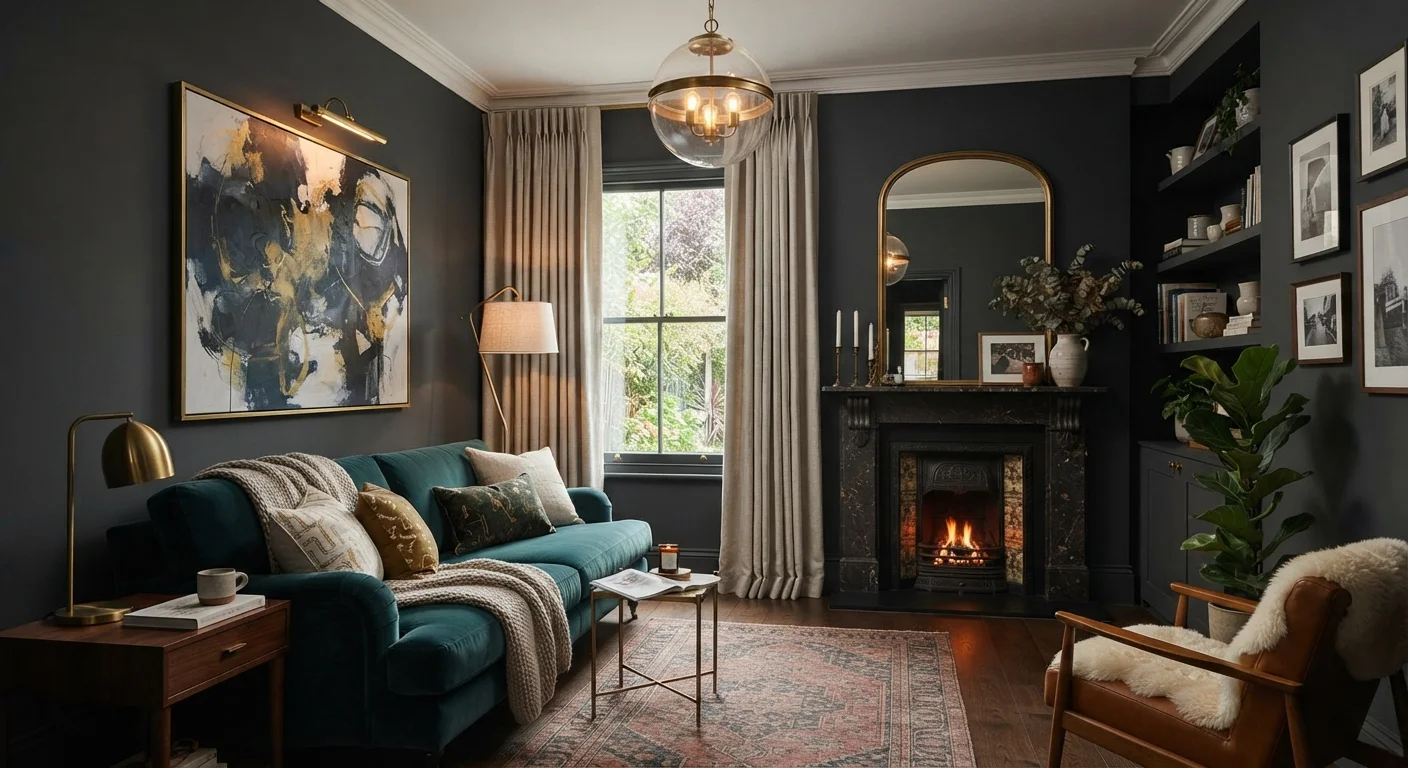
The fear of dark paint is probably the most persistent decorating myth in circulation. The logic seems intuitive: lighter colors reflect more light, so pale walls must make a room feel bigger. In practice, a flat white or beige applied to a room with poor natural light simply reveals every flaw - awkward proportions, mismatched trim, sparse furnishings - without adding warmth or depth.
A deep color on the walls, particularly when it's carried to the ceiling and trim, blurs the boundaries of the room and creates a sense of enveloping cohesion. The room reads as a complete environment rather than a box with things in it. Rooms with low natural light often benefit most from this approach. The key is finish: matte or eggshell finishes absorb light softly, while high-gloss finishes in small spaces can feel harsh and reflective in an unflattering way. For guidance on how your room's sunlight exposure should influence your color choices, see how sunlight direction should influence your decor.
Myth
Small rooms need small furniture - large pieces will overwhelm the space.
Fact
A few well-scaled, larger pieces typically make a small room feel more intentional and open than many small, cluttered ones.
This myth leads homeowners to fill rooms with an accumulation of small chairs, narrow side tables, and compact shelving units - which actually creates visual clutter and makes the space feel busier and more cramped. Every additional piece of furniture introduces more legs, edges, and transitions for the eye to process.
One substantial sofa, one generous coffee table, and one or two accent chairs will almost always read better than six or seven small pieces attempting to fill the same floor area. The principle here is related to visual weight and scale - concepts explained in more detail in what scale and proportion mean in interior decorating. Fewer, larger pieces also leave more open floor space visible, which is the actual cue the brain uses to assess room size.
Myth
Hanging curtains at window height makes the room look neat and proportional.
Fact
Curtain rods hung close to the ceiling - even when the window is much lower - make ceilings appear significantly taller and rooms feel larger.
Where a curtain rod is placed has an outsized impact on perceived ceiling height. When curtains hang from just above the window frame, the eye reads the wall above the curtain as a separate zone, effectively lowering the visual ceiling. When the rod is positioned near the ceiling line and the panels fall to the floor, the eye follows a continuous vertical line from top to bottom - making the room feel taller.
This is one of the most effective and least expensive adjustments available to renters and homeowners alike. You don't need floor-to-ceiling windows; the visual effect works even when the actual window takes up only a portion of the wall. The curtain panels essentially imply a much taller opening. Use simple, unlined panels in a fabric that diffuses rather than blocks light if the goal is to maintain brightness while gaining height.
Myth
Mirrors always make a room feel larger, so placement doesn't matter much.
Fact
Mirrors expand perceived space only when they're placed to reflect something worth seeing - a light source, a window, or an attractive area of the room.
A mirror hung on a wall that faces another blank wall, a door, or a cluttered corner does little to improve a room's sense of scale. Worse, it can highlight disorder and make the space feel busy. The effect people are hoping for - doubled depth, reflected light, an illusion of extension - only works when the mirror captures something that reads as open space or natural light.
Position mirrors so they face windows when possible, or so they reflect the most attractive and uncluttered part of the room. In narrow hallways, a large mirror at the end creates genuine depth. On a wall adjacent to a window, a mirror bounces light laterally across the room. Getting placement right matters far more than mirror size or style.
Myth
Small area rugs are safer in tight spaces because they take up less visual room.
Fact
Undersized rugs visually fragment the floor and make a room feel more disjointed and smaller - not less so.
A rug that doesn't reach the front legs of the furniture it anchors floats in the middle of the room without connecting to anything. The eye reads the floor as several disconnected zones, which introduces visual noise and shrinks perceived scale. This is one of the most common and correctable decorating mistakes in small living rooms and bedrooms.
The general principle is to choose a rug large enough that at least the front legs of all major seating pieces sit on it. In a bedroom, the rug should extend far enough beyond the bed that you step onto it rather than bare floor when getting up. A single, properly sized rug unifies the seating group or sleeping area into one cohesive zone, which the eye processes as ordered and spacious rather than fragmentary. For more on how rugs and other textiles affect a room's feel, see layering textiles for depth and cohesion.
Putting Corrected Principles Into Practice
Correcting these myths isn't just an academic exercise - each one translates directly into decisions you can make today without a renovation budget. Start with paint: if a room feels cold or undefined, going darker on one or all walls often adds the grounding it lacks. See accent walls vs. full-room colour for guidance on choosing between the two approaches.
For furniture, prioritize fewer, appropriately scaled pieces over a roomful of small ones. Floating furniture a few inches from the wall - rather than pushing everything to the perimeter - creates breathing room in the center and often makes a floor plan feel larger. Before making any big moves, it's worth running through a furniture rearrangement checklist to consider traffic flow, focal points, and lighting together.
Window treatments are one of the most affordable interventions available. Hanging curtain rods just below the ceiling line and using floor-length panels adds perceived height regardless of where the actual window ends. Finally, choose one large area rug that anchors the seating group rather than several small rugs that visually chop the floor into fragments. These principles hold across room sizes - and they're explored in depth in our guide to styling a small living room.
~10%
Perceived size increase from ceiling-height curtains
Interior design professionals commonly observe that hanging curtains near the ceiling line rather than the window frame can make a room feel noticeably taller, though exact perception varies by room and individual.
1 large vs. 5+ small
Furniture pieces per seating group for best results
Design educators generally recommend anchoring a seating area with one or two substantial pieces rather than filling it with multiple small items that increase visual clutter.