

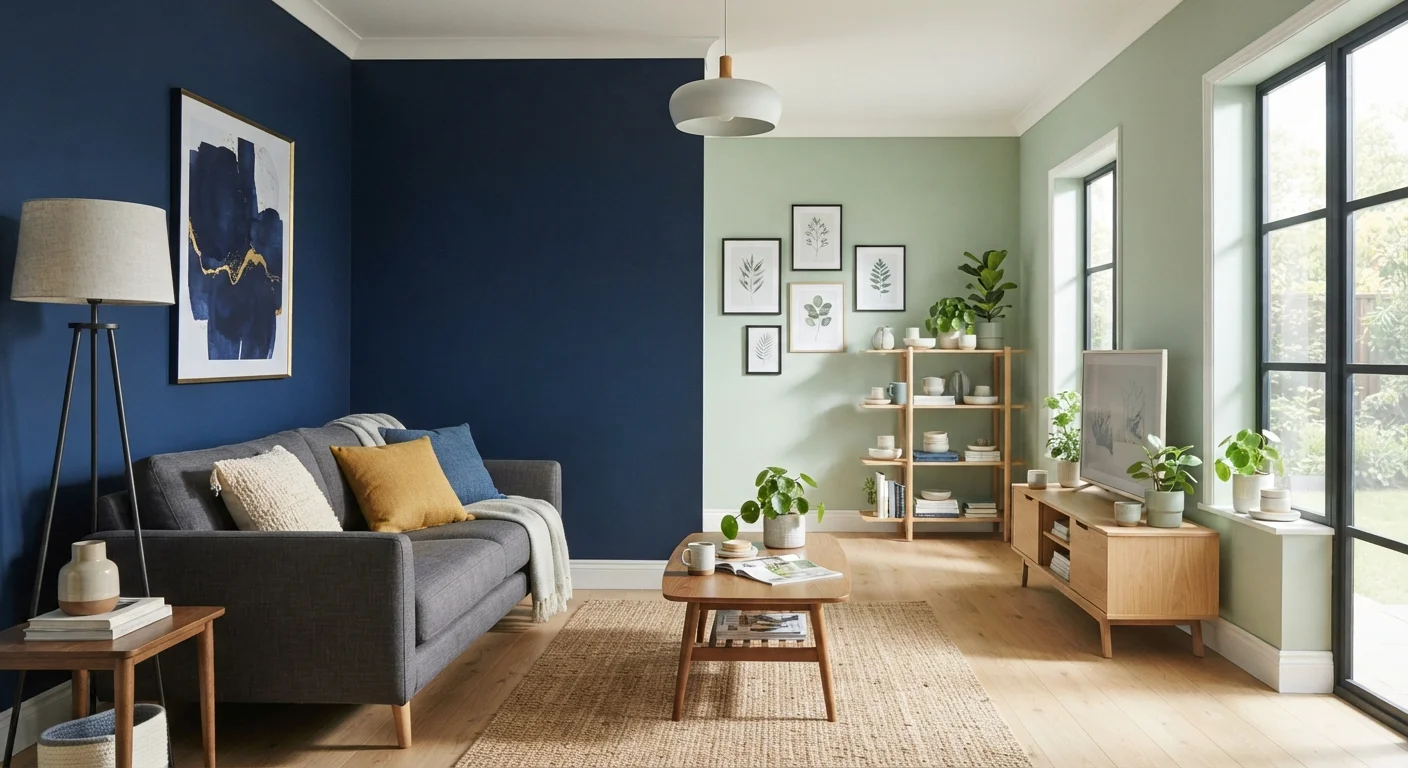
Key Takeaways
Option A
Accent Wall
The targeted, low-commitment focal point.
Best for: Homeowners who want a pop of colour or drama without committing to painting an entire room.
Option B
Full-Room Colour
The immersive, cohesive transformation.
Best for: Those who want a unified atmosphere and are confident in their colour choice across all four walls and the ceiling.
If you want to experiment with a bold colour without overpowering the room
Accent Wall
One statement wall lets you introduce saturated or dark tones - think deep teal or terracotta - without the visual weight of four painted surfaces.
If you want a polished, designer-level finish throughout the space
Full-Room Colour
Painting all walls, and often the ceiling, in the same hue creates an enveloping effect that reads as deliberate and sophisticated rather than decorative afterthought.
If you're renting or planning to sell in the near future
Accent Wall
A single wall is faster and cheaper to repaint back to neutral, reducing friction for landlords or prospective buyers who prefer a blank canvas.
If your room lacks natural architectural interest
Full-Room Colour
When walls are all identical and the room has no standout feature, a unified colour unifies the space more effectively than singling out one unremarkable wall.
If you're working with a tighter budget and limited time
Accent Wall
One wall requires significantly less paint and prep time, making it a practical choice when resources are constrained.
Understanding What Each Approach Actually Does
An accent wall - sometimes called a feature wall - means painting a single wall in a contrasting or deeper shade while leaving the remaining walls neutral or a lighter complementary tone. Full-room colour means applying the same hue to all four walls, and increasingly, the ceiling too, for a cohesive wraparound effect.
Neither approach is inherently superior. The right choice depends on your room's proportions, its natural light, and the mood you're trying to create. As a starting point, ask yourself: does your room have one wall that already draws the eye - a fireplace surround, a large window wall, the wall your sofa or bed faces? If so, an accent wall has a natural home. If no single wall stands out, full-room colour tends to deliver a more resolved result.
It's worth understanding that light transforms colour dramatically. How sunlight direction affects your colour choices is a critical step most homeowners skip - a north-facing room will read the same paint chip very differently from a south-facing one.
Side-by-Side: How the Two Approaches Compare
Looking at both approaches across practical criteria helps clarify the decision before you buy a drop of paint.
| Criterion | Accent Wall | Full-Room Colour |
|---|---|---|
| Paint quantity needed | Low - one wall only | High - four walls plus ceiling |
| Time to complete | Shorter - fewer surfaces | Longer - full room prep and coverage |
| Risk of colour regret | Lower - less surface area | Higher - commitment is greater |
| Design cohesion | Moderate - depends on placement | High - unified, enveloping effect |
| Works in smaller rooms | Situational - can feel arbitrary | Often effective - reduces visual breaks |
| Ease of reverting | Easier - one wall to repaint | More effort - full room repaint |
| Requires architectural focal point | Yes - works best with one | No - works on any layout |
Cost is often the deciding factor for smaller projects, but consider the longer-term picture too. If you choose the wrong accent wall colour, you've repainted one surface. If you choose the wrong full-room colour, you've repainted four. Testing samples - large swatches, not tiny chips - in your actual lighting conditions reduces that risk regardless of which route you take.
When Accent Walls Work Well - and When They Don't
The most successful accent walls share one trait: they feel inevitable rather than added on. The wall behind a bed headboard, the chimney breast in a living room, or the far wall in a dining room that frames the table - these are focal points that already carry visual weight. Deepening that with colour reinforces what's already there.
Where accent walls tend to fall flat is when the chosen wall has no natural significance - a random side wall in a bedroom, for example, or a wall obscured by a large wardrobe. In those cases, the colour reads as an afterthought rather than a design decision.
Colour choice also matters more on a single wall. Because the accent colour has no surrounding context of the same hue, it must work harder to look intentional. Colours that share undertones with your furniture and flooring tend to land better than colours selected in isolation. If you're unsure whether your existing palette skews warm or cool, understanding warm vs. cool neutral undertones can help you identify a compatible direction.
~1 gallon
Paint needed for an average accent wall
A standard 10×10 ft wall typically requires one gallon of paint for two coats, versus four or more gallons for a full room.
2-3 shades
Depth difference for effective accent walls
Interior designers commonly suggest choosing an accent colour two to three shades deeper than your surrounding wall colour to achieve contrast without clash.
When Full-Room Colour Creates a Better Result
Full-room colour has earned a renewed following in interior design circles, partly because it sidesteps the arbitrary nature of a poorly placed accent wall. When every surface - including the ceiling - shares the same hue, the eye reads the room as a unified whole rather than a collection of competing elements.
This approach works particularly well in smaller rooms. Contrary to a widely held belief, painting a small room a dark colour doesn't necessarily make it feel cramped - the lack of contrast between walls can actually make boundaries feel less defined, which can read as expansive. Several decorating rules about room size turn out to be myths, and this is one of them.
Full-room colour also rewards rooms with interesting architectural details - crown moulding, built-in shelving, or original trim - because a single surrounding colour lets those features read more clearly. If you're renting and painting isn't an option, rental-friendly alternatives to paint are worth exploring instead.
One practical note: always use interior-grade paint formulated for walls. Interior and exterior paints differ in formulation in ways that affect durability and finish quality - using the wrong type leads to early failure regardless of colour choice.