

Key Takeaways
Feline Scratching Behaviour
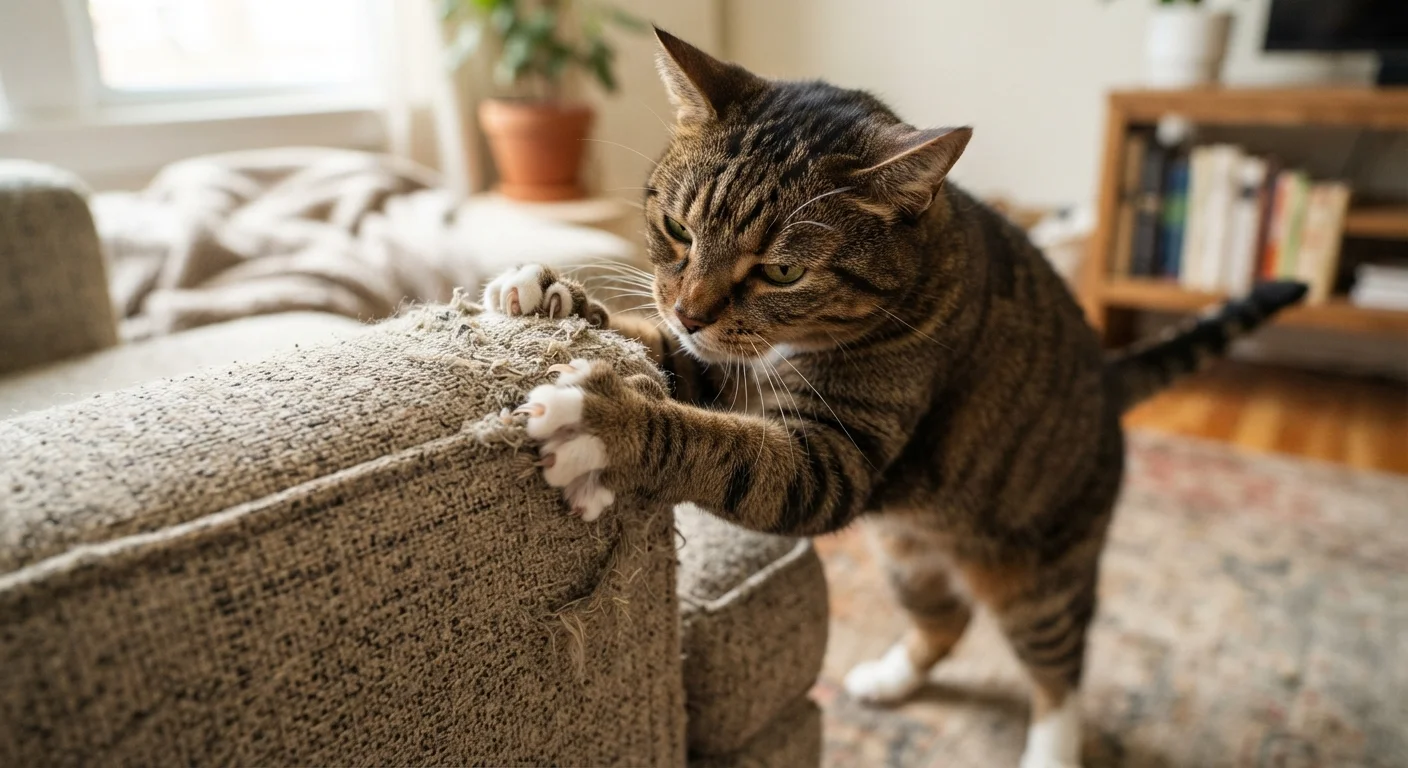
Scratching is a natural, instinct-driven behaviour in cats that serves multiple physical and communicative functions. Cats scratch to shed dead claw sheaths, stretch the muscles and tendons of their forelimbs, and leave both visible marks and scent signals for other cats. It is not a sign of a poorly trained or destructive cat - it is simply what cats do.
Cats possess scent glands in their paw pads (interdigital glands) that deposit pheromones onto scratched surfaces, making scratching a form of olfactory territorial communication in addition to its physical benefits.
The Real Reasons Cats Scratch
Cats scratch for at least four distinct reasons, and understanding each one helps explain why simply removing a sofa does not solve the problem.
- Claw maintenance: Scratching pulls away the outer dead sheath of the claw, exposing the sharper layer underneath. Without this, claws become overgrown and uncomfortable.
- Muscle and tendon exercise: A full scratching motion engages the shoulders, spine, and forelimb muscles in a way that stretching alone does not replicate. Cats often scratch immediately after waking, using it much like a morning stretch.
- Scent marking: Interdigital scent glands in a cat's paws deposit pheromones onto the scratched surface, sending chemical messages to other cats - and reinforcing the cat's own sense of territorial security.
- Visual marking: The torn fibres and claw marks left behind are a visible signal. Prominent locations - the corner of a sofa, a doorframe - are often chosen deliberately for maximum visibility.
Because scratching meets genuine physical and communicative needs, attempts to suppress it entirely are both unsuccessful and unkind. The productive goal is redirection, not elimination.
Scratching Behaviour Can Signal Stress
An abrupt increase in scratching - especially in new locations - can indicate that a cat is feeling anxious or insecure rather than simply preferring different furniture. Life changes such as a new pet, a new household member, or a home move are common triggers. If scratching escalates without an obvious environmental explanation, a veterinary or veterinary behaviourist consultation is a reasonable next step.
Why Furniture Is So Appealing
From a cat's perspective, upholstered furniture has a lot going for it. It is stable, large enough for a full-body stretch, positioned in high-traffic areas where scent marks will be noticed, and has a texture that shreds satisfyingly. Many scratch posts, by contrast, are short, lightweight, placed in corners, and made of looped carpet that snags rather than shreds.
Location matters enormously. Cats prefer to scratch near sleeping spots (post-nap stretching), near entry points to a room (territorial signalling), and in areas where household members spend time (social visibility). A post tucked behind a door simply will not compete.
~60%
Cat owners report furniture scratching as a concern
Estimates from feline behavioural surveys consistently place furniture scratching among the most commonly reported cat behaviour concerns in US households.
28-32 in
Minimum recommended scratch post height
Feline behaviour specialists generally recommend this height to allow a full vertical stretch, which most commercially sold posts do not reach.
2-4 weeks
Recommended nail trim frequency for indoor cats
Regular trimming at this interval blunts claws sufficiently to reduce furniture damage while preserving normal scratching behaviour.
Understanding these preferences explains why so many posts go unused - and exactly what needs to change to redirect behaviour successfully. For a broader look at how environment shapes cat wellbeing, see our Indoor Cat Handbook.
What Actually Works: Evidence-Based Strategies
Behavioural guidance consistently points to the same core approach: make the appropriate surface more attractive than the furniture, and make the furniture temporarily less so.
Choose posts with the right properties
- Height: Tall enough for a full vertical stretch - typically at least 28-32 inches for an average adult cat.
- Stability: A post that rocks or tips will be abandoned. Weight the base or mount it to a wall if needed.
- Texture: Sisal rope or sisal fabric is preferred by most cats because it shreds cleanly. Some cats prefer corrugated cardboard. Looped carpet is usually less effective.
- Orientation: Most cats prefer vertical surfaces, but some individuals strongly favour horizontal scratching pads. Offer both initially to identify preference.
Placement is non-negotiable
Position new posts immediately next to the furniture currently being scratched. Once the cat is consistently using the post, it can be moved gradually - a few inches per day - toward a more convenient permanent location.
Positive reinforcement
When your cat uses a post, reward with calm praise, play, or a small treat. Never punish scratching on furniture - startling or scolding a cat creates anxiety without teaching an alternative, and stress can actually intensify scratching behaviour.
Temporary deterrents on furniture
Double-sided tape, plastic furniture guards, or a sheet of loosely draped aluminium foil can make a scratched surface less appealing while the cat establishes a new habit with the post. Remove deterrents once the redirection is consistent.
Regular nail trimming
Trimming blunts the claws and meaningfully reduces furniture damage. It does not remove the need to scratch, but it limits the impact. Our grooming guide covers safe technique for at-home nail trims.
Multi-Cat Homes and Scratching Dynamics
In households with more than one cat, scratching behaviour takes on additional social significance. Posts become contested resources, and a lower-ranking cat may be displaced from a preferred post, leading them to use furniture instead. The general guidance for multi-cat homes - one resource per cat, plus one extra - applies to scratching surfaces as well as litter boxes and feeding stations.
Placing posts in several rooms, at different heights, reduces competition and gives each cat access to appropriate scratching regardless of social hierarchy. Our multi-cat household checklist provides a practical framework for assessing whether your home's resource distribution is adequate.
Try Catnip to Introduce a New Post
Sprinkling dried catnip on or around a new scratching post can attract cats to investigate it and begin scratching. Not all cats respond to catnip (sensitivity is hereditary), but for those that do, it is a simple and harmless way to build a positive association with the new surface.
A Note on Declawing
Declawing remains a point of serious concern among veterinary professionals. The procedure - technically an amputation of the third phalanx (toe bone) of each digit - is associated with post-operative pain, long-term musculoskeletal changes, and in some cats, increased biting behaviour and litter box avoidance. The American Association of Feline Practitioners has formally opposed the practice, and it is prohibited in several US cities and states.
The good news is that the evidence-based strategies described here are genuinely effective when applied consistently. Declawing is not a necessary or recommended solution to furniture scratching. If scratching behaviour is severe or sudden in onset, a veterinary consultation is worthwhile to rule out underlying discomfort or anxiety as contributing factors - scratching that represents a meaningful behavioural change deserves professional evaluation rather than a purely physical remedy.
Common misconceptions about cats - including the idea that declawing is a routine, harmless procedure - are worth examining critically, as they can lead to real harm.