

Key Takeaways
Why Textile Layering Is a Skill, Not Just a Style
Most homeowners already own rugs, cushions, throws, and curtains - but few think of them as a system. When these elements are chosen and arranged intentionally, they do something no single piece of furniture can: they make a room feel simultaneously finished and lived-in.
Layering textiles is fundamentally about controlling visual weight - the sense that some areas of a room feel heavier or lighter than others. If you're not familiar with the term, our plain-language decorating glossary breaks it down clearly. Done well, layering draws the eye around a room rather than leaving it to land awkwardly on one focal point. Done poorly, it tips quickly into visual clutter - which is why a deliberate method matters.
Start with the Foundation: Rugs and Curtains First
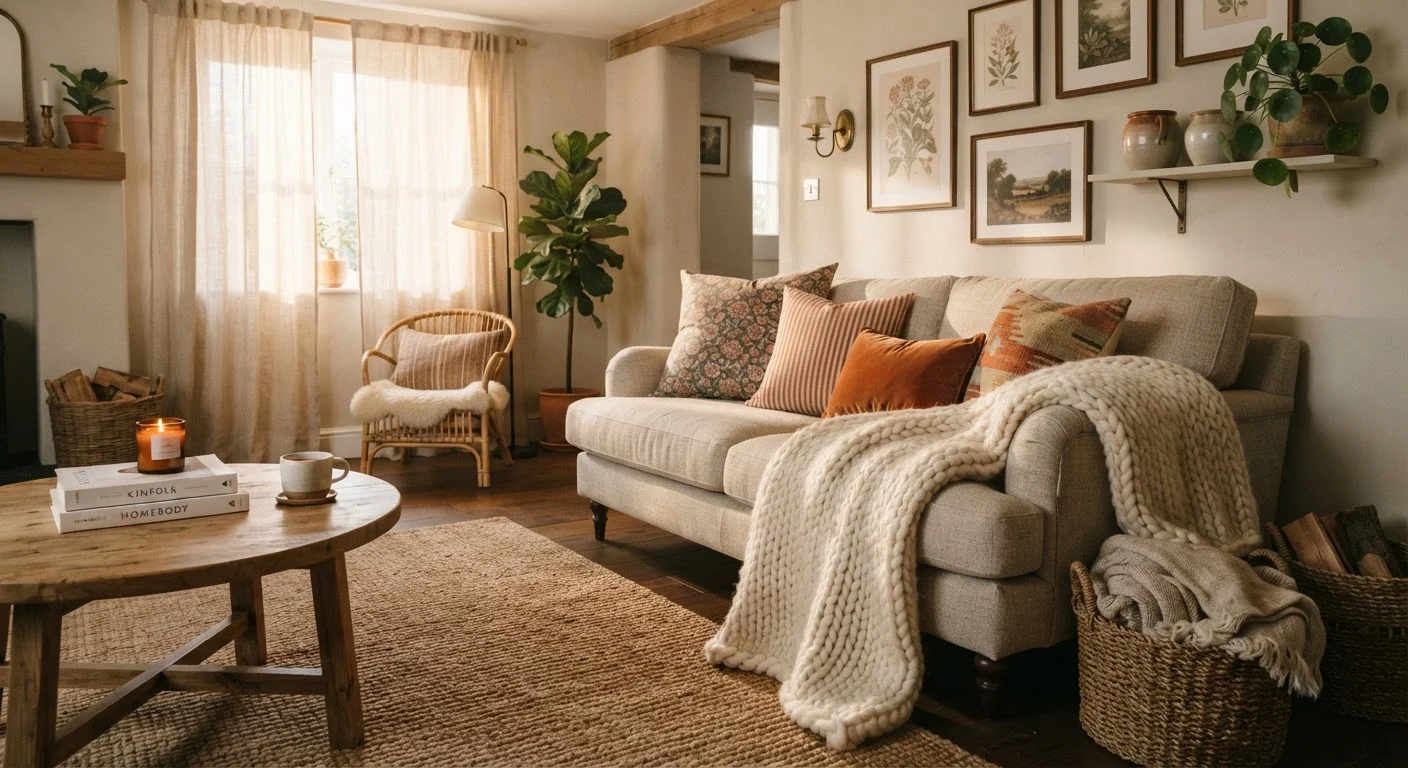
Think of textiles in three tiers. The foundation tier includes your largest pieces: the area rug and window treatments. These set the room's texture baseline and carry the most visual weight, so they should be chosen before anything smaller.
A rug anchors the seating area and defines the room's scale. For most living rooms, a rug that fits all or most of the front legs of your furniture reads as intentional rather than accidental. Curtains, meanwhile, work hardest when hung close to the ceiling and wide of the window frame - this is a perception trick that adds height without requiring structural changes, useful whether you own your home or rent. If you're decorating a rental, see our guide on rental-friendly decorating ideas for approaches that won't cost you your security deposit.
Prioritize Texture Before Pattern
When choosing foundation textiles like rugs and curtains, prioritize texture over pattern. A nubby wool rug or a linen curtain panel adds richness and depth without locking you into a pattern that may be hard to work around later. Patterns can be introduced more safely at the cushion and throw stage, where they're easier and less expensive to change.
When choosing foundation textiles, prioritize texture over pattern. A nubby wool rug or a linen curtain panel adds richness without committing to a pattern that may be harder to work around later.
The Middle Tier: Cushions and Throws That Actually Work
Once your foundation is set, the middle tier - cushions and throws - is where most of the expressive work happens. Here is where the common mistake of over-matching causes the most damage. A sofa piled with identically sized cushions in a matching set reads as flat and unconsidered. This connects directly to the insight explored in our article on why matching sets make rooms look flat.
Instead, combine cushion covers in at least two different textures - say, a velvet alongside a woven cotton - and vary the sizes. A grouping of three (one large, one medium, one small) consistently looks more natural than two or four. For throws, resist the urge to fold them symmetrically. A throw casually gathered at one end of a sofa or draped over the back of a chair signals comfort in a way a neatly stacked blanket does not.
Holding It Together: Pattern, Color, and Repetition
The question most people ask at this point is: how do I keep it from looking chaotic? The answer is deliberate repetition. Choose one anchor color from your rug or curtains and repeat it - in a different texture or scale - in at least one cushion or throw. You don't need an exact match; you need a visual echo.
For pattern mixing, the rule of scale is reliable: pair a large-scale pattern with a smaller-scale one in the same general color family. A big botanical print cushion sits comfortably next to a small geometric one, provided they share a tone. Limit active patterns to two; let the third piece be a solid. If you're working with a neutral base - which most US homes are - our piece on warm vs. cool neutrals can help you identify which undertones to carry through your textile choices.
Avoiding Overcrowding in Smaller Spaces
Layering does not mean more is always better. In smaller rooms especially, every textile needs to earn its place. If a throw and a cushion are doing the same job - adding a soft texture in a warm tone - one of them can go. The goal is variety of purpose, not volume of objects.
Lighter-weight textiles (thin cotton, gauzy linen) preserve a sense of airiness in compact rooms, while heavier ones (chunky knit throws, dense wool rugs) absorb some of that visual space. For small living rooms specifically, our small living room styling guide covers how to balance softness and spaciousness without sacrificing either. The same logic that prevents furniture from overwhelming a small room applies to textiles: scale and proportion matter as much as personal taste.